Joint Ownership Exception Faces 'Useless' Crisis
Ministry of Economy and Finance: "Cases Set by Income Tax and Comprehensive Real Estate Tax Laws Proportionally Exist"... Experts: "Legal Disputes Remain Possible"
[Sejong=Asia Economy Reporters Kim Hyunjung and Son Seonhee] The ruling party and government have agreed to change the comprehensive real estate tax (종합부동산세) taxable base from the current official price standard to the ‘top 2%’ ratio, but concerns are rising that fierce tax resistance and criticism will emerge, especially in high-priced housing concentrated areas, depending on the detailed plan. In particular, the method of imposing tax on jointly owned houses has not yet been decided, raising controversy over reverse discrimination even before the details are finalized.
According to the ruling party and government on the 24th, they recently formed a consensus to promote the ‘top 2%’ imposition plan for single-homeowners’ comprehensive real estate tax and are coordinating the details. Specifically, this includes a clear threshold amount to determine whether payment is required this year and the method of imposing tax on jointly owned houses.
◆No clear answer on joint ownership= The most confusing part is joint ownership between spouses. Previously, if a couple owned one house with half shares each, the comprehensive real estate tax was exempted up to 1.2 billion KRW (600 million KRW per person). However, since joint ownership was not eligible for the long-term holding special deduction, controversy over reverse discrimination arose. In response, the comprehensive real estate tax enforcement decree was amended last February to establish a special provision for single-homeowners with joint ownership, allowing them to choose between joint ownership (1.2 billion KRW exemption) and sole ownership (long-term holding special deduction) to receive tax benefits. However, with the upcoming ‘top 2%’ final plan, there is a possibility that the existing tax enforcement decree will become obsolete within three months.
The Democratic Party set the comprehensive real estate tax imposition standard at the ‘top 2%’ but did not provide any solution for joint ownership cases. While the market expects the tax imposition criteria for joint ownership to be relaxed, nothing has been decided. A Democratic Party official said, "The government will come up with an appropriate plan." With less than six months left until the tax payment period (December 1?15), the ruling party and government seem to be shifting responsibility to each other over detailed issues.
Woo Byungtak, head of the tax team at Shinhan Bank, said, "It is highly likely that the criteria for joint ownership will remain as is," adding, "The government has already given the choice between sole and joint ownership. If the criteria for joint ownership are also raised, equity issues with sole owners may arise again."
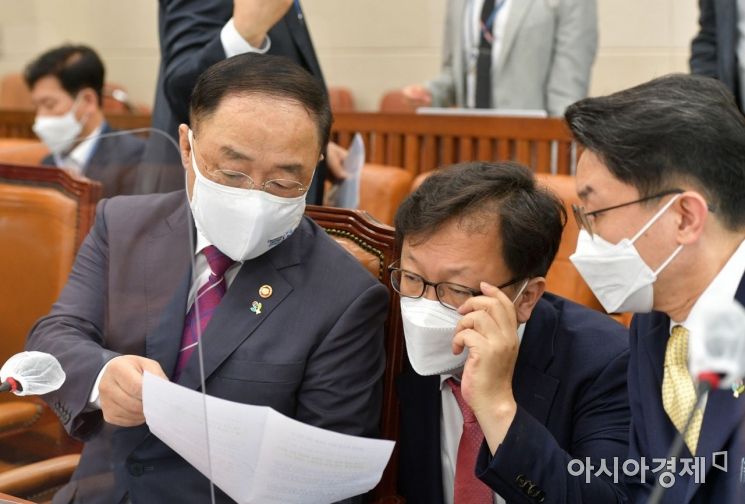 Deputy Prime Minister for Economy Hong Nam-ki attended the full meeting of the Planning and Finance Committee held at the National Assembly on the 23rd and spoke with Lee Ok-won, the 1st Vice Minister of the Ministry of Economy and Finance, and other ministry officials before the meeting began. Photo by Yoon Dong-joo doso7@
◆"Violation of tax legality principle" vs "No legal problem"= As soon as the ruling party’s special real estate committee’s 2% imposition plan was revealed, the market raised claims that it violates Article 59 of the Constitution, which states ‘tax items and rates shall be determined by law,’ arguing it breaches the principle of tax legality. The Ministry of Economy and Finance had withheld official judgment due to concerns over tax revenue stability but recently changed its stance after Deputy Prime Minister and Minister of Economy and Finance Hong Namki stated there is ‘no problem.’
Deputy Prime Minister Hong said at the National Assembly’s Planning and Finance Committee meeting the day before, "The non-taxable housing price standard for single-homeowners is 900 million KRW in the Income Tax Act, but it is delegated to the enforcement decree," adding, "There is a precedent in legislation, so setting the ‘top 2%’ standard by enforcement decree is not a violation of the tax legality principle." He further explained, "Since the purpose is not to increase tax revenue, there is room to adjust the comprehensive real estate tax, and we share this view with the Democratic Party."
The Ministry of Economy and Finance cited the current Income Tax Act as an example, stating there is no problem in making the bill. Since the Income Tax Act allows the president’s decree to determine land subject to capital gains tax, there is precedent.
However, the market still sees room for legal disputes. Lawyer Kim Yerim of Jeonghyang Law Firm explained, "There is no case in domestic related laws where the taxable target is set by range (%) rather than a specific amount," adding, "Since the taxable target itself is unclear, legal disputes may arise later based on administrative disposition, or constitutional complaints and lawsuits related to official prices may continue."
◆Conflicts such as collective constitutional complaints are inevitable= Depending on the ‘top 2%’ standard amount, whether to pay the comprehensive real estate tax may differ even within the same complex, and market conflicts and confusion are expected. Especially, complexes in the Gangnam 4 districts (Gangnam, Songpa, Seocho, Gangdong) with official prices between 1.1 billion and 1.2 billion KRW are already unsettled.
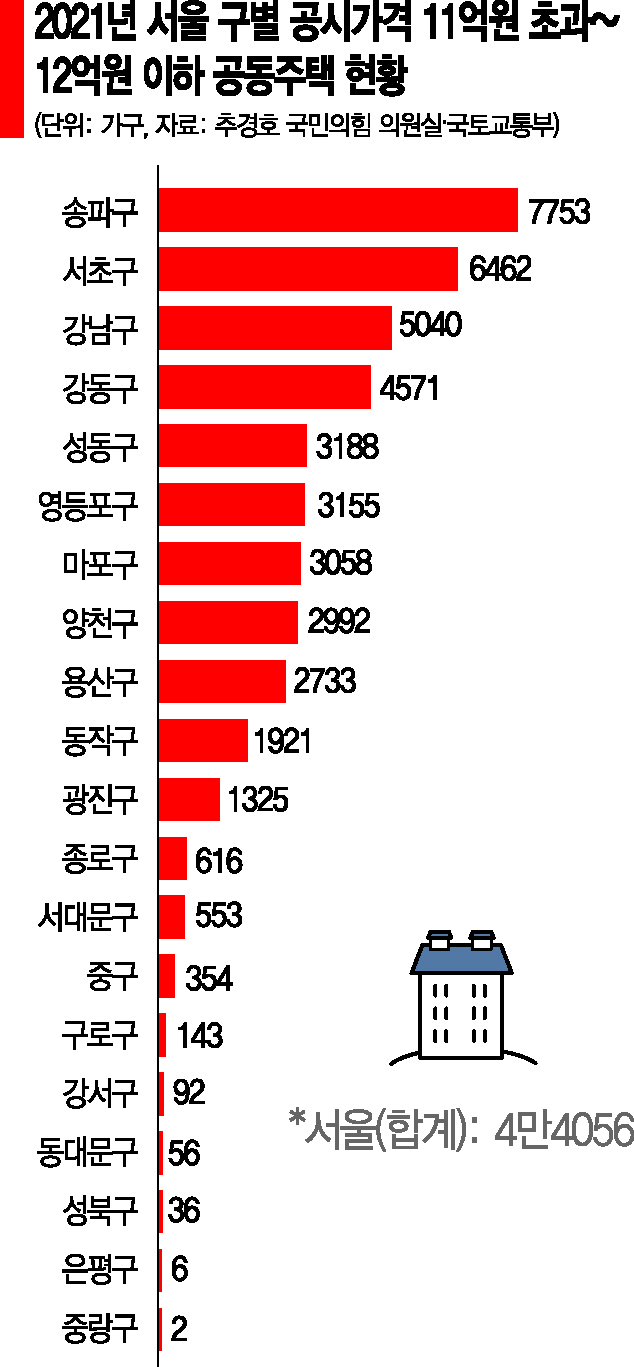
According to the office of Rep. Chu Kyung-ho of the People Power Party, as of 2021, there are 44,056 apartments in Seoul with official prices between 1.1 billion and 1.2 billion KRW, more than half (54.1%) of which are concentrated in the Gangnam 4 districts. Songpa-gu accounts for 7,753 households (17.6%), followed by Seocho-gu (6,462 households, 14.7%), Gangnam-gu (5,040 households, 11.4%), and Gangdong-gu (4,571 households, 10.4%). There are no apartments in the same price range in Geumcheon-gu, Gwanak-gu, Dobong-gu, Nowon-gu, or Gangbuk-gu. While the Gangnam 4 districts will have the most beneficiaries excluded from the comprehensive real estate tax, it is also expected that many will narrowly receive tax bills.
Professor Park Kibek of the Tax Department at University of Seoul emphasized, "The top 2% cannot be a standard; it is just a will to do so," adding, "A specific number should be presented quickly as a standard."
© The Asia Business Daily(www.asiae.co.kr). All rights reserved.
![Clutching a Stolen Dior Bag, Saying "I Hate Being Poor but Real"... The Grotesque Con of a "Human Knockoff" [Slate]](https://cwcontent.asiae.co.kr/asiaresize/183/2026021902243444107_1771435474.jpg)
















