Joint Seminar on Overcoming Haeundae-ran
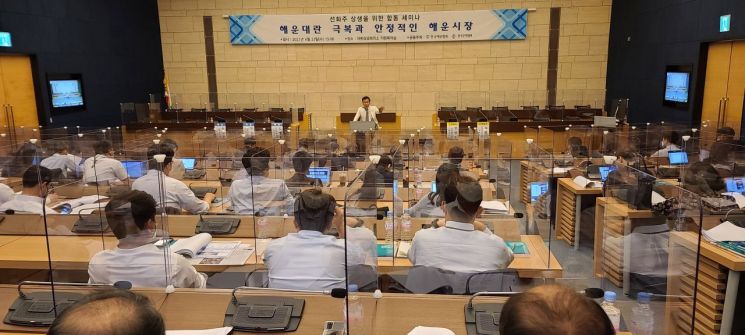 The Korea Shipping Association and the Korea International Trade Association held a shipper-carrier win-win cooperation seminar on the 23rd at the Korea Chamber of Commerce and Industry Members' Meeting Room, under the theme of "Overcoming the Shipping Crisis and Stabilizing the Shipping Market."
[Asia Economy Reporter Dongwoo Lee] Recently, the Korea Fair Trade Commission (KFTC) has imposed massive fines on 12 domestic container shipping companies operating on Southeast Asia routes for unfair joint conduct. The shipping and trade industries have expressed concerns that the KFTC's hefty fines will cause significant disruptions in shipping service supply, exacerbating the logistics crisis.
The Korea Shipping Association and the Korea International Trade Association urged the KFTC to fully reconsider its review report during a shipper-carrier win-win cooperation seminar titled "Overcoming the Shipping Crisis and Stabilizing the Shipping Market," held on the 23rd at the Korea Chamber of Commerce and Industry's Members' Meeting Room.
In his keynote speech, Vice Chairman Kim Young-moo pointed out, “If, as the KFTC claims, regular shipping companies are fined billions of won, it will not only hinder the reconstruction of the shipping industry but also cause diplomatic friction, retaliatory measures, and massive ship sales, resulting in enormous side effects.”
Former Professor Yang Chang-ho of Incheon National University highlighted issues with the review report in his presentation on "Overcoming the Shipping Crisis and Shippers," stating, “The KFTC's judgment of unfair joint conduct based on regular carriers' failure to report freight rates and non-compliance with consultations is a misinterpretation of the legislative intent of the Shipping Act's joint conduct provisions and Article 58 of the Fair Trade Act.”
Professor Yang also emphasized, “If Korea proactively imposes fines on carriers operating Southeast Asia routes, foreign carriers may pass on the antitrust law risks to Korean import-export shippers through freight rates, and there is also concern that foreign carriers might avoid calling at Korean ports.”
Earlier, Kim Tae-il, Head of the Shipping and Logistics Research Division at the Korea Maritime Institute, analyzed the causes and outlook of container freight rate surges. He explained that the freight rate spikes on Asia-Americas and Europe routes are due to intensified container ship capacity shortages and empty container scarcity, combined with large-scale economic stimulus measures mainly in advanced countries such as the U.S. and Germany. This has led to increased consumption of durable goods like home appliances due to remote work, in addition to medical and protective supplies related to the COVID-19 pandemic.
Kim forecasted, “Regarding supply and demand and freight rate outlooks for liner routes, uncertainties are expected to increase due to declining disposable incomes in major advanced countries centered on the U.S. and retaliatory consumption following the easing of COVID-19. Although market conditions in 2022 are expected to be weaker than in 2021, the market will still be supplier-driven.”
During the panel discussion, Kim Byung-yoo, Head of Member Support at the Korea International Trade Association, noted that while the KFTC conducted investigations according to procedures, if fines are imposed on shipping companies, it could lead to ship sales to pay fines, reduced shipping capacity from Korea, and further freight rate increases, causing damage to the export industry.
Professor Han Jong-gil of Sungkyul University stressed, “The European Union revised its antitrust regulations in 2008 to allow alliances but prohibit freight rate collusion. As a result, the market dominance of the three European companies?Maersk Line, MSC, and CMA CGM?has become formidable. It is necessary to closely monitor the fact that major advanced countries such as the U.S. and Japan continue to exempt shipping from antitrust laws.”
Professor Woo Su-han of Chung-Ang University pointed out that by banning freight rate collusion in 2008, the EU allowed the market dominance of the three European companies to expand to the extent that they control market order. He emphasized the need to recognize that joint conduct, including freight rates, has actually contributed to market stabilization.
They all agreed that the recent surge in liner freight rates is excessive compared to the increase in cargo volume. With the peak season approaching and concerns about worsening ship shortages, they argued that win-win cooperation between shippers and carriers is more necessary than ever.
© The Asia Business Daily(www.asiae.co.kr). All rights reserved.
![Clutching a Stolen Dior Bag, Saying "I Hate Being Poor but Real"... The Grotesque Con of a "Human Knockoff" [Slate]](https://cwcontent.asiae.co.kr/asiaresize/183/2026021902243444107_1771435474.jpg)















