Applied to Food from 2023
3-Year Grace Period for Milk and Cheese
Insufficient Facility Investment Due to Cost Burden
Concerns Over Widening Gap with Large Corporations
[Asia Economy Reporter Seungjin Lee] The ‘consumption deadline labeling system’ for food is set to be implemented starting in 2023, raising alarms for small and medium-sized food manufacturers and distributors lacking sufficient cold chain (refrigerated and frozen transport and storage) systems.
On the 24th, the National Assembly’s Health and Welfare Committee resolved at the bill review subcommittee to adopt an amendment to the Food Labeling and Advertising Act that changes the food expiration date to a consumption deadline. From January 2023, the current expiration date will be replaced by the consumption deadline labeling system for food products. However, a special provision will apply to refrigerated foods such as milk and cheese, with implementation starting in 2026.
As the consumption deadline labeling system gains momentum, concerns are emerging among small and medium-sized food manufacturers and distributors. The current expiration date refers to the period during which distribution and sale to consumers are permitted from the manufacturing date, set approximately 60-70% ahead of the point when food quality changes. The consumption deadline is set at about 80-90% ahead of the quality change point, making the management of food distribution and storage even more critical.
In cold chain distribution, major retail giants such as Lotte Shopping, Shinsegae, and Homeplus dominate. The Big 3 operate over 500 stores nationwide equipped with refrigerated and frozen facilities, comparable to cold chain infrastructure.
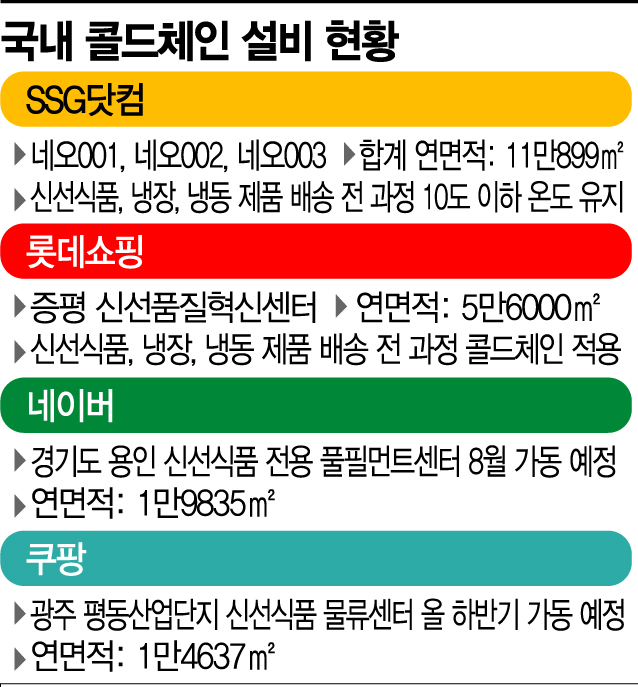
Shinsegae’s SSG.com operates ‘Neo003’ in Gimpo, which boasts the largest cold chain facility in Korea. It is characterized by preventing exposure to room temperature even during the brief time food is loaded onto transport vehicles from the cold storage. Lotte Shopping has strengthened its cold chain capabilities by establishing a 56,000㎡ Fresh Quality Innovation Center in Jeungpyeong, Chungbuk. Naver is preparing to operate a 19,835㎡ fresh food dedicated fulfillment center in Yongin, Gyeonggi, and Coupang is focusing on cold chain enhancement by investing approximately 800 billion KRW in fresh food logistics centers, including a 14,637㎡ facility in the Pyeongdong Industrial Complex in Gwangju, as well as locations in Changwon, Gyeongnam; Wanju, Jeonbuk; and Cheongju, Chungbuk.
For domestic small and medium-sized enterprises, investment in cold chain infrastructure remains insufficient due to cost issues. With the introduction of the consumption deadline, expansion of refrigeration facilities is necessary, but securing land and investment costs are significant challenges. Ultimately, there are concerns that the adoption of the consumption deadline labeling system will intensify consumer preference for products from large corporations, widening the gap between large and small businesses.
© The Asia Business Daily(www.asiae.co.kr). All rights reserved.
![Clutching a Stolen Dior Bag, Saying "I Hate Being Poor but Real"... The Grotesque Con of a "Human Knockoff" [Slate]](https://cwcontent.asiae.co.kr/asiaresize/183/2026021902243444107_1771435474.jpg)
















