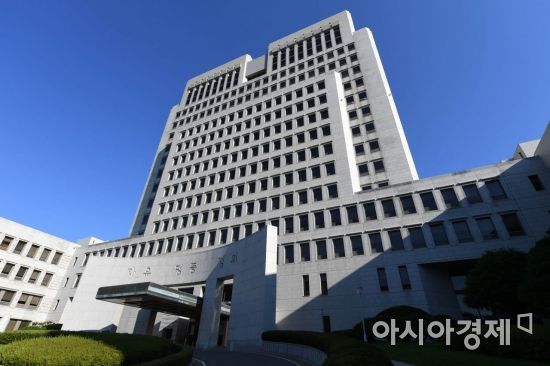
[Asia Economy Reporter Baek Kyunghwan] The Supreme Court is set to deliver its final judgment on conscientious objectors who refuse military service based on personal beliefs rather than the doctrines of a specific religion. This is the first time the Supreme Court is addressing refusal of active duty enlistment based on non-religious beliefs. Previously, the Supreme Court acquitted a man who refused reserve forces training due to personal convictions.
On the 24th, the Supreme Court's First Division (Presiding Justice Kim Seonsu) will hold a sentencing hearing for the case of Jeong Mo, who was charged with violating the Military Service Act.
Jeong was prosecuted for failing to enlist by the enlistment date without justifiable reason after receiving an active duty enlistment notice in October 2017.
Before the Constitutional Court and Supreme Court recognized "conscientious objection to military service" in February 2018, the first trial court sentenced Jeong to 1 year and 6 months in prison. The court reasoned that "the defendant's refusal to enlist for active duty based on religious conscience or political beliefs does not constitute a 'justifiable reason' as stipulated by the Military Service Act."
During the trial, Jeong stated that as a sexual minority, he had felt alienated by the uniform entrance exam education and peer culture enforcing masculinity since high school. He said he came to rely on Christian faith and participated in missionary groups after entering university. According to the court, Jeong took part in emergency prayer meetings held by Christian groups opposing Israel's military invasion and praying for peace in Palestine, one-person protests addressing the Yongsan tragedy, protests against the 60th anniversary peace prayer meeting for the Korean War, opposition movements against the naval base in Gangjeong Village, Jeju Island, and Wednesday demonstrations.
However, the appellate court overturned the ruling after the Constitutional Court and Supreme Court made their decisions on "conscientious objection to military service." The court stated, "The defendant's faith and beliefs are deeply rooted internally and form a clear substance, which cannot be seen as compromising or strategic," and ruled that "a justifiable reason to refuse military service as defined by the Military Service Act is recognized." It added, "The defendant refused enlistment despite facing criminal punishment of 1 year and 6 months imprisonment," and "in the appellate trial, he also expressed willingness to perform alternative service in prison or detention center for 36 months."
Earlier in February, the Supreme Court ruled that individuals could not be punished for refusing reserve forces training and military mobilization summons based on beliefs such as rejecting violence and killing.
© The Asia Business Daily(www.asiae.co.kr). All rights reserved.
![Clutching a Stolen Dior Bag, Saying "I Hate Being Poor but Real"... The Grotesque Con of a "Human Knockoff" [Slate]](https://cwcontent.asiae.co.kr/asiaresize/183/2026021902243444107_1771435474.jpg)















