Korea Atomic Energy Research Institute Effectively Removes Residual Cesium After Soil Separation Using Magnetism
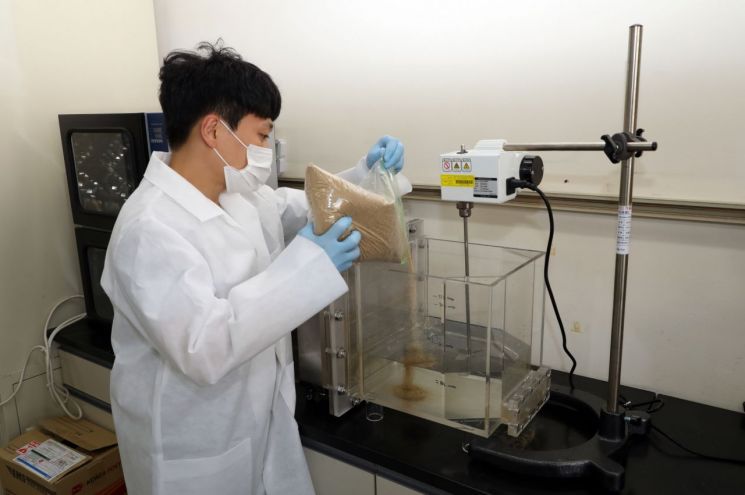
[Asia Economy Reporter Kim Bong-su] A technology has been developed that effectively removes up to 97% of cesium, a major radioactive contaminant, from the soil of nuclear accident sites or decommissioned nuclear facilities.
The Korea Atomic Energy Research Institute announced on the 23rd that Dr. Kim Il-guk's team from the Decommissioning Technology Research Department developed a technology that selectively separates clay (fine soil particles with a diameter of 0.002mm or less) strongly bonded with cesium using magnetism, and effectively removes residual cesium from the contaminated soil remaining after clay separation. This technology has already completed registration of two domestic patents last month and is currently under patent examination in the United States and Japan.
Radioactive cesium strongly adsorbs to clay in contaminated soil due to its physical and chemical properties. Therefore, a technology that selectively separates clay, which accounts for 10-30% of the soil, is necessary.
The research team utilized the general characteristic of clay surfaces carrying a negative charge. They manufactured positively charged magnetic nanoparticles to induce selective binding with clay particles in the soil through electrostatic attraction. In this process, the magnetized clay particles can be easily separated using an external magnet without additional energy. Since separation relies solely on magnetic force and the solution used for separation can be continuously reused, no separate waste liquid treatment is required, making it economically advantageous.
By combining a simple mesh filter during the magnetic clay separation process, the research team was able to further enhance the selectivity of separation and confirmed a 90% decontamination effect with this process alone.
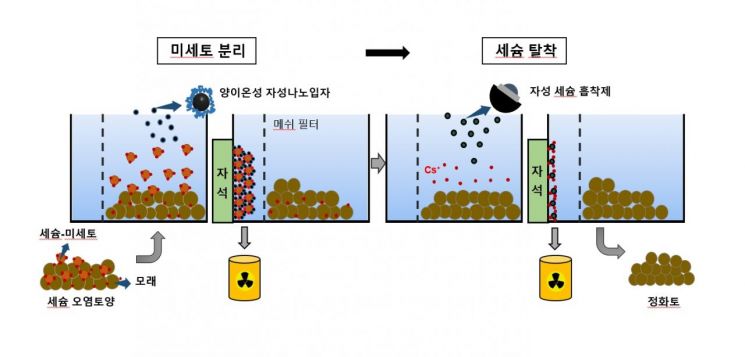
After clay separation, the residual contaminated soil may require additional decontamination processes to meet the strict domestic standards. To address this, the research team washed the remaining soil by introducing a magnetic adsorbent combined with ferrocyanide particles (used for cesium removal). The washing experiment confirmed that over 95% of cesium was removed.
As a result, by magnetically separating clay from radioactive contaminated soil and performing washing using a magnetic adsorbent, they succeeded in selectively removing about 97% of radioactive cesium.
The research results were published online last month in the international academic journal Chemical Engineering Journal (I.F.: 10.652, top 3% in the JCR chemical engineering field).
Dr. Kim Il-guk said, "The soil purification technology developed this time is expected to be applicable not only to radioactive contaminated soil but also to general environmental contaminated soil such as heavy metals and petroleum. We plan to supplement the research aiming for commercialization." He added, "Since it is very advantageous for commercialization by applying low-energy magnetic separation technology, it is expected to be directly utilized in treating large amounts of radioactive contaminated soil that may occur during the decommissioning of nuclear facilities in the future."
© The Asia Business Daily(www.asiae.co.kr). All rights reserved.
![Clutching a Stolen Dior Bag, Saying "I Hate Being Poor but Real"... The Grotesque Con of a "Human Knockoff" [Slate]](https://cwcontent.asiae.co.kr/asiaresize/183/2026021902243444107_1771435474.jpg)
















