The Citizens' Coalition for Economic Justice Announces Analysis of Price Changes in 75 Seoul Complexes
Gangnam 30-pyeong Units Up 1.09 Billion KRW, Non-Gangnam Areas Up 500 Million KRW
Meanwhile, Household Income Increased by Only 2.98 Million KRW
Apartment Price Increase 192 Times Household Income Growth
"Bubble Growth Led by Unearned Income Instead of Income-Led Growth," Criticized
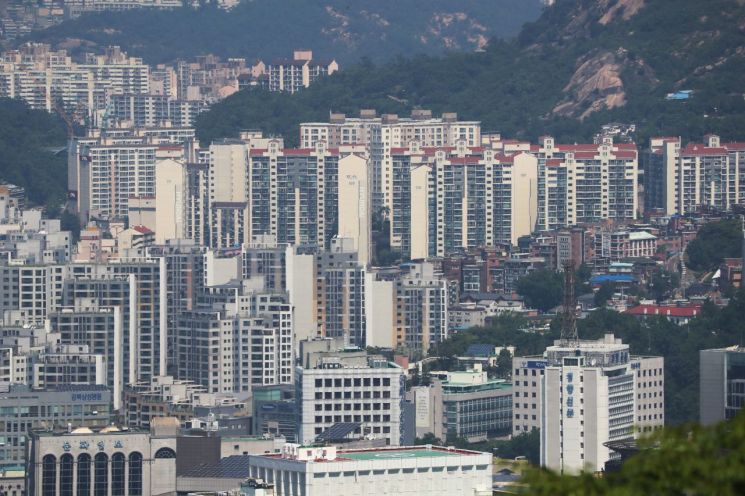
[Asia Economy Reporter Onyu Lim] An analysis by the Citizens' Coalition for Economic Justice (CCEJ) revealed that Seoul apartment prices doubled during the four years of the Moon Jae-in administration. It also explained that the time required to purchase a home increased by more than 10 years. The CCEJ criticized, "The Moon administration, which prioritized income-led growth, only achieved bubble growth driven by unearned income."
According to the CCEJ on the 23rd, the price per 3.3㎡ (1 pyeong) of Seoul apartments rose from 20.61 million KRW in May 2017, when the Moon administration began, to 39.71 million KRW in May this year, an increase of 19.1 million KRW over four years. The rate of increase reached nearly double, at 93%. Converted to a 30-pyeong apartment, a Seoul apartment that could be purchased for 620 million KRW before the administration started now costs 1.19 billion KRW, an increase of 570 million KRW.
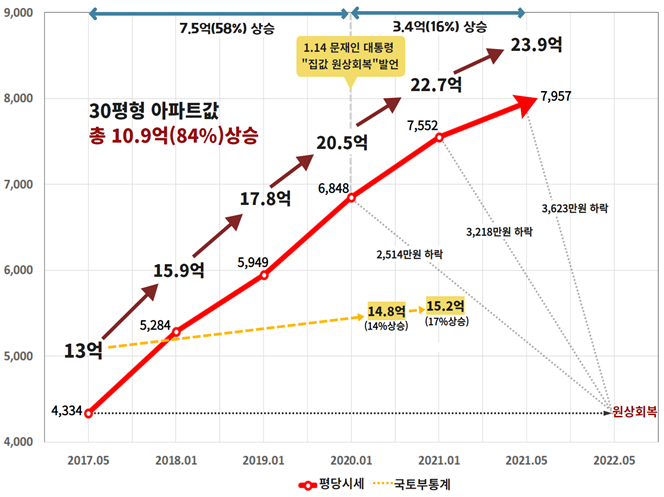
In the Gangnam 3 districts (Gangnam, Seocho, Songpa), the price per pyeong rose from 43.34 million KRW to 79.57 million KRW, an increase of 36.23 million KRW (84%) during this period. The price of a 30-pyeong apartment increased by 1.09 billion KRW (from 1.3 billion KRW to 2.39 billion KRW). The rate of increase was even steeper in non-Gangnam areas. The average price per pyeong in the other 22 districts rose from 17.51 million KRW to 34.27 million KRW, a 96% increase. The price of a 30-pyeong apartment, which was 530 million KRW, surged to 1.03 billion KRW.
The CCEJ explained that this analysis was conducted using KB Kookmin Bank market price information for a total of 75 complexes, three from each of the 25 autonomous districts in Seoul, covering 115,000 households.
The CCEJ claims that as Seoul apartment prices soared, the time required for ordinary citizens to purchase a home also increased significantly. During the same period, the disposable income per household rose only by 2.98 million KRW (7%), from 45.2 million KRW to 48.18 million KRW. Assuming all household income is saved to purchase a 30-pyeong apartment in Seoul, the required time increased from 14 years in May 2017 to 25 years last May. For apartments in the Gangnam 3 districts, the time increased from 29 years to 50 years, a 21-year increase.
Kim Seong-dal, Director of the Real Estate and Construction Reform Division at CCEJ, stated, "The increase in apartment prices during the four years of the Moon administration was 192 times the increase in income," and criticized, "While emphasizing income-led growth, it only achieved bubble growth driven by unearned income."
The CCEJ also demanded government statistical reform. They pointed out that this analysis significantly differs from the Ministry of Land, Infrastructure and Transport’s response last December to their inquiry, which stated a 17% increase in house prices over four years. A CCEJ official said, "Only by accurately recognizing the reality of house price increases can we understand the reasons behind the failure of 25 policy measures."
© The Asia Business Daily(www.asiae.co.kr). All rights reserved.
![Clutching a Stolen Dior Bag, Saying "I Hate Being Poor but Real"... The Grotesque Con of a "Human Knockoff" [Slate]](https://cwcontent.asiae.co.kr/asiaresize/183/2026021902243444107_1771435474.jpg)
















