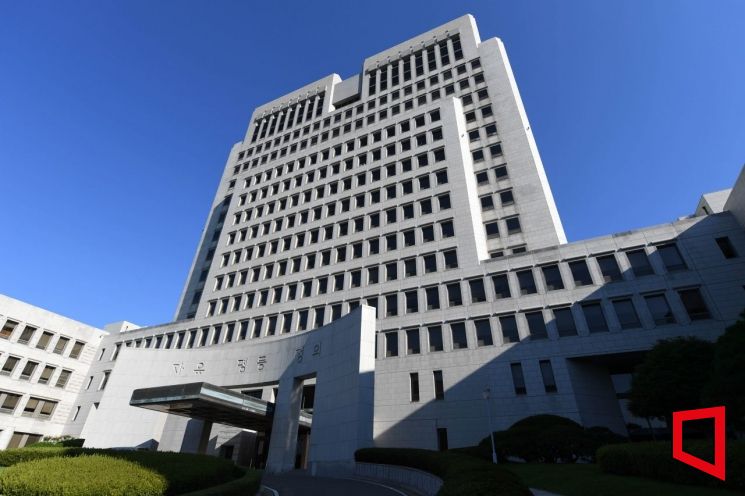
 Supreme Court, Seocho-dong, Seoul. Photo by Honam Moon munonam@
[Asia Economy Reporter Kim Daehyun] The Supreme Court has ruled that if a worker belonging to a previous service provider had a legitimate expectation of employment succession, the refusal of employment succession by the new service provider constitutes unfair dismissal. Employment succession refers to the transfer of workers' employment status from one company to another without change.
On the 23rd, the Supreme Court's First Division (Presiding Justice Lee Gitaek) announced that it upheld the lower court's ruling, which dismissed the appeal filed by Mr. A, the representative of a coal company, against the Central Labor Relations Commission's decision to cancel the unfair dismissal relief reconsideration ruling.
Previously, in 2018, Mr. A signed a service contract with Korea Coal Corporation and a mining site in Gangwon Province, succeeding the employment of 17 workers from the previous service provider except for Mr. B. At that time, Mr. B was unable to attend work for three months due to a finger fracture accident.
After completing treatment, Mr. B submitted a medical opinion stating that there was "no hindrance to returning to regular work" and requested employment succession, but Mr. A refused. When the Central Labor Relations Commission recognized Mr. B's dismissal as unfair, Mr. A filed a lawsuit against the commission.
The first and second trials ruled against the plaintiff. Mr. A has an obligation to succeed Mr. B's employment. The second trial court pointed out, "Workers including Mr. B appear to have continuously worked since 2009 regardless of changes in the service provider and have renewed their labor contracts several times," adding, "Although there is no regulation requiring the plaintiff to succeed the employment of these workers, the plaintiff testified that employment succession had been customarily practiced."
The Supreme Court also agreed with this judgment. The court stated, "Mr. B, a worker belonging to the previous service provider, had a legitimate expectation that his employment would be succeeded by the new service provider, the plaintiff," and "Refusing employment succession without reasonable grounds despite Mr. B's request for succession is equivalent to unfair dismissal."
Furthermore, the court said, "The lower court did not err in its understanding of the legal principles regarding the obligation of employment succession and the reasonable grounds for refusal of employment succession, and there is no mistake affecting the judgment," dismissing the plaintiff's appeal.
© The Asia Business Daily(www.asiae.co.kr). All rights reserved.
![Clutching a Stolen Dior Bag, Saying "I Hate Being Poor but Real"... The Grotesque Con of a "Human Knockoff" [Slate]](https://cwcontent.asiae.co.kr/asiaresize/183/2026021902243444107_1771435474.jpg)














