22nd 4th Minimum Wage Commission Plenary Meeting
Labor and Management's Initial Minimum Wage Proposals Expected to Be Revealed on 24th
Labor Demands 10,770 Won vs Management's 8,720 Won... Labor's Demand Is Key
"No Reason to Raise Considering Living Costs vs Nonsense, Call for TV Debate"
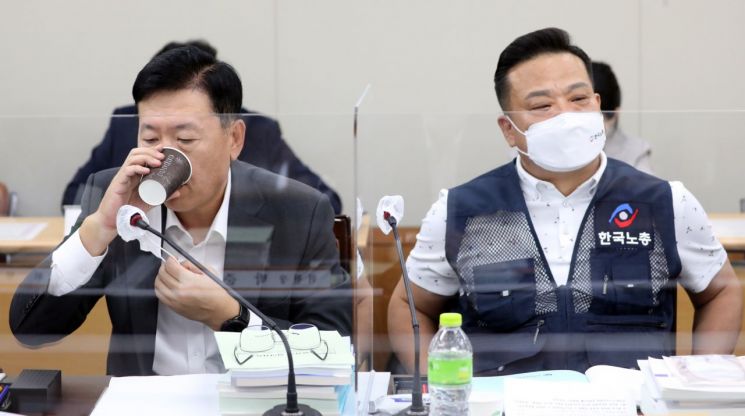 On the afternoon of the 22nd, during the 4th plenary meeting held in the Minimum Wage Commission meeting room at the Government Sejong Complex, Ryu Ki-jung, Executive Director of the Korea Employers Federation and a user committee member (left), drinks water while Lee Dong-ho, Secretary General of the Korean Confederation of Trade Unions and a labor committee member, appears deep in thought. (Photo by Yonhap News)
[Sejong=Asia Economy Reporter Moon Chaeseok] 10,770 won vs 8,720 won. These are the estimated minimum wage amounts for next year currently known from the labor and management sides. The legal deliberation deadline is one week away, and the initial proposals from both sides are likely to be presented at the 5th plenary meeting in two days. In this situation, labor and management engaged in intense debates over whether to set the minimum wage in monthly units with the hourly wage noted alongside, or to calculate it based on the hourly wage unit.
The Minimum Wage Commission, a social dialogue body that deliberates and decides on the minimum wage, held its 4th plenary meeting at 3 p.m. on the 22nd at the Government Complex Sejong to continue deliberations on next year’s minimum wage.
The topic of this meeting was the unit of minimum wage determination. Until now, the minimum wage has been decided in hourly units (8,720 won) and noted alongside in monthly units (1,822,480 won). The labor side proposed deciding next year’s minimum wage in monthly units first, then noting the hourly wage, while the management side insisted it should be set in hourly units. No conclusion was reached at the 3rd plenary meeting on the 15th.
The possibility of differential application by industry was also discussed. The management side argued for applying a lower minimum wage to industries such as lodging and food services that have suffered from COVID-19 business difficulties compared to other industries. The labor side argued that the minimum wage system should uphold its role as the “last bastion” protecting low-wage workers universally.
The issue of differential application by industry is a long-standing debate but has rarely been applied in practice. In the first year of the minimum wage introduction in 1988, minimum wages were applied differently across two industry groups, but since then, the same wage has been applied to all industries. This was to prevent unnecessary fairness controversies, but voices calling for consideration of the special circumstances of the COVID-19 crisis next year are not insignificant.
Once conclusions on the determination unit and differential application are reached, full discussions on the level of next year’s minimum wage will begin. If both sides finalize drafts at the 5th meeting on the 24th, the process will proceed by narrowing differences. So far, it is known that the labor side demands 10,770 won per hour, and the management side 8,720 won (the same level as this year). The key issue is how much the labor side will propose to increase compared to this year, with the two major labor unions reportedly suggesting at least 10,000 won.
Both labor and management showed clear differences in views regarding the standards and analyses for minimum wage deliberations. The Korea Employers Federation reiterated on the 20th that, after considering workers’ living expenses, there is no clear reason to raise the minimum wage next year, as previously claimed. Ryu Ki-jung, Executive Director of the Federation, said, “After analyzing key statistics such as living expenses, similar workers, labor productivity, and income distribution, which are major factors in minimum wage decisions, it appears there is little reason to increase the minimum wage next year. The labor productivity growth rate is much lower than the minimum wage increase rate, and considering the excessive increases in the minimum wage over the past 3 and 5 years compared to labor productivity, we hope to concretize differential application by industry starting today and maintain a stable stance regarding the minimum wage level.”
Park Hee-eun, Vice Chairperson of the Korean Confederation of Trade Unions (KCTU), said, “The Federation is making absurd claims that there are no reasons to raise the minimum wage. Instead of misleading public opinion like this, if necessary, we hope to verify each other’s claims publicly through a TV debate. As a major economic power and OECD member, we urge an end to outdated exploitation of low-wage workers and call for solutions that allow small and micro businesses, small business owners, self-employed workers, and laborers to coexist.”
© The Asia Business Daily(www.asiae.co.kr). All rights reserved.
![Clutching a Stolen Dior Bag, Saying "I Hate Being Poor but Real"... The Grotesque Con of a "Human Knockoff" [Slate]](https://cwcontent.asiae.co.kr/asiaresize/183/2026021902243444107_1771435474.jpg)















