'Shrinkflation' Phenomenon: Reducing Food Quantity Instead of Raising Prices
Processed Food Manufacturers in the US, UK, and Others Cut Contents
"Raw Material Shortage... Reducing Contents Better Than Price Increase," Companies Explain
Past Domestic Controversy Over 'Nitrogen Snacks'
Accelerated Amid Soaring Inflation Rates in Major Countries This Year
Experts Say "Price Hikes Trigger Consumer Resistance"
"Companies Tend to Choose Cost Reduction First"
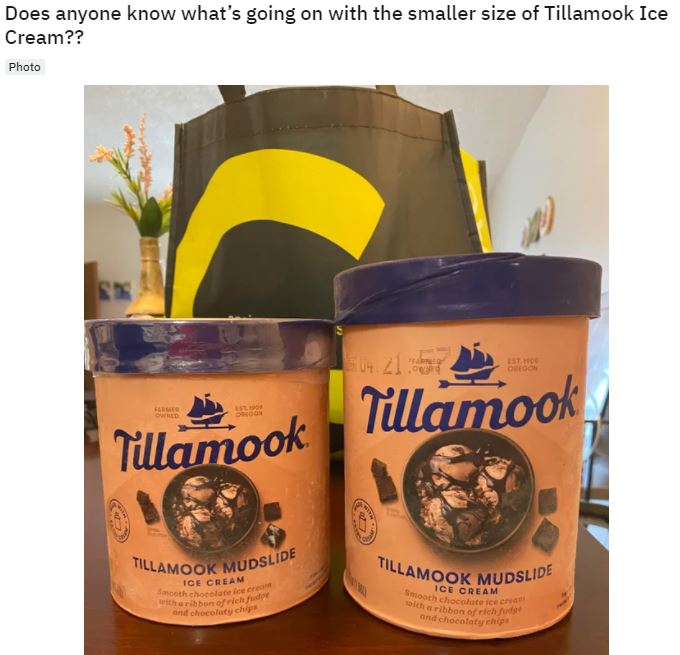 A comparison of ice cream containers from the American ice cream manufacturer 'Tillamook'. / Photo by Reddit, an internet community
[Asia Economy Reporter Lim Ju-hyung] "The size of ice cream has shrunk by 15%," "As the size of food decreases, consumers' lives will become tougher."
Local U.S. media outlets such as The Washington Post, ABC News, and CBS News have simultaneously reported on the phenomenon of 'shrinkflation,' raising concerns about the rising cost of food. Shrinkflation is a neologism combining 'shrink' and 'inflation,' referring to the practice where companies reduce the amount of food inside packaging to curb price increases. In Korea, this phenomenon was previously highlighted during the so-called 'nitrogen snack' controversy.
According to CBS News on the 4th (local time), the ice cream brand 'Tillamook' in Oregon recently announced on its website that it would reduce the amount of ice cream in a container by about 15%.
Tillamook cited rising prices and raw material shortages as reasons for downsizing their ice cream. Recently, global food demand surged unexpectedly, leading to shortages of various berries and vanilla, causing a sharp rise in ingredient prices. Tillamook emphasized, "To lessen the shock to consumers, we chose to reduce the content rather than increase the price of the ice cream."
Ice cream is not the only product with reduced contents inside the packaging. Recently, netizens from countries such as the U.S., Canada, and the U.K. have shared similar cases on social media platforms like Twitter, expressing their dissatisfaction.
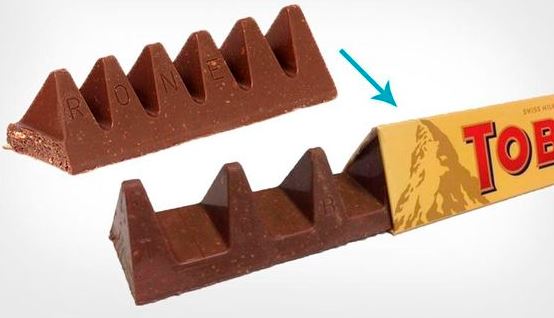 A product of the Swiss chocolate manufacturer 'Toblerone,' which was criticized in the past for changing the shape of its chocolate bars to reduce costs. / Photo by Internet homepage capture
Various 'content diet' methods include changing the shape to a bumpy form to reduce cocoa butter content in chocolate bars, or significantly shortening the length of candies. One netizen lamented, "In the past, we deliberately reduced snack portions due to the health food trend, but now the actual shortage of ingredients is causing food quantities to shrink," adding, "Is this really happening in the 21st century?"
The phenomenon where prices and packaging remain the same but the quantity or quality of the contents inside decreases is called 'shrinkflation.' The term was proposed in 2015 by British economist Pippa Malmgren and has since gained popularity online, becoming widely used today.
Shrinkflation mainly appears in the processed food industry. This sector is highly sensitive to raw material prices such as grains, flour, and cooking oil, and since its main customers are consumers sensitive to food costs, companies find it difficult to raise prices outright.
The reason shrinkflation has become a hot topic again this year is due to the recent sharp rise in global inflation. As of last month, inflation rates in major countries such as the U.S. (5.0%), EU (2.0%), and the U.K. (2.1%) all exceeded central bank targets.
According to the Food Industry Statistics Information System (IFS), grain prices, which significantly affect processed foods, have surged over 30% in the past year. Unless product prices are raised, companies need to 'diet' by reducing raw material content or the size of the food itself.
Shrinkflation has also occurred domestically before. A representative example is the 'nitrogen snack' controversy that erupted in 2014. Nitrogen snacks refer to snacks with excessively little content compared to the size of the packaging. To preserve snacks for a long time, nitrogen is filled inside the bag, causing the packaging to puff up, which led to the term 'nitrogen snack.'
 In 2014, two university students made headlines by crossing the Han River on a raft made by bundling together over 60 domestic snacks. / Photo by Yonhap News
At that time, two university students dissatisfied with nitrogen snacks attempted to cross the Han River on a raft made by tying together 60 bags of domestic snacks, drawing attention to excessive over-packaging by food companies.
If shrinkflation becomes widespread, single-person households or low-income groups who rely on inexpensive processed foods for meals may face significant inconvenience.
A 20-something office worker, A, who occasionally eats processed foods like lunch boxes, said, "Even now, prices of meat, eggs, and vegetables are burdensome when shopping, so if processed foods deteriorate too, I don't know what I will eat."
University student B (25) said, "It seems like ramen and ice cream have never had a price drop," adding, "I've only seen cases of price increases, reduced content, or deteriorated taste. Isn't this too much?" expressing frustration.
Experts have suggested increasing transparency in food-related information disclosure to minimize the impact of shrinkflation on low-income groups.
Professor Kim Tae-gi of Dankook University's Department of Economics explained, "It has long been a method for companies to reduce manufacturing costs by cutting some raw materials or content as prices rise. Since consumers are sensitive to prices, companies prefer to reduce production costs rather than raise product prices."
He added, "If this phenomenon worsens, households heavily affected by food prices may suffer. Strengthening labeling obligations on product contents so consumers can scrutinize and make informed purchases is one possible solution," he advised.
© The Asia Business Daily(www.asiae.co.kr). All rights reserved.
![Clutching a Stolen Dior Bag, Saying "I Hate Being Poor but Real"... The Grotesque Con of a "Human Knockoff" [Slate]](https://cwcontent.asiae.co.kr/asiaresize/183/2026021902243444107_1771435474.jpg)


















