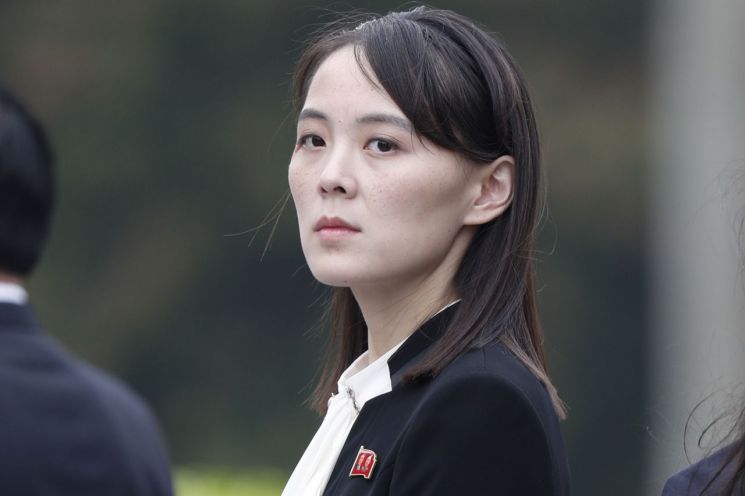
[Asia Economy reporters Yoo In-ho and Lee Ji-eun] As South Korea and the United States work to create a dialogue atmosphere with North Korea through the conclusion of the working group, Kim Yo-jong, deputy director of the North Korean Workers' Party, poured cold water by calling it a "misguided expectation." This is interpreted as meaning that North Korea will not engage in talks unless clear incentives such as sanctions relief, which North Korea desires, are presented.
On the 22nd, Kim Yo-jong rebutted the White House's characterization of Kim Jong-un, General Secretary of the Workers' Party, delivering an "interesting signal" regarding his message to the U.S. at the plenary meeting.
In a statement released through the Korean Central News Agency that afternoon, Kim said, "I heard reports that the U.S. White House National Security Advisor stated that our Party Central Committee's plenary meeting's stance toward the U.S., declared this time, is regarded as an interesting signal."
She continued, "There is a Korean (North Korean) proverb that says 'the interpretation is more important than the dream,'" adding, "It seems the U.S. is probably interpreting it in a way that comforts itself." She further said, "Having misguided expectations will only lead them to greater disappointment."
Earlier, Jake Sullivan, U.S. White House National Security Advisor, in an interview with ABC on the 20th (local time), referred to Kim Jong-un's message at the Party plenary meeting that "we must be prepared for both dialogue and confrontation" as an "interesting signal," and said he was waiting for a clear signal from North Korea on whether it would engage in talks.
Kim Yo-jong's rebuttal to Sullivan's remarks can also be interpreted as a de facto rejection of Sung Kim, U.S. Special Representative for North Korea, who recently visited South Korea and expressed hope for a "positive response from North Korea."
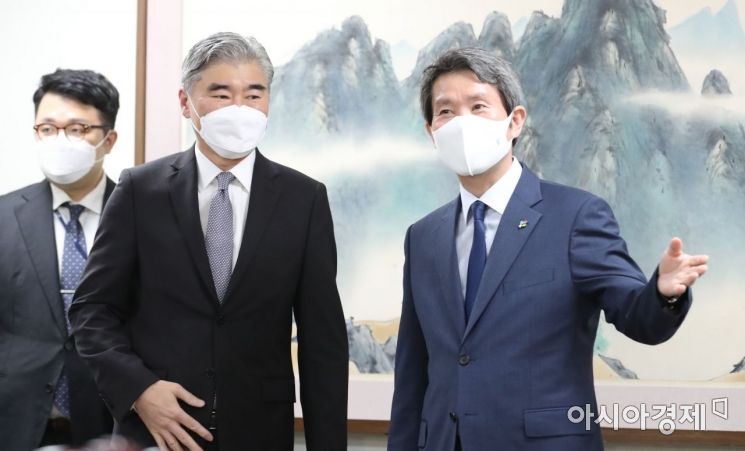 Minister of Unification Lee In-young is seen greeting Sung Kim, the U.S. Special Representative for North Korea, at the Government Seoul Office in Jongno-gu, Seoul, on the 22nd, then escorting him to his seat. Photo by Hyunmin Kim kimhyun81@
On the morning of the 22nd, Kim met with Unification Minister Lee In-young and said, "We are now at a very important moment and point in time to transition to a dialogue phase," adding, "We expect North Korea to respond quite positively to our dialogue proposal."
At the North Korea nuclear chief-level talks held the previous day, he also expressed hope for resuming dialogue, saying, "I hope that Kim Jong-un, General Secretary of the North Korean Workers' Party, mentioning dialogue shows that we will soon receive a positive response." This interprets Kim Jong-un's statement at the plenary meeting on the 17th that "we must be prepared for both dialogue and confrontation" as a willingness to engage in talks.
On the same day, South Korea and the U.S. actively worked to create a "dialogue atmosphere" with North Korea by agreeing to end the working group, which North Korea had viewed as a thorn in its side. The Ministry of Foreign Affairs announced, "At the North Korea nuclear chief-level talks between South Korea and the U.S. (held the previous day), it was agreed to conclude the working group." When Minister Lee proposed visits to Mount Kumgang, reunions of separated families, and cooperation on health and livelihood issues, Kim responded, "We want to closely cooperate with the South Korean government's ideas," which is also seen as part of creating a dialogue atmosphere.
However, with Kim Yo-jong directly issuing a statement to strongly rebut this, South Korea and the U.S. are expected to seek additional practical measures to bring North Korea to the negotiating table, such as promoting four-party talks.
Jung Sung-jang, director of the North Korea Research Center at the Sejong Institute, explained, "Although Kim Jong-un has shown a more proactive attitude toward North Korea-U.S. talks compared to January this year, it seems North Korea is not yet ready to immediately engage in talks," adding, "The U.S. needs to have China bring North Korea to the negotiating table by promoting the holding of four-party talks on North Korea's nuclear issue involving China and South Korea as well."
© The Asia Business Daily(www.asiae.co.kr). All rights reserved.
![Clutching a Stolen Dior Bag, Saying "I Hate Being Poor but Real"... The Grotesque Con of a "Human Knockoff" [Slate]](https://cwcontent.asiae.co.kr/asiaresize/183/2026021902243444107_1771435474.jpg)
















