Korea Research Foundation Professor Kyungdeok Park and UNIST Research Team
"Usable for Optical Quantum Information Communication"
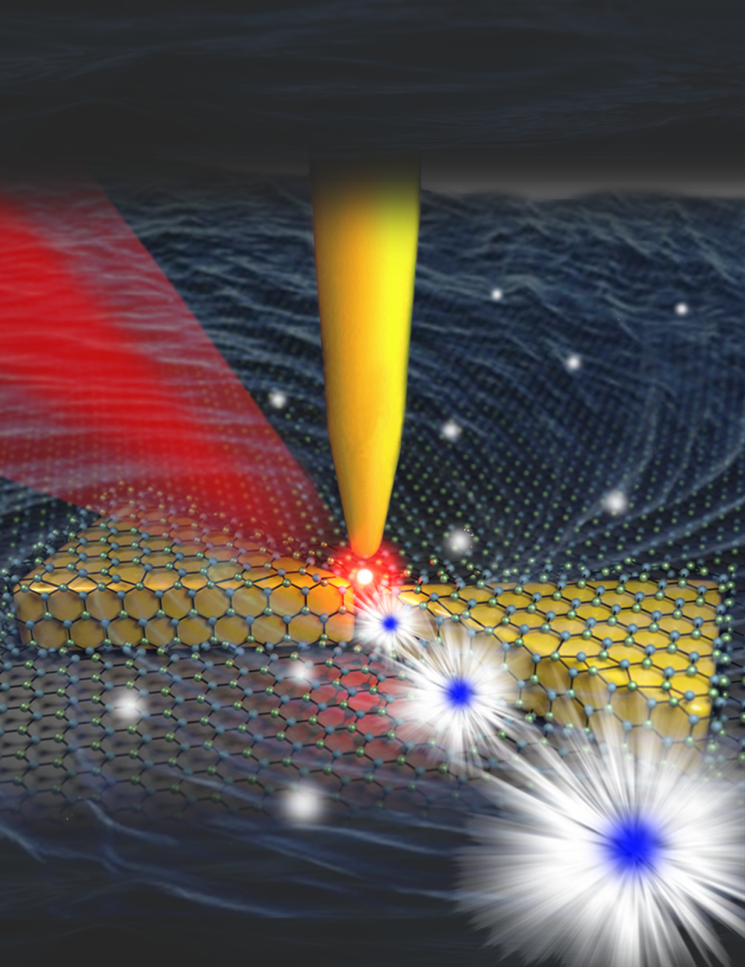
[Asia Economy Reporter Kim Bong-su] A technology has been developed that can generate bright quantum light sources at desired locations at room temperature without cumbersome cryogenic equipment such as liquid nitrogen, liquid helium, or temperature control devices. It is 40,000 times brighter than existing semiconductor quantum light sources, drawing attention for its potential use in quantum information communication.
The National Research Foundation of Korea announced on the 22nd that a joint research team led by Professor Kyungduk Park of Ulsan National Institute of Science and Technology (UNIST) and Professor Junseok Noh of Pohang University of Science and Technology (POSTECH) developed a technology that can stably generate quantum light sources of two-dimensional materials at room temperature.
To practically utilize the light source in devices, it was necessary to control the position of quantum light sources that exist randomly at arbitrary locations. Overcoming the challenge that quantum light sources could only be generated and detected at low temperatures was also required. Quantum light sources refer to quantized light emitted from the discrete electronic energy structures inside materials. Existing nano-optical resonators can control the position of the light source but have limitations in spatial resolution (the ability to distinguish two separate objects), while probe-enhanced photoluminescence nanoscopy offers high resolution but struggles to generate quantum light sources.
The research team combined these two approaches and designed a light control and measurement system using a new concept called resonant nanoscopy. They had already developed a technology to fabricate nano-optical resonators in the shape of a sharply pointed bowtie at the atomic level using continuous domino lithography processes, enabling the generation of quantum light sources in two-dimensional semiconductor materials at desired locations.
By integrating photoluminescence nanoscopy, they induced a triple antenna effect (an effect that more strongly focuses light through a resonator structure formed by three antennas), enabling the generation of quantum light sources with high efficiency. Quantum light sources could be detected at room temperature with a spatial resolution of about 15 nanometers (approximately one ten-thousandth the thickness of a human hair). It was confirmed that the brightness of the quantum light sources created in this way was 40,000 times stronger than semiconductor quantum light sources without the antenna effect. The light emitted from one LED applying the triple antenna effect is equivalent in brightness to the light emitted from 40,000 conventional LEDs.
The research team expects this to be used as a light source for quantum information communication devices and as a tool to understand quantum materials at the nanoscale. They also explained that it could be applied to highly sensitive detection of weak optical signals from various nanomaterials. The research results were published online on the 18th in the international materials physics journal Advanced Functional Materials.
© The Asia Business Daily(www.asiae.co.kr). All rights reserved.
![Clutching a Stolen Dior Bag, Saying "I Hate Being Poor but Real"... The Grotesque Con of a "Human Knockoff" [Slate]](https://cwcontent.asiae.co.kr/asiaresize/183/2026021902243444107_1771435474.jpg)















