50s Store Owner Endured Persistent Complaints and Abusive Language
Coupang Eats Repeatedly Said "Please Be Careful Next Time" Even After Owner Collapsed
Expert: "Malicious Reviews Greatly Influence Consumer Choices"
 Recently, a customer verbally abused a store owner in their 50s, causing controversy. Photo by MBC 'News Desk' broadcast screen capture.
[Asia Economy Reporter Heo Midam] "Malicious customers who kill people with words must be severely punished."
Recently, an incident occurred where a customer used a delivery app to demand a refund for 'one shrimp tempura' and verbally abused a shop owner in her 50s, sparking public outrage. After the shop owner refunded the price of one shrimp tempura, the customer demanded a full refund for the entire order and continued to engage in so-called 'star rating terrorism' and other abuses. The shop owner, who suffered severe stress from this, eventually collapsed from a cerebral hemorrhage and died three weeks later.
Cases of some consumers abusing delivery apps to threaten shop owners have been increasing recently, becoming a social problem. As cases of 'gapjil'?abusive behavior by customers?such as demanding refunds through delivery apps continue, self-employed business owners are expressing their frustration. Experts are calling for improvements at the delivery app system level.
On the 21st, MBC reported that Ms. A, a woman in her 50s running a gimbap shop in Dongjak-gu, Seoul, suffered from customer complaints and pressure from the delivery app company, collapsed from a cerebral hemorrhage last month, and ultimately lost her life.
According to the report, Ms. A received the first complaint call from customer B one hour and 30 minutes before collapsing. B had ordered gimbap and dumplings through the delivery app 'Coupang Eats' the previous day.
At that time, B claimed that one of the three shrimp tempuras had a strange color and demanded a refund of 2,000 won, the price of one piece. During this process, a verbal dispute broke out between the two, and Ms. A was reportedly shocked by B's abusive language and was seen crying.
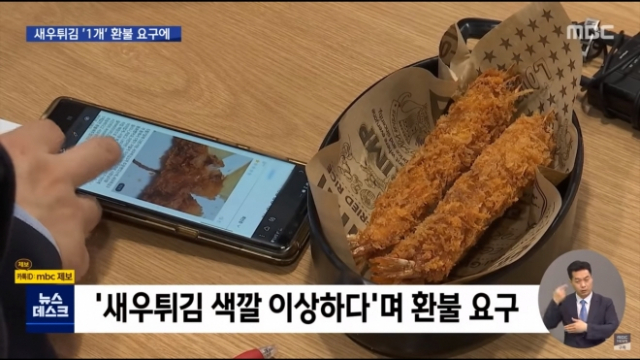
Later, when Coupang Eats contacted Ms. A, she said, "(B) kept saying, 'Don't live your life like that. Your parents taught you that way,'" and expressed her frustration, saying, "How old do you think I am? No matter how much I run a business, that's not acceptable." However, Ms. A eventually apologized and refunded the price of the shrimp tempura.
However, after receiving the refund for the shrimp tempura, B demanded a full refund for all the food ordered through Coupang Eats. He also left a one-star rating with a comment calling the owner 'inconsiderate' on the app review.
As B's complaints continued, Coupang Eats contacted Ms. A several times. After a call with Coupang Eats, Ms. A grabbed her head and collapsed. She was transported to the hospital but passed away three weeks later. However, Coupang Eats reportedly continued to call the shop after Ms. A collapsed, saying things like "Please inform Ms. A to prevent the same problem from happening again" and "Please be careful in the future."
After the story became known, citizens expressed anger at the customer's abusive behavior. Office worker Kim (27) said, "How unfair must the shop owner feel from the malicious customer's abuse?" and criticized, "Is it reasonable to leave a one-star rating after demanding a refund due to abusive language and receiving it? People who carry out star rating terrorism against small business owners without reason should reflect. Isn't this what gapjil is?"
He added, "Such cases should be punished. Isn't it like killing someone with words? We must not forget that shop owners are also precious family members to someone."
There were also criticisms of Coupang Eats' complacent response. University student Lee (25) said, "B is bad, but Coupang Eats takes a commission in the middle. Shouldn't they mediate between customers and shop owners? Why do shop owners have to handle malicious customers alone? I'm going to delete the Coupang Eats app now."
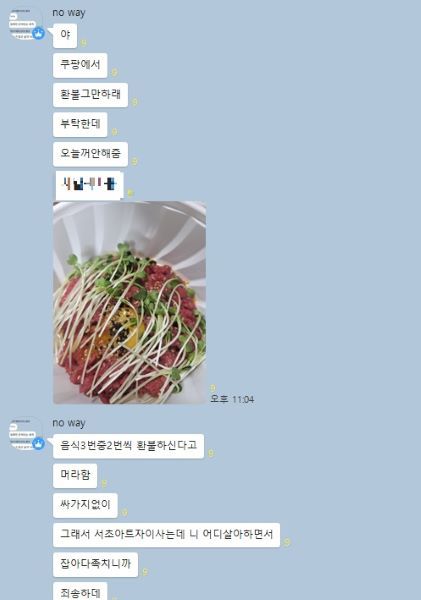 A participant in a KakaoTalk open chat room is sharing a story about being banned from refunds due to habitual refund requests. Photo by Online Community Screenshot.
As cases of abusing delivery app star ratings and reviews to threaten shop owners continue, controversy is growing. A new term, 'delivery beggar,' has even emerged to describe customers who fraudulently get refunds for delivery food.
Earlier on the 16th, a story about a malicious customer who ordered food and requested refunds for all sorts of reasons caused public outrage. According to various online communities, participant C, using the nickname 'No Way' in a group chat, shared photos of food and said, "Coupang asked me to stop requesting refunds. They said they won't refund today's order. They complained about getting refunds for two out of three orders."
C was also reported to have received a refund simply because the sashimi ordered by delivery was spilled, and even after eating all the properly delivered sushi, got a refund using the excuse that "the food disappeared."
The problem is that shop owners have no choice but to respond kindly to such malicious customers, as if "crying while eating mustard." Since the COVID-19 pandemic last year, the number of people eating delivery food at home has increased, making delivery orders a key source of revenue. Therefore, consumer reviews and star ratings have become even more important. Maintaining good reviews and star ratings is essential to attract new customers.
As the importance of reviews has grown, delivery apps like Coupang Eats and Baedal Minjok have established their own measures against false or malicious reviews. However, as false reviews become more sophisticated and intelligent, there are criticisms that these measures are losing effectiveness.
Some have even suggested removing the review function from delivery apps altogether. One netizen said, "Star ratings and reviews should not exist at all. Delivery apps can manipulate them as they please. Many consumers who ordered food based on reviews or star ratings were disappointed or had bad experiences. If the food is bad, consumers won't order from the same place again. I wonder if the star rating system is really necessary."
Experts have suggested improving the delivery app system to enhance review culture. Professor Eunhee Lee of Inha University's Department of Consumer Studies said, "Consumers refer to reviews and photos to choose from many options. Therefore, malicious or false reviews beyond limits greatly influence consumers' choices. This is also why self-employed business owners are stressed by reviews."
She added, "If malicious and false reviews about a shop are rampant, delivery apps should take firmer measures than they do now."
© The Asia Business Daily(www.asiae.co.kr). All rights reserved.
![Clutching a Stolen Dior Bag, Saying "I Hate Being Poor but Real"... The Grotesque Con of a "Human Knockoff" [Slate]](https://cwcontent.asiae.co.kr/asiaresize/183/2026021902243444107_1771435474.jpg)

















