Over the past decade, a total of 4,737 forest fires have occurred domestically, turning 11,196 hectares of precious forest into ashes. There were significant human casualties with 43 deaths and 91 injuries. The damage to forest resources alone exceeds 600 billion KRW. When combined with property damage, the total losses increase substantially.
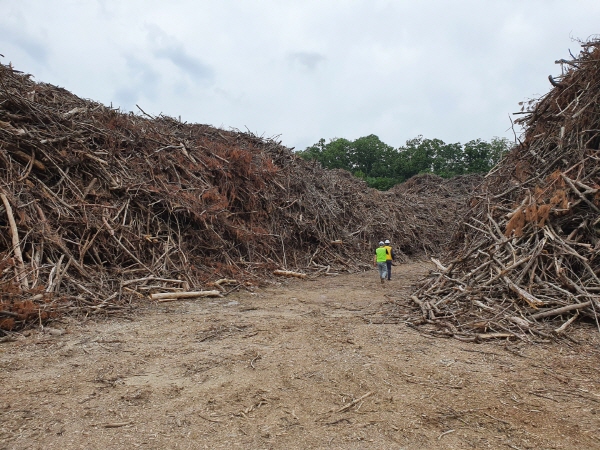
The area affected by forest pests and diseases also reached approximately 40,000 hectares nationwide in 2019, indicating that the threat continues. Domestic forest disasters are gradually becoming larger in scale due to climate change. Forest byproducts such as branches left unused after forest management activities serve as ignition sources or factors that spread forest fires.
During periods of heavy rainfall, these byproducts can be washed away by swollen waters, blocking check dams and other structures, thereby obstructing runoff and causing greater damage. During the heavy rains in 2020, the amount of floating debris such as vegetation reached the highest level in the past decade. This debris flowed into dams, rivers, and drinking water sources nationwide, causing public concern.
Forest byproducts left abandoned in mountainous areas accumulate annually at about 4 million cubic meters. Active management by related agencies such as the Korea Forest Service is required to remove these forest byproducts, which pose a significant threat to forest disaster prevention and public safety.
However, the government, including the Korea Forest Service, is not simply standing by. To address these issues, the "Unused Forest Biomass" system has been implemented and operated since 2018.
Unused forest biomass refers to forest materials generated from domestic forest management activities that do not meet the standards for lumber or are difficult to collect, making their use inefficient. This system collects such materials and converts them into fuel such as wood pellets to be used as energy.
Through this process, factors that cause forest disasters such as wildfires are removed in advance, and it is known to create various virtuous cycle effects nationally, including revitalizing local economies through the creation of forest-related jobs.
In particular, unused forest biomass corresponds to carbon inevitably emitted and left unattended in forests. By utilizing it as an energy source, it can directly replace fossil fuels. This is a model case for sustainable forest development and responding to the climate crisis. It also aligns with the international trend to address the climate crisis.
Unused forest biomass consists of byproducts from harvesting, species renewal, forest development, forest tending, roadside tree materials, and damaged wood from forest pests, diseases, and fires. Due to low quality and high collection costs, it is difficult to use in other wood industries.
In the past, small and medium-sized domestic wood pellet manufacturers, which faced management difficulties due to falling oil prices, have transformed into suppliers of wood pellets for power generation through new investments and factory expansions in line with this policy trend. It is estimated that the supply capacity has expanded to about 900,000 tons annually, mainly through private investment.
Provinces such as Gangwon-do and Gyeongsangbuk-do, which have experienced large-scale forest fires, recognize the necessity of this industry and are actively attracting and revitalizing related companies. However, despite these positive intentions, the related industry has recently been struggling with management difficulties due to falling REC prices, a sharp decline in new demand from power companies, a surge in inventory, and reduced operating rates of manufacturing facilities.
Regarding speculative claims that unused forest biomass may not be carbon neutral, greenhouse gas experts have pointed out that these are inaccurate. It is also easy to confirm that the role of forest bioenergy is highlighted in the IEA's "2050 Net Zero Scenario." In particular, the IPCC has predicted that bioenergy combined with CCS (Carbon Capture and Storage) will contribute significantly to carbon reduction.
Looking at the forest sector in the long-term low-carbon strategies (LEDS) submitted by countries to the UN, the activation of forest bioenergy is mainstream. Recently, top domestic experts, including the Korean Wood Science and Technology Society, have issued a letter emphasizing the value and promotion of unused forest biomass, drawing attention.
According to the "Annual Report on Forest and Forestry Trends" published by the Korea Forest Service, Sweden, a recent presidential visit country, has a high proportion of wood product production in its national economy, and it is analyzed that the harvest volume is steadily increasing through the establishment of a high value-added wood production system and the utilization of unused forest byproducts.
Ultimately, it is interpreted that international discussions on forest biomass have reached a mature level that is not shaken by ambiguous claims from some quarters.
Researcher Lee Soo-min of the National Institute of Forest Science stated in an interview, "The unused forest biomass industry, which reduces carbon emitted and left unattended in forests and has various public benefits as a fossil fuel alternative energy, is an essential industry. In particular, the unused forest biomass policy is an advanced case rarely seen overseas, and urgent whole-of-government policy support is needed in renewable energy, environment, and jobs."
© The Asia Business Daily(www.asiae.co.kr). All rights reserved.
![Clutching a Stolen Dior Bag, Saying "I Hate Being Poor but Real"... The Grotesque Con of a "Human Knockoff" [Slate]](https://cwcontent.asiae.co.kr/asiaresize/183/2026021902243444107_1771435474.jpg)















