Chief Executive Choi Jeong-dan "Completed 4-Stage Autonomous Driving Warm-Up Through Otobi"
Competitiveness Increased with 7 Types of Proprietary Autonomous Driving AI Training Data
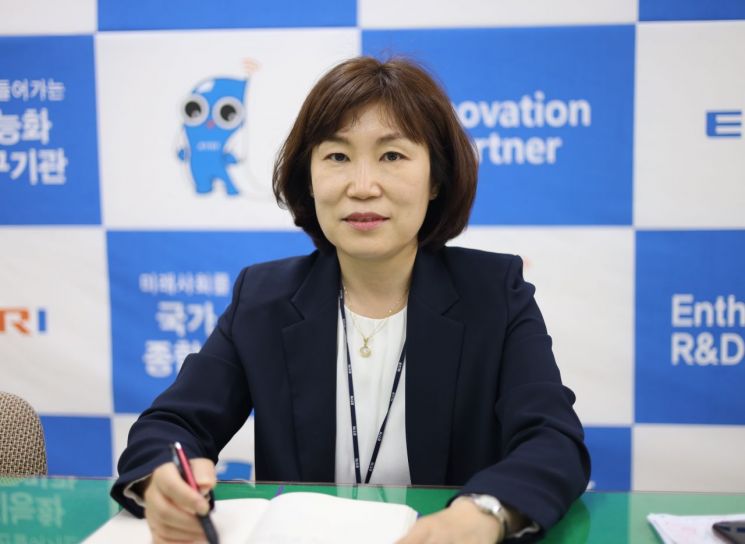 Choi Jeong-dan, Head of the Intelligent Robotics Research Division at the Electronics and Telecommunications Research Institute (ETRI)
[Asia Economy Reporter Eunmo Koo] "With the development of 'AutoVe,' which has undergone data training on tail lights, traffic signals, and irregular roads, the warm-up for Level 4 autonomous driving is complete. Moving forward, we will operate the service, identify shortcomings, and repeatedly improve through research and development (R&D) to enhance the completeness of future-oriented autonomous driving services."
On the 21st, Choi Jeongdan, Head of the Intelligent Robotics Research Division at the Electronics and Telecommunications Research Institute (ETRI), evaluated in an interview with Asia Economy that the development of AutoVe, a driverless autonomous vehicle equipped with high-performance artificial intelligence (AI) software, marks the full-scale advancement of Level 4 autonomous driving technology, where the system itself can respond to unexpected situations instead of a driver.
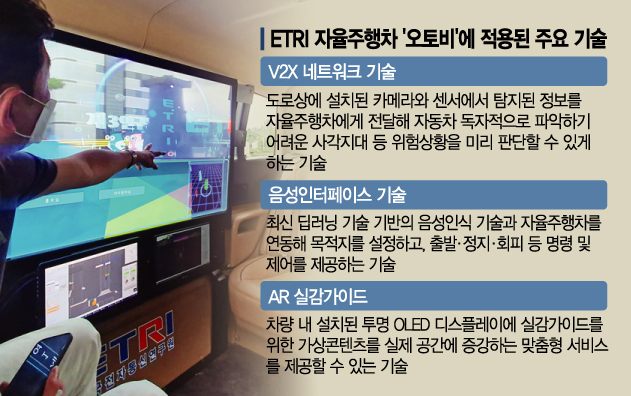
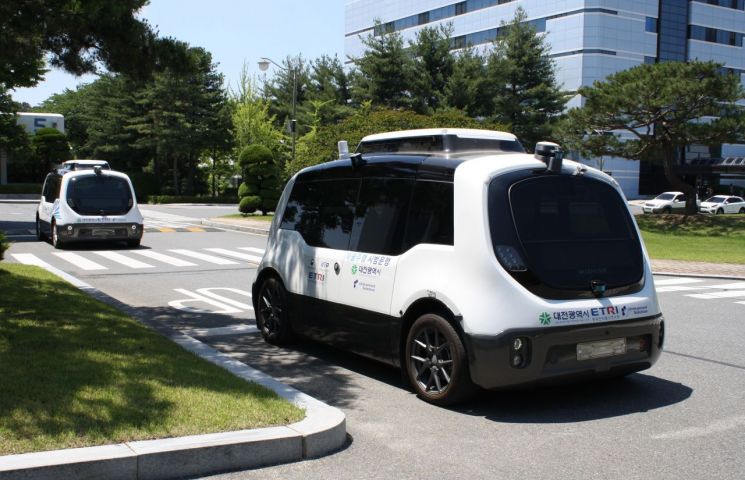
AutoVe, developed by ETRI, obtained Korea's first temporary autonomous driving operation permit in February this year and started a pilot shuttle bus service circulating researchers on the 9th. The AI algorithm applied to AutoVe processes information obtained from cameras and LiDAR sensors in real time to recognize the surrounding environment and autonomously create driving routes. Notably, it enhances safety by applying data-centric vehicle-to-everything (V2X) network technology, providing expanded situational awareness capabilities to autonomous vehicles.
Head Choi explained, "Self-autonomous driving relying solely on the vehicle's own recognition capabilities has limitations in perceiving external situations. When collaborative cognition is achieved through sensors installed on streetlights or traffic signals, it can observe more broadly and predict situations in advance." By expanding recognition capabilities through cameras and sensors installed in autonomous vehicles and external infrastructure, it can effectively respond to blind spots and construction zones. In 2019, the government also declared plans to complete Level 4 autonomous driving infrastructure (wireless communication networks between vehicles and roads, 3D high-precision maps, integrated control systems, road signs) by 2027 to commercialize fully autonomous driving on major roads for the first time in the world, along with legal and institutional arrangements.
Head Choi cited the AI training data, built on the largest scale domestically in the autonomous driving field, as the competitive edge of AutoVe's AI algorithm. Since 2017, ETRI has collected over 100,000 km of road traffic data and directly constructed seven types of autonomous driving AI training data (14 million cases), including recognition of traffic signals and tail lights, 2D and 3D multi-object recognition, and prediction of other vehicle movements, which were trained into AutoVe's AI. Head Choi explained, "A representative example is the tail light data, which is rare even globally. Through training on tail light data, the system can learn and judge whether a vehicle should go, stop, or avoid based on the flashing status of turn signals and brake lights."
The research team plans to focus on advancing AI algorithms over the next four years and intensify demonstration services from 2025, aiming to commercialize Level 4 autonomous vehicles by 2027. Head Choi said, "There are still many challenges to improving AI performance," citing the issue of negotiation between vehicles at non-signalized intersections as an example. He said, "At non-signalized intersections, drivers use hand signals and subtle cues to judge the situation, but autonomous vehicles have not yet been adjusted for this. We will improve the system in connection with laws and regulations by methods such as requiring complete stops or allowing vehicles to merge sequentially one by one."
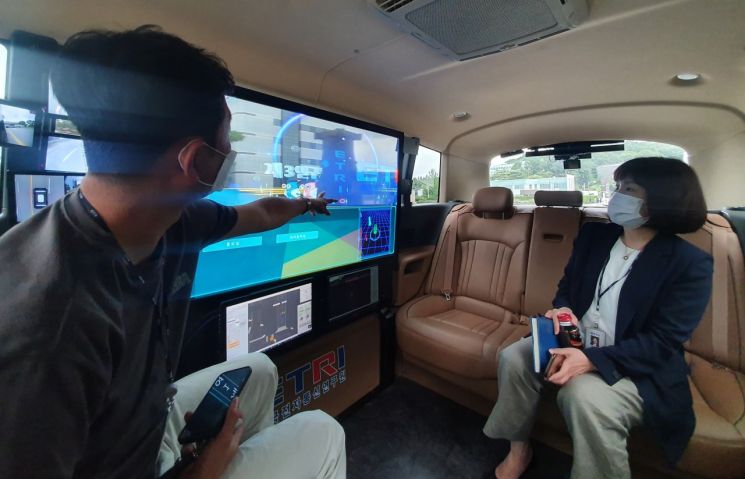 Chief of the Advanced Intelligence Robotics Research Division Choi Jeong-dan is boarding the Autobi and examining the OLED display equipped with AR immersive guide technology.
During the demonstration test process, it will also be examined whether Level 4 autonomous vehicles can provide 'last mile' services for vulnerable road users. Head Choi stated, "The goal is to support mobility in areas underserved by public transportation through autonomous driving technology." He added, "We plan to integrate autonomous driving technology into public services for vulnerable groups such as the elderly living in areas where commercialization is unlikely due to low profitability."
In the long term, plans are underway to expand the application of autonomous driving technology to various fields such as public safety and national defense. A representative example is the introduction of unmanned robotic patrol vehicles in cooperation with the National Police Agency to strengthen security in patrol-vulnerable districts. Head Choi predicted, "If patrol cars continuously circle designated areas unmanned, they will function as moving CCTV, providing crime prevention effects, and when summoned, the unmanned patrol car can also serve as a shelter."
© The Asia Business Daily(www.asiae.co.kr). All rights reserved.



















