Will the Summer Jeonse Crisis Recur as Seoul Move-in Volume Drops 30%
Seoul Apartment Jeonse Price Increase Hits 19-Week High
Rising Jeonse Prices in Dongjak-gu Due to Seocho-gu Reconstruction Relocation Demand
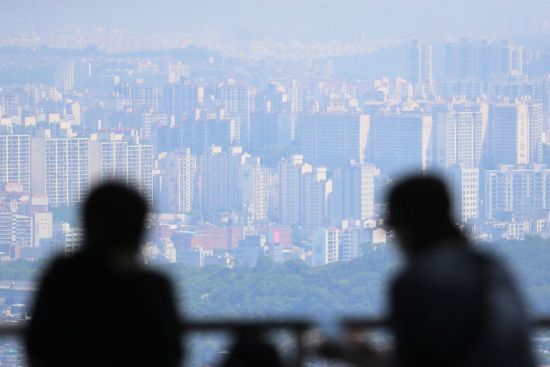 The photo shows an apartment complex viewed from Namsan, Seoul on that day.
 [Image source=Yonhap News]
[Asia Economy Reporters Kim Hyemin and Lim Onyu] The Seoul jeonse market, which had been quiet for a while, is showing signs of stirring again. Recently, as jeonse listings have decreased across Seoul, concerns have emerged that the jeonse crisis seen immediately after the implementation of the new Housing Lease Protection Act last year could reoccur. Jeonse prices in the Seocho-gu area, where reconstruction relocation demand has surged, are already rising uncontrollably. With the expected decrease in housing supply from June to September, there are also forecasts that instability in the jeonse market could potentially stimulate the sales market.
◆Seoul Jeonse: Sharp Decline in Listings Leads to Price Increase = According to the Korea Real Estate Board on the 21st, the apartment jeonse price increase rate in Seoul for the second week of this month rose by 0.03 percentage points from the previous week to 0.11%. This is the highest rate in 19 weeks.
Seoul apartment jeonse prices surged sharply immediately after the new lease law was implemented at the end of July last year but had barely stabilized through the winter off-season and the 2·4 supply measures. However, as jeonse listings in Seoul apartments fell below 20,000 units for the first time in five months, causing a supply-demand imbalance, the rate of increase has expanded again. This once again proves the correlation between the quantity of jeonse listings and price.
◆Reconstruction Relocation Demand Also Stimulates Nearby Jeonse Prices= In particular, large-scale reconstruction relocations are exacerbating supply shortages in surrounding areas. A representative example is the outskirts of Seocho-gu. In Seocho-gu, relocation demand is concentrated on about 5,000 households, including Banpo Jugong Complex 1 District 1, 2, and 4 Blocks (2,120 households), Block 3 (1,490 households), and Sinbanpo 18 and 21 Complexes (290 households). With limited new listings and rapidly increasing demand, the jeonse price increase rate in the Seocho-gu area is growing. According to Real Estate 114, the jeonse price increase rate in Seocho-gu, which was 0.04% at the end of last month, recently rose to 0.15%. The cumulative increase rate so far this month has reached 0.41%.
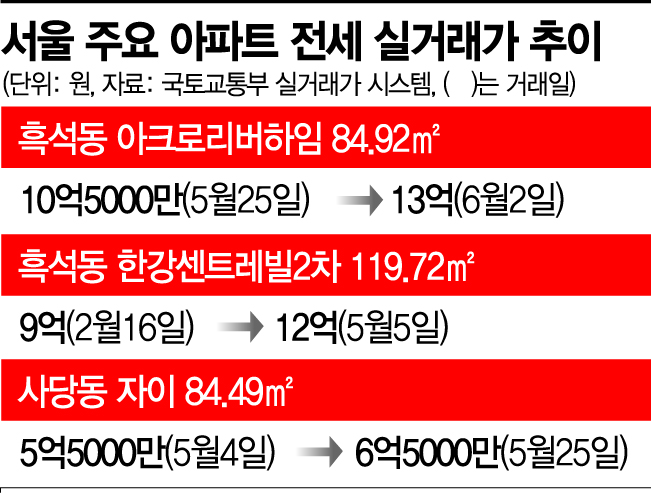
Reconstruction relocation demand is also pushing up jeonse prices in nearby Dongjak-gu. The jeonse price increase rate in Dongjak-gu, which was 0.05% at the end of last month, soared to between 0.16% and 0.19%. Record-high prices are also being reported. According to the Ministry of Land, Infrastructure and Transport’s real transaction price disclosure system, an 84.92㎡ (exclusive area) unit in Acro Riverheim, Heukseok-dong, Dongjak-gu, recorded a jeonse contract at 1.3 billion KRW on the 2nd of this month, a new high. This is 250 million KRW higher than the 1.05 billion KRW recorded on April 25. The jeonse price for a 119.73㎡ unit in Heukseok Hangang Centreville 2nd Complex in Heukseok-dong also jumped from 900 million KRW in February to 1.2 billion KRW in May, just three months later. Even the 84.49㎡ unit in Sadang Xi, Sadang-dong, which is over 20 years old, rose by 100 million KRW within a month.
◆Summer, When Even Move-ins Decrease, Is a Critical Point= Experts expect the jeonse shortage to continue for the time being, as the number of apartment move-ins in Seoul is also scheduled to decrease during the summer. According to a survey commissioned by Asia Economy to Zigbang, the expected number of apartment move-ins in Seoul from June to September over four months is only 10,752 households. This is a 30% (4,585 households) decrease compared to 15,337 households during the same period last year.
Besides the decrease in move-in volume, factors contributing to the summer jeonse crisis include landlords passing on increased property tax burdens due to official price hikes and demand waiting for 3rd New Town subscription. Yoon Jihae, senior researcher at Real Estate 114, said, "Despite the moving off-season ahead of the summer vacation period, jeonse prices have surged significantly due to relocation demand from redevelopment projects in the Gangnam area and an overall decrease in listings. Looking at Seoul as a whole, instability in the monthly rent and jeonse market is intensifying, and there are signs that non-homeowning tenants are moving toward buying, attempting to chase purchases."
© The Asia Business Daily(www.asiae.co.kr). All rights reserved.
![Clutching a Stolen Dior Bag, Saying "I Hate Being Poor but Real"... The Grotesque Con of a "Human Knockoff" [Slate]](https://cwcontent.asiae.co.kr/asiaresize/183/2026021902243444107_1771435474.jpg)
















