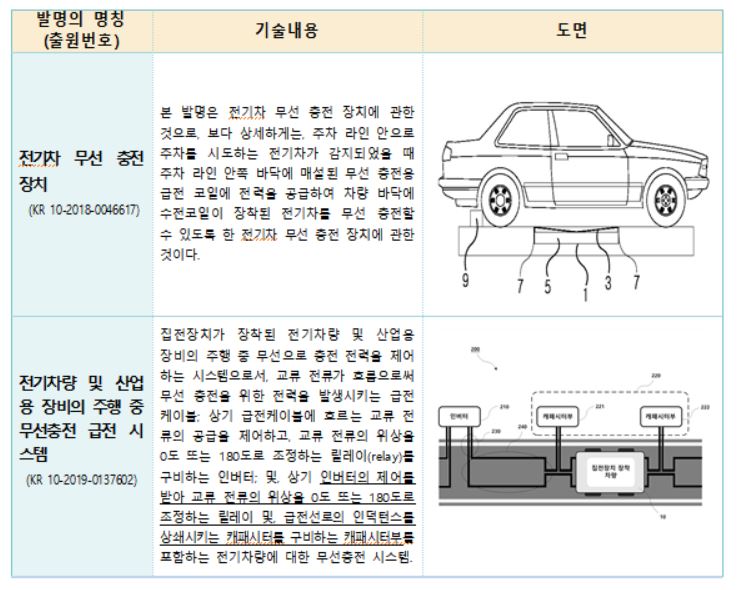
 Major patent application cases related to 'wireless charging road technology'. Provided by the Korean Intellectual Property Office
[Asia Economy (Daejeon) Reporter Jeong Il-woong] Next month, an OLEV (On-Line Electric Vehicle) bus equipped with wireless charging technology is scheduled to operate in the Daedeok Special Zone area of Yuseong-gu, Daejeon. The OLEV bus is a wireless charging electric vehicle developed by KAIST in 2009, designed to charge its battery through electric lines embedded in the road (wireless), enabling the vehicle to run.
The development of wireless charging road technology that charges vehicles while driving and related patent applications are increasing. Wireless charging roads are expected to play a role in promoting the popularization of electric vehicles by reducing the battery capacity of electric cars.
According to the Korean Intellectual Property Office on the 21st, a total of 299 patents related to wireless charging roads were filed from 2010 to 2019. This means an average of 29 wireless charging road-related patents were filed annually.
In particular, patent applications related to wireless charging roads, which were 10 in 2010, surged to 30 to 40 cases annually from 2014. This reflects the growing industry interest in charging technology as electric vehicles become more popular.
By technology, transmission and reception pad technology that aligns the coil positions of the road and electric vehicle accounted for the largest number of patent applications with 169 cases (56.6%).
Additionally, 60 patents (20%) were filed for technology to monitor charging of vehicles that do not stop and handle billing, 36 patents (12%) for electromagnetic field emission guide (magnetic shielding reduction) technology, and 34 patents (11.4%) for technology detecting foreign substances such as metal between coils were among the frequently filed technologies.
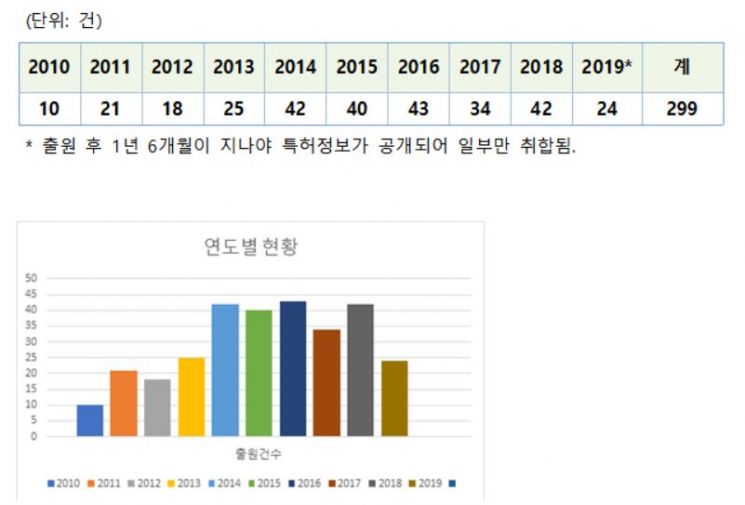 Data on wireless charging road technology patents filed in the past 10 years. Provided by the Korean Intellectual Property Office
Most of the filed technologies focus on improving wireless charging performance, and the increased charging performance is analyzed by the Korean Intellectual Property Office to be aimed at promoting commercialization by lowering facility installation costs.
Wireless charging patent applications are led by large corporations and research institutes such as Hyundai Motor Company with 46 cases, Korea Advanced Institute of Science and Technology (KAIST) with 12 cases, and LG Electronics with 7 cases.
Among small and medium-sized enterprises, Edone (8 cases) and Green Power (6 cases) have joined the ranks of wireless charging patent applicants, while foreign companies such as Qualcomm (11 cases), Auckland Uniservices (5 cases), and Toyota (2 cases) are also listed.
Chu Hyung-seok, an examiner at the Electrical Examination Division of the Korean Intellectual Property Office, said, “Wireless charging roads are likely to expand as a charging method not only for electric vehicles but also for various mobility devices such as unmanned delivery drones. In particular, wireless charging roads are a turning point for the electric vehicle market, and competition to secure patents is expected to become more intense in the future.”
© The Asia Business Daily(www.asiae.co.kr). All rights reserved.
![Clutching a Stolen Dior Bag, Saying "I Hate Being Poor but Real"... The Grotesque Con of a "Human Knockoff" [Slate]](https://cwcontent.asiae.co.kr/asiaresize/183/2026021902243444107_1771435474.jpg)
















