[Asia Economy Reporter Changhwan Lee] Recently, traffic accidents involving elderly drivers have increased by approximately 28,500 cases over four years. In response, although the government is strengthening driver’s license management, there are calls to also pay attention to technological solutions such as driver assistance systems that can help elderly drivers operate vehicles more safely.
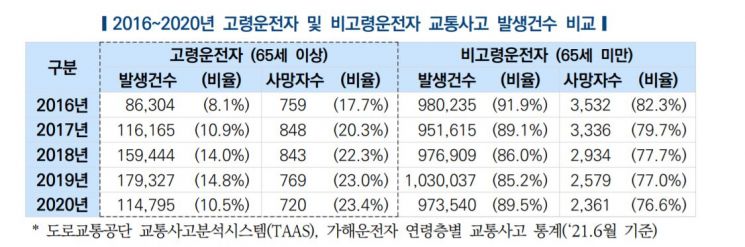
According to the industrial trend report by the Korea Automotive Technology Institute on the 21st, the proportion of licensed drivers aged 65 and older in South Korea has been increasing annually, from 8.0% in 2016 to 11.1% last year.
The number of traffic accidents caused by these elderly drivers reached 114,795 last year, accounting for 10.5% of all traffic accidents. This is a 2.4 percentage point increase compared to 8.1% in 2016.
Serious traffic accidents have also increased. Among traffic accident fatalities, cases where the perpetrator was an elderly driver (23.4%) have significantly risen compared to 17.7% in 2016.
As the issue of traffic accidents involving elderly drivers has emerged, the government has made cognitive ability assessments and traffic safety education mandatory when drivers aged 75 and older renew their licenses.
The renewal cycle has also been shortened from five years to three years, focusing on strengthening license management for elderly drivers. Many local governments also operate voluntary license surrender programs.
Limitations of Government Prevention Policies; Need to Focus on Technological Solutions
However, the report points out that even if the renewal cycle is shortened, it is difficult to prevent accidents if driving ability rapidly declines within one to two years, and the voluntary license surrender system is limited in effectiveness for cases where driving is unavoidable for livelihood.
Therefore, the institute argues that attention should be paid to technological solutions focusing on continuous prevention rather than periodic management.
For example, it is necessary to closely analyze the cognitive and behavioral characteristics and accident causes of vulnerable drivers, including elderly drivers, develop related advanced driver assistance systems (ADAS), and either mandate their installation or provide insurance and tax benefits when installed.
In fact, Japan operates a system that provides subsidies ranging from 20,000 to 100,000 yen when drivers aged 65 and older install ADAS such as pedestrian collision mitigation brakes and unintended acceleration suppression devices.
The institute believes it is necessary to design related policies keeping in mind not only elderly drivers but all vulnerable drivers in general.
Hojoong Lee, a senior researcher at the Korea Automotive Technology Institute, said, "Not all elderly drivers cause more accidents, so excessive administrative measures may raise fairness issues and negatively affect the self-efficacy of elderly people. Instead of limiting measures to a specific age group, it is necessary to review physical and mental factors that increase the likelihood of causing traffic accidents and design systems that support safe driving for all vulnerable drivers."
© The Asia Business Daily(www.asiae.co.kr). All rights reserved.
![Clutching a Stolen Dior Bag, Saying "I Hate Being Poor but Real"... The Grotesque Con of a "Human Knockoff" [Slate]](https://cwcontent.asiae.co.kr/asiaresize/183/2026021902243444107_1771435474.jpg)















