Full Return to School Allowed up to New Distancing Level 2... Regional Adjustments Possible
Kindergarten and Grades 1-2 Exempt from Density Limits up to New Distancing Level 3
Grade 12 Vaccinations from 3rd Week of July, Repeat Students Early August... Discussions Ongoing for Academy Instructors
Partitioned Cafeterias Fully Seated up to Level 2, Alternative Meals Provided from Level 3
Goal to Resume Normal Academic Activities like Experiential Learning and Discussions from October
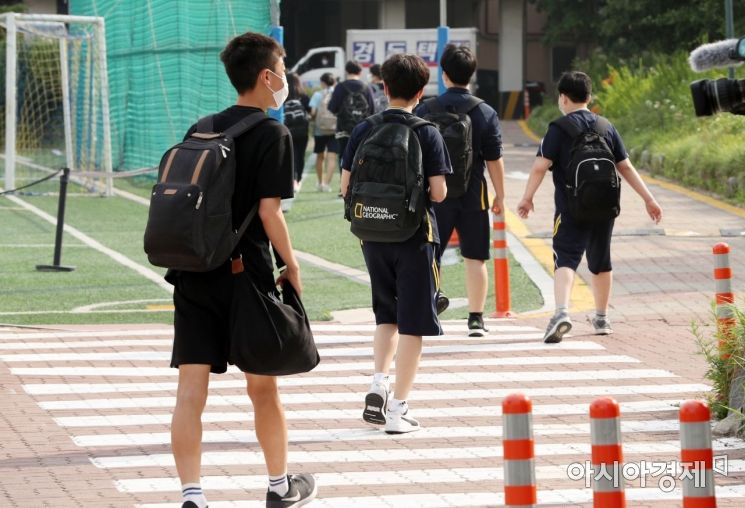 As the school density standard was raised from one-third to two-thirds, middle school students in the metropolitan area have increased attendance, and vocational high school students can now attend school every day. On the 14th, students were attending school at Jangpyeong Middle School in Dongdaemun-gu, Seoul. 2021.06.14 Photo by Joint Press Corps
[Asia Economy Reporter Han Jinju] The Ministry of Education will apply new school density standards from the second semester in accordance with the revised Level 4 social distancing plan. From the second semester, full attendance of all students will be allowed up to the new Level 2 social distancing (previously Level 2.5). Measures such as converting special classrooms and deploying modular classrooms will be promoted to alleviate overcrowded classes.
On the 20th, the Ministry of Education announced a phased implementation plan for full attendance in the second semester. The school density standards were also adjusted to align with the new social distancing criteria effective from July. The new school density standards will be applied starting from the second semester.
Full attendance up to previous Level 3... Kindergarten and Grades 1-2 in elementary school exempt from density limits
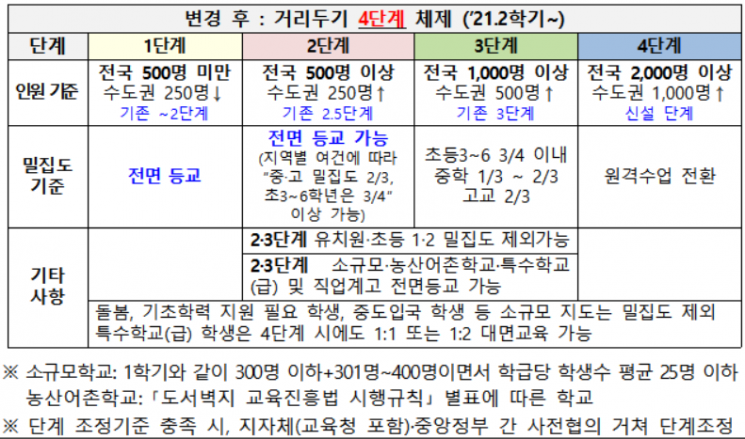
According to the revised social distancing plan, school density is as follows: ▲Level 1 (fewer than 500 nationwide confirmed cases) full attendance ▲Level 2 (500 or more nationwide cases) full attendance possible, with middle and high schools allowed up to 2/3 attendance and grades 3-6 in elementary school allowed up to 3/4 attendance depending on regional conditions ▲Level 3 (1,000 or more nationwide cases) attendance limited to within 3/4 for grades 3-6 in elementary school, 1/3 to 2/3 for middle school, and 2/3 for high school. From Level 4 (2,000 or more nationwide cases), remote classes will be implemented. The Ministry of Education will provide schools with about a one-week preparation period when social distancing levels are adjusted.
An official from the Ministry of Education said, "Depending on local infection situations, we plan to guarantee about two weeks for phased expansion or autonomous phased attendance by schools," adding, "We expect herd immunity to be possible from October and will actively seek ways to enable free classroom activities."
Kindergarten and grades 1-2 in elementary school are exempt from density limits even at the new Levels 2 and 3. Small-scale and rural schools, special schools, and vocational high schools can have full attendance at Levels 2 and 3. Additionally, small-group instruction for students needing care or basic academic support, and newly arrived immigrant students are excluded from density limits. Students in special schools or classes can have one-on-one or one-on-two face-to-face classes even at Level 4.
Full attendance is possible up to the new Level 2 (previously Level 2.5). The new social distancing levels are numerically one step lower than the previous ones; for example, the previous Level 3 required full remote classes, but from the second semester, attendance up to 2/3 is allowed. Even if full attendance becomes difficult like in the first semester, kindergarten and grades 1-2 in elementary school are excluded from density limits to allow daily attendance.
Vaccinations for Grade 12 students in the third week of July, repeat exam takers in early August... Meal-time quarantine management standards also established
During summer vacation, vaccinations will be administered to school staff, care personnel, Grade 12 students, and repeat exam takers preparing for college entrance exams. The order is as follows: ▲Kindergarten, elementary, and middle school staff and care personnel, daycare centers (July-August) ▲Grade 12 students and high school staff (third week of July onward) ▲After-school instructors for elementary, middle, and high schools (July-August) ▲College entrance exam candidates (early August). The Ministry of Education is consulting with the Korea Disease Control and Prevention Agency regarding priority vaccinations for university admissions officers and arts and physical education academy instructors. Vaccinations for repeat exam takers, including those retaking the college entrance exam, will be planned by selecting candidates who take the September mock CSAT (College Scholastic Ability Test).
Vaccination plans for students other than Grade 12 have not yet been finalized. In South Korea, Pfizer vaccinations are currently authorized only for those aged 16 and above. An official from the Ministry of Education said, "The Ministry of Food and Drug Safety is reviewing a proposal to lower the authorized age for Pfizer vaccinations to 12 years old," adding, "An expert group is reviewing whether to change the authorized age, and once a conclusion is reached, we will discuss it together."
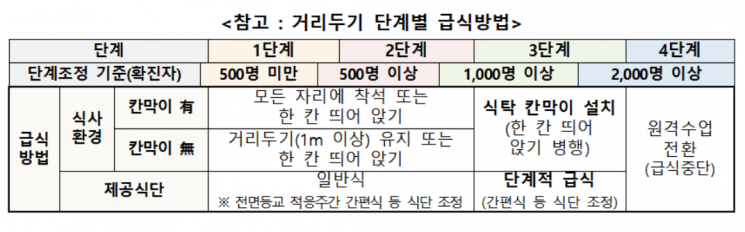
Parents are concerned about the high risk of infection during meal times when full attendance resumes. In response, the Ministry of Education also announced quarantine management measures for meal times according to social distancing levels. In cafeterias with partitions, seating is allowed at all seats up to Level 2. In cafeterias without partitions, social distancing of 1 meter or seating with one seat apart is required up to Level 2.
For the first two weeks after full attendance begins, simple meals will be provided. This is to allow an adaptation period for schools to find the necessary meal service methods. Simple meals can also be provided from Level 3 social distancing. Partitions must be installed in cafeterias, and seating with one seat apart is mandatory. The Ministry of Education is also considering switching to or combining classroom meal distribution if social distancing is difficult.
The Ministry of Education will additionally deploy 10,000 quarantine personnel such as health teachers and meal assistance staff. In the first semester, 49,942 personnel were supported, and using supplementary budgets, support will be increased to up to 60,000. Guidelines covering the scope and work rules for school quarantine personnel will be announced early next month.
Flexible academic operations allowed in overcrowded schools
While full attendance is the principle, the Ministry of Education will allow flexible academic operations by schools or education offices after gathering opinions from school members. It is also possible to create detailed criteria by region within the density limits for each level. For example, up to Level 2 social distancing, schools with more than 1,000 students (average 30 students per class) may apply up to 3/4 density.
In overcrowded classes, flexible academic operations such as partial remote classes tailored to the characteristics of each school level are possible. For example, attending school four days and remote classes one day, or flexibly adjusting class hours. Additionally, special classrooms such as multipurpose rooms may be converted into regular classrooms, and modular school buildings will be deployed. For modular classrooms, schools with demand will be surveyed and introduced starting as early as the second semester where possible. Improvements related to overcrowded classes will be announced in July through the 'Comprehensive Education Recovery Plan.'
An official from the Ministry of Education said, "When overcrowded classes are split, new classes are created requiring additional teachers, so we plan to secure contract teachers to support homeroom and teaching," adding, "We also plan to reflect the increase in classes due to modular classrooms and teacher placement in the mid- to long-term teacher supply and demand plan."
Furthermore, from October, experiential activities, discussion classes, experiments, and practical training will be possible. The Ministry of Education plans to normalize school educational activities from October, considering thorough quarantine measures and vaccination status. Guidelines related to attendance, evaluation, and records, as well as infection prevention management for elementary, middle, and special schools, will be revised and announced early next month.
Deputy Prime Minister and Minister of Education Yoo Eun-hye said, "All related departments including the education sector and the Korea Disease Control and Prevention Agency will work together to prepare for full attendance of all students in the second semester without disruption, and we ask all citizens to cooperate with vaccination and compliance with quarantine rules with the heart of a parent."
© The Asia Business Daily(www.asiae.co.kr). All rights reserved.
![Clutching a Stolen Dior Bag, Saying "I Hate Being Poor but Real"... The Grotesque Con of a "Human Knockoff" [Slate]](https://cwcontent.asiae.co.kr/asiaresize/183/2026021902243444107_1771435474.jpg)


















