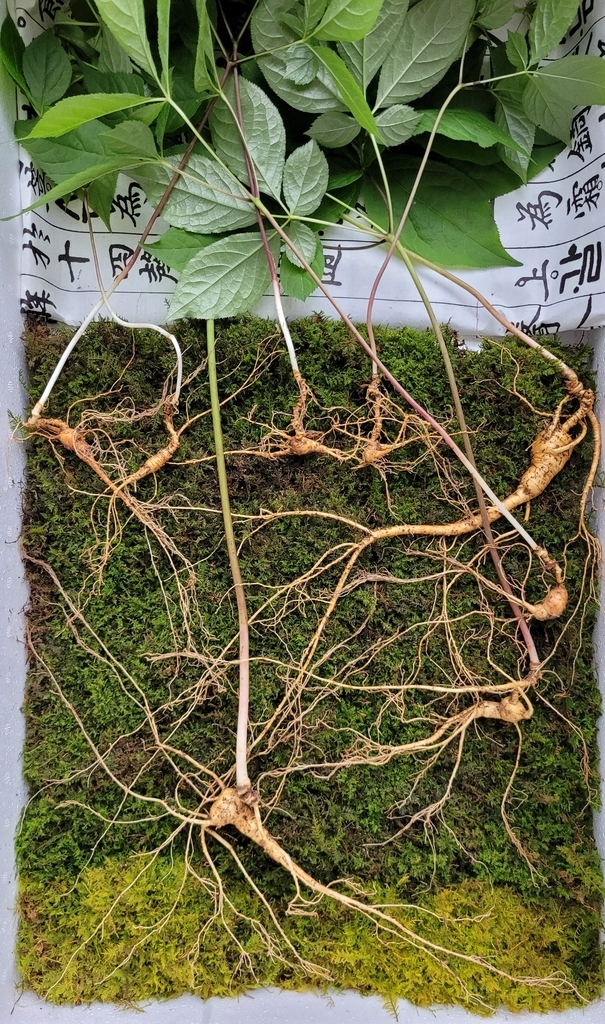
 A family of thousand-year-old wild ginseng discovered in Jirisan, Hamyang-gun, Gyeongnam. Photo by Korea Traditional Simmani Association
[Asia Economy Reporter Seoyoung Kwon] A family of wild ginseng spanning four generations was discovered in the foothills of Jirisan Mountain in Hamyang-gun, Gyeongnam, drawing significant attention.
On the 20th, the Korea Traditional Simmani Association announced that herbalist Jeong Mo (65), who lives in Hamyang, requested an appraisal of eight wild ginseng roots he found on the 17th in the foothills of Jirisan Mountain in Macheon-myeon. Wild ginseng (Cheonjong Sansam) refers to ginseng that has naturally grown for over 50 years, and the ginseng Jeong discovered was identified as a so-called "family ginseng" passed down through four generations.
The eight wild ginseng roots measured a total length of 52 cm and weighed 86 g in total. Among them, the main root weighed about 37 g and was estimated to be over 100 years old, while the remaining five secondary roots were also estimated to be over 20 years old. Notably, the roots had a deep yellow color, finely detailed heads, and an outstanding form, leading to a final appraisal value of 120 million KRW.
Earlier, on May 7, a wild ginseng estimated to be over 100 years old was found at an altitude of 700 meters on Deogyusan Mountain in Hamyang-gun, Gyeongnam. Herbalist Lee Mo (62) discovered this ginseng, which had a root length of 63 cm and weighed 68 g, with an appraisal value set at 90 million KRW.
Additionally, on May 22, herbalist Seok Mo (59) harvested an extra-large wild ginseng measuring 1 meter in length and weighing 240 g on the 80% ridge line of Gamaksan Mountain. This ginseng was classified as Injong Sansam, with the main root estimated to be over 100 years old as well.
In response, Jeong Hyeongbeom, president of the Korea Traditional Simmani Association, explained, "This year, appraisal requests for large wild ginseng weighing over 1 nyang have been made more than five times, indicating an increase in wild ginseng discoveries," adding, "It seems that wild ginseng, which could not adapt to last year's heavy rain and snowfall, is growing well due to sufficient moisture supply."
© The Asia Business Daily(www.asiae.co.kr). All rights reserved.

















