37-Year-Old Godeok Jugong 9 Complex Phase 1 Fails Safety Inspection, Reconstruction Denied
Complexes Continue to Face Setbacks in Feasibility Reviews Following Mokdong New Town
However, Prices of Reconstruction Complexes Still Rising Amid Supply Policy Uncertainty
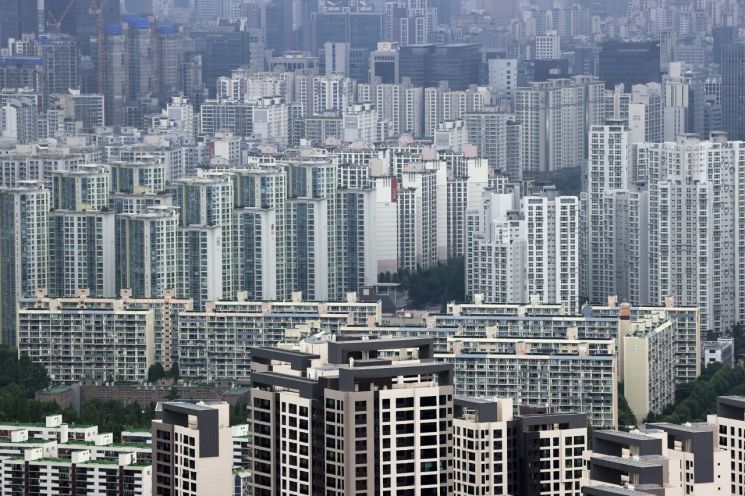 View of apartments in the Gangnam area of Seoul as seen from Daemosan Mountain, Seoul. 2021.6.11 [Image source=Yonhap News]
[Asia Economy Reporter Lim On-yu] The Godeok Jugong 9 Complex in Myeongil-dong, Gangdong-gu, Seoul, which is in its 37th year since completion, has been ruled ineligible for reconstruction. Although Seoul Mayor Oh Se-hoon pledged to revitalize reconstruction, many aging large complexes still cannot even establish maintenance plans due to the high barriers of safety inspections. Despite proposals for system improvements, the Ministry of Land, Infrastructure and Transport has remained silent, seemingly putting the brakes on Mayor Oh’s 'speedy housing supply' amid rising housing prices.
Godeok Jugong 9 Complex Also Faces Setback in Safety Inspection Review: "Standards Are Out of Touch with Reality"
According to the maintenance industry on the 20th, the Korea Institute of Civil Engineering and Building Technology announced on the 11th that the safety inspection appropriateness review for the Godeok Jugong 9 Complex reconstruction resulted in a maintenance judgment of grade C (62.70 points) to Gangdong District Office. Previously, this apartment passed the preliminary safety inspection in February 2018 and received a conditional reconstruction grade D (51.29 points) in the first detailed safety inspection (private institution) last December.
For grade D, an appropriateness review by public institutions (Korea Institute of Civil Engineering and Building Technology and Korea Institute of Safety Management) is required. As a result, the final score increased by more than 10 points, making reconstruction impossible. Specifically, this apartment received grade C in all categories including structural safety, residential environment, and cost analysis, in addition to building finishing and equipment aging (grade D).
The more than 10-point difference between the first inspection and the appropriateness review has caused significant dissatisfaction among residents hoping for reconstruction. An owner of Godeok Jugong 9 Complex said, "We are preparing a collective complaint to Gangdong District Office, the Ministry of Land, Infrastructure and Transport, and the Korea Institute of Safety Management to verify whether the appropriateness review results were appropriate."
Following Mok-dong 9 and 11 Complexes in Yangcheon-gu, Seoul, the reconstruction of Godeok Jugong 9 Complex was also blocked at the appropriateness review stage, raising criticism that the strengthened safety inspection standards are unrealistic. In 2018, the Ministry of Land, Infrastructure and Transport strengthened reconstruction safety inspection standards by focusing more on structural stability (20%→50%) than residential environment (40%→15%). As a result, even if the quality of life for residents deteriorates significantly due to aging, reconstruction becomes difficult if there are no structural problems.
Mayor Oh, who pledged to revitalize reconstruction, has requested system improvements from the Ministry of Land, Infrastructure and Transport since taking office. However, the possibility of improvement is currently low. At a hearing last month, Minister of Land, Infrastructure and Transport Noh Hyung-wook said, "Safety inspections are a means to verify the necessity of reconstruction based on structural safety and degree of aging," and added, "It is necessary to be cautious about relaxing standards for the sake of project activation, which is contrary to the original purpose of the system." It is also known that this discussion did not proceed during a recent meeting with Mayor Oh regarding housing supply activation.
As complexes fail to pass the first hurdle of safety inspections one after another, the atmosphere among reconstruction promotion complexes has also cooled. For example, Sangye Jugong 6 Complex in Sangye-dong, Nowon-gu, Seoul, received grade D (54.14 points) in the first detailed safety inspection but decided to postpone the appropriateness review until system improvements are made. A Ministry of Land, Infrastructure and Transport official said, "We plan to hold further consultations on easing reconstruction safety inspections considering market stability."
Reconstruction Barriers Remain, but Housing Prices Continue to Rise Amid Shaken Supply Measures
Nevertheless, housing prices in Seoul continue to soar amid expectations for reconstruction revitalization. According to the Korea Real Estate Board’s weekly apartment trend report, the apartment price increase rate in Seoul for the second week of June was 0.12%, marking the highest increase in one year and six months since the third week of December 2019.
The upward trend in Seoul housing prices had slowed after the announcement of the 2·4 Plan, which included additional supply plans for new towns, but recently has recorded a sharp V-shaped rise. The cancellation of the Gwacheon Government Complex supply plan due to resident opposition and setbacks in the supply of Taereung Golf Course and Yongsan Camp Kim have instead heightened market expectations for rising housing prices.
With Mayor Oh promising to revitalize maintenance projects, the rise is particularly steep in reconstruction complexes. Despite increasing regulatory intensity by designating areas such as Apgujeong-dong, Mok-dong, Yeouido-dong, and Seongsu-dong?where reconstruction and redevelopment are underway?as land transaction permission zones, the result has been to stimulate housing prices in the outskirts. In fact, Nowon-gu, where mid-to-low priced reconstruction complexes are concentrated, rose by 0.25% in the second week of June, maintaining the highest increase rate in Seoul for 10 consecutive weeks.
A Korea Real Estate Board official said, "Overall, the decrease in listings, price increases in some areas, and record-high transactions in reconstruction complexes have expanded the rise in apartment prices."
© The Asia Business Daily(www.asiae.co.kr). All rights reserved.
![Clutching a Stolen Dior Bag, Saying "I Hate Being Poor but Real"... The Grotesque Con of a "Human Knockoff" [Slate]](https://cwcontent.asiae.co.kr/asiaresize/183/2026021902243444107_1771435474.jpg)















