Bank of Korea 'Overseas Economic Focus'
Recent Surge in Chinese Producer Prices: Background and Ripple Effects
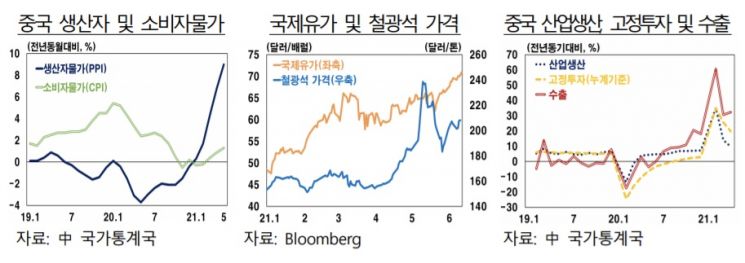
[Asia Economy Reporter Kim Eunbyeol] Amid the recent sharp rise in China's Producer Price Index (PPI), an analysis suggests that if the Chinese government passes on the PPI increase to export prices of manufactured goods considering corporate profits, it could act as a factor expanding global inflation.
On the 20th, the Bank of Korea stated in its 'Overseas Economic Focus' report, "The upward trend in China's PPI is expanding due to supply-demand imbalances in iron ore, crude oil, and other commodities," adding, "Since the PPI increase can spread to global inflation through export prices, continuous monitoring is necessary."
China's PPI growth rate surged 9.0% year-on-year last month, marking the highest level since September 2008 (9.1%). The National Bureau of Statistics of China estimated that the base effect from last year's PPI decline is about 3.0 percentage points. The supply-demand imbalance in iron ore, crude oil and other commodities led to a sharp rise in international raw material prices, and the Chinese economy maintained solid growth centered on manufacturing.
The Bank of Korea noted that although costs have risen, since Chinese authorities aim to keep the inflation target around 3% and strive to stabilize consumer prices, it is unlikely that cost increases will be easily passed on to prices. Therefore, it analyzed that profitability could weaken, especially in industries highly dependent on raw materials such as automobiles and shipbuilding, leading to deteriorating profitability for Chinese companies.
Furthermore, it pointed out that if the PPI increase is passed on to export prices to preserve corporate profits, it could act as a factor expanding global inflation. The Bank of Korea added, "Recently, the authorities' acceptance of yuan appreciation to stabilize raw material import prices could also lead to an increase in export prices."
According to Standard Chartered, the correlation coefficient between the U.S. consumer price index and China's producer price index is about 0.61, which is high, especially for the U.S., where the import share of Chinese goods is large. This is higher compared to other countries such as India (0.53), Australia (0.33), and Korea (0.17).
© The Asia Business Daily(www.asiae.co.kr). All rights reserved.
![Clutching a Stolen Dior Bag, Saying "I Hate Being Poor but Real"... The Grotesque Con of a "Human Knockoff" [Slate]](https://cwcontent.asiae.co.kr/asiaresize/183/2026021902243444107_1771435474.jpg)















