Representative Song Young-gil Passes Real Estate Policy Test
[Asia Economy Reporter Park Cheol-eung] The Democratic Party of Korea has adopted a party resolution to limit the imposition of comprehensive real estate tax to the top 2% of publicly announced land prices. Although consultations with the government and opposition parties will follow, the likelihood of implementation is high. Currently, the standard is set at 900 million KRW, but going forward, even if housing prices rise, only a certain proportion will be subject to the comprehensive real estate tax.
Capital gains tax exemption criteria for single-homeowners will also be raised from 900 million KRW to 1.2 billion KRW.
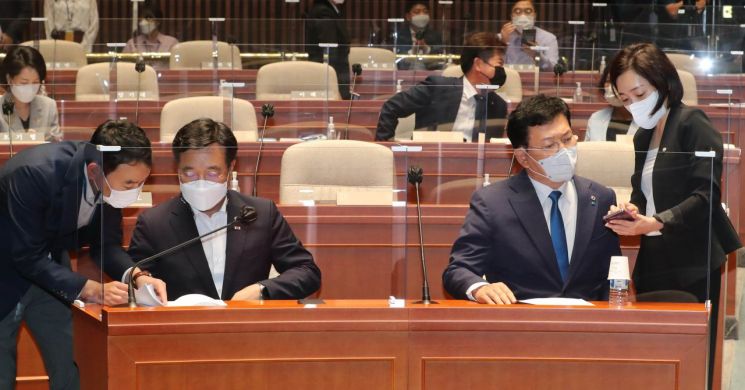
On the 18th, the Democratic Party held a policy members' meeting to discuss and vote on the reform plans for the comprehensive real estate tax and capital gains tax, ultimately deciding on this course. Within the party, there were significant concerns that this might send unstable signals to the real estate market, but the leadership, including Representative Song Young-gil, persuaded members by emphasizing the relief of burdens on single-homeowners.
The exact ratio of approval and opposition was not disclosed, and it is reported that only some leaders, including Representative Song, have confirmed the results. Therefore, there remains a possibility of internal dissent in the future.
Upon taking office early last month, Representative Song prioritized public livelihood and activated a special real estate committee. He appointed Representative Kim Jin-pyo, who is considered relatively moderate, as the committee chair, signaling an early direction toward easing tax and loan regulations.
Regarding the comprehensive real estate tax, although some suggested using 1.2 billion KRW as the standard, the committee’s proposal to limit it to the top 2% of publicly announced land prices was adopted. This corresponds to a publicly announced price of over 1.1 billion KRW, which is expected to translate to a market transaction price of over 1.5 billion KRW.
This means that single-homeowners will see a reduction in their tax burden. The raised capital gains tax threshold also lowers the burden on those who are not multi-homeowners, reducing the tax paid on profits from buying and selling homes.
The Democratic Party aims to impose heavier taxes on multi-homeowners while easing the burden on single-homeowners. Representative Song has stated that even with the easing of the comprehensive real estate tax, the reduction in tax revenue will not be significant, and that taxes collected from the top 2% will be used to contribute to the supply of affordable housing for ordinary citizens.
From Representative Song’s perspective, he has overcome a crisis that could have dealt a fatal blow to his leadership had the proposal been rejected. However, the divided opinions within the party may leave aftereffects in some form. In particular, the nondisclosure of the approval ratio increases the likelihood of rumors and speculation.
© The Asia Business Daily(www.asiae.co.kr). All rights reserved.
![Clutching a Stolen Dior Bag, Saying "I Hate Being Poor but Real"... The Grotesque Con of a "Human Knockoff" [Slate]](https://cwcontent.asiae.co.kr/asiaresize/183/2026021902243444107_1771435474.jpg)
















