"Financial Institutions' Internal Controls Should Encourage Incentives Rather Than Punishments"
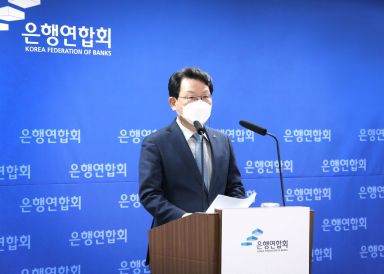
[Asia Economy Reporter Jin-ho Kim] Kim Kwang-soo, Chairman of the Korea Federation of Banks, stated on the 18th, "We will push to jointly prepare improvement measures for internal control systems with other financial sectors in the second half of this year and propose them to the financial authorities."
Chairman Kim made these remarks while attending the special policy seminar titled "Improvement Directions for Internal Control Systems of Domestic Financial Companies," held at the Bankers Hall in Myeong-dong, Seoul.
Kim said, "The recent problems occurring in the banking sector's internal control systems happened in a situation where legal standards were unclear and there were no similar precedents. Considering the principles of clarity and predictability, it is desirable to approach this from the perspective of system improvement rather than disciplinary action."
During the seminar's topic presentation, it was pointed out that the financial authorities should induce financial companies' obligation to establish internal controls through incentives rather than punishment. The policy suggestion emphasized that encouraging voluntary compliance is more effective for securing the effectiveness of internal control systems. It was also stated that when administrative sanctions are imposed based on internal control violations, clear legal grounds and sanction standards must be established.
Professor Lim Jeong-ha of the Seoul National University of Science and Technology Law School first reviewed that internal control under the current governance law is a form of self-regulation, then proposed four measures to secure the effectiveness of self-regulated internal control.
First, she said that internal control composition and operation plans should be prepared to fit the individual characteristics of financial companies. Next, she emphasized that the supervisory authorities' role should focus more on suggesting directions for internal control improvement rather than sanctions. In particular, when imposing administrative sanctions due to internal control violations, such violations should be equivalent to legal violations or administrative obligations arising from dispositions, and clear legal grounds and sanction standards must be established.
Furthermore, to secure the effectiveness of internal control, it was suggested to provide incentive effects (such as incentives related to inspections and sanctions) for building internal control systems. Professor Lim said, "Incentives should be given when financial companies establish and effectively operate reasonable information and reporting systems and internal control systems."
Professor Yoon Seung-young of Hankuk University of Foreign Studies Law School emphasized "the duties and responsibilities of directors regarding internal control under company law." Referring to U.S. precedents, Professor Yoon proposed ten specific criteria (guidelines) to judge directors' monitoring duties.
Specifically, cases of directors' monitoring duty violations were categorized into four types: ▲ tacit complicity in significant illegal acts ▲ failure of supervisory reporting systems for important company operations, among others. Cases not considered violations of monitoring duties were classified into three types: ▲ managerial risks ▲ failure to recognize illegal acts despite implementation of internal control systems, etc. Then, ten items such as whether preventive standard procedures were established and whether monitoring bodies were designated were presented as criteria to judge directors' monitoring duties who need to improve internal controls.
The final presenter, Attorney Kim Si-mok of Law Firm Yulchon, pointed out problems with the current governance law and recent sanction decisions through his presentation titled "Review of the Financial Company Governance Act Amendment Bill."
Attorney Kim said, "The financial authorities have recently sanctioned financial companies for 'not establishing effective internal control standards' in cases where violations of internal control standards were an issue. This not only contradicts the purpose of enacting the governance law but also goes against the interpretation of the current governance law," sharply criticizing the situation.
© The Asia Business Daily(www.asiae.co.kr). All rights reserved.
![Clutching a Stolen Dior Bag, Saying "I Hate Being Poor but Real"... The Grotesque Con of a "Human Knockoff" [Slate]](https://cwcontent.asiae.co.kr/asiaresize/183/2026021902243444107_1771435474.jpg)















