After FOMC Meeting Results Announcement, Dollar Strengthens Sharply for Second Day
Gold and Silver at Lowest Since April... Emerging Markets Face Increased Inflation Pressure
[Asia Economy Reporter Park Byung-hee] After the Federal Open Market Committee (FOMC) meeting, the dollar showed a sharp rally for two consecutive days, shaking the global financial markets. Due to the strong dollar, commodities and gold prices, which had been soaring, could not avoid a downward trend. Investors who had invested in commodities and gold as inflation hedging tools fell into a panic state. The global stock market appeared confused and unsettled by the FOMC meeting results.
◆ Commodities hit hard by the strong dollar = The dollar index, which reflects the relative value of the dollar against major currencies such as the euro, pound, and yen, rose 0.6% on the 16th (current time) following the FOMC meeting results and increased by 0.87% on the 17th. A foreign news agency reported that the dollar index rose 1.8% over two days, marking the largest two-day gain this year.
The dollar sharply strengthened as the Federal Reserve (Fed), the U.S. central bank, was assessed to have adopted a more hawkish stance at the FOMC. There is also an evaluation that the central bank’s monetary policy stance is entering a reset phase, causing significant turbulence in the commodity market due to the strong dollar.
On the 17th at the New York Mercantile Exchange (NYMEX), August delivery gold futures prices plunged 4.7% ($86.60) per ounce from the previous day, closing at $1,774.80, the lowest since April 30. Silver futures prices also fell 7%, closing at $25.86, marking the lowest level since April 20.
Copper futures closed down 4.7% at $4.18 per pound. Platinum and palladium also plunged 7.6% and 11%, respectively. Grain prices showed weakness as well, with corn futures falling 4%. Bloomberg reported, "Soybean futures prices have dropped more than 20% from the May peak, giving back all gains made this year."
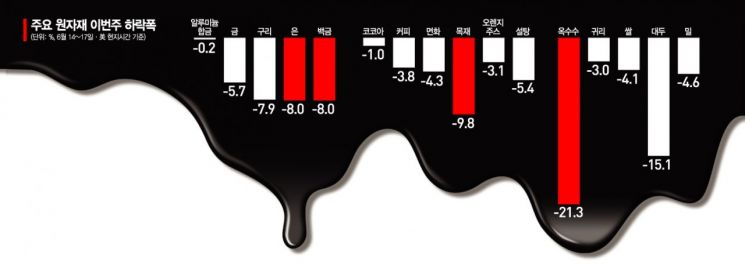
The Chinese government’s announcement to release commodity reserves into the market also dealt a blow to the commodity market. On the 16th, the Chinese government announced it would release major commodity reserves such as aluminum and copper to stabilize prices.
Bloomberg forecasts that commodity prices will show varying trends depending on the item. Considering the economic recovery following the easing of COVID-19 lockdown measures, the decline in energy and industrial commodity prices is expected to be temporary. On the other hand, some commodities that had risen due to monetary policy influences are likely to face inevitable declines.
Jason Bloom, investment strategist at Invesco, said, "I believe this is the early phase of a long-term boom similar to the commodity supercycle from the late 1990s to 2008," and predicted that commodity prices will continue to rise in the long term. He added, "The Fed’s hawkish stance is unrelated to commodity supply shortages, and while China’s release of reserves may cause short-term price declines, China cannot control the commodity market."
Michael Cuoco, head of the hedge fund division at StoneX Group, explained, "The FOMC and Chinese government’s influence has triggered a risk-averse sentiment," adding, "The central bank’s stimulus measures that had driven commodity prices up are now being reset."
◆ "Strong dollar causes disproportionate pain to emerging markets" = The decline in commodity prices could ease inflationary pressures. However, if the strong dollar trend continues, inflationary pressures in emerging markets are expected to intensify. A strong dollar leads to weaker emerging market currencies, which in turn raises import prices in those countries.
The Wall Street Journal (WSJ) diagnosed that the strong dollar ultimately reflects the economic boom of the U.S., which accounts for a quarter of the global economy, and this could cause disproportionate pain to some emerging markets. The U.S. economic boom means increased U.S. imports and repatriation of dollar funds to the U.S., which can lead to higher borrowing costs and inflation. Accordingly, central banks in Russia, Brazil, and Turkey have preemptively raised their benchmark interest rates.
Elvira Nabiullina, Governor of the Bank of Russia, said, "We maintained low benchmark interest rates for quite some time to avoid clipping the wings of the economic recovery," adding, "Given the changed environment and inflation risks, it is now time to raise the benchmark interest rate."
© The Asia Business Daily(www.asiae.co.kr). All rights reserved.
![Clutching a Stolen Dior Bag, Saying "I Hate Being Poor but Real"... The Grotesque Con of a "Human Knockoff" [Slate]](https://cwcontent.asiae.co.kr/asiaresize/183/2026021902243444107_1771435474.jpg)
















