Security guards 90% subcontracted and indirectly employed
3-6 month ultra-short-term contract practice
Service companies strictly 'Eul' in relations with residents
Hard to appeal unfairness despite abuse
Experts say "Employment structure in security industry needs improvement"
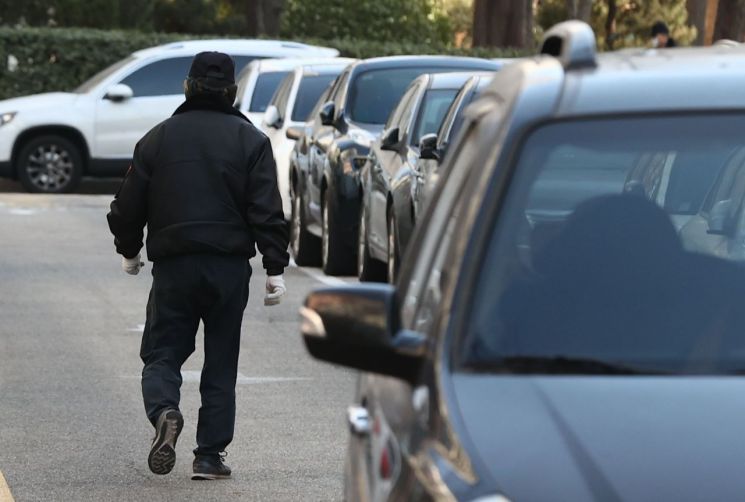 A security guard is working at an apartment complex in Seoul. This is not directly related to the article.
 [Image source=Yonhap News]
[Asia Economy Reporter Lim Juhyung] "I am really happy to be able to work again.", "Thank you so much to the residents who helped us."
The security guards of Junggye Green Apartment in Nowon-gu, Seoul, who were notified of their dismissal via text message, held a press conference on the 16th to share their feelings about reinstatement. Thanks to the continuous protests by the apartment residents, the security guards were able to return to their workplace.
The so-called 'text message dismissal incident' was resolved amicably, but concerns remain that the issue of power harassment against apartment security guards continues. Due to the complex subcontracting structure, security guards, who are inevitably in a vulnerable 'Eul' position, have to endure poor working conditions and power harassment. Experts advise that reform is needed in the labor structure of the security industry, where indirect employment and short-term contracts have become customary.
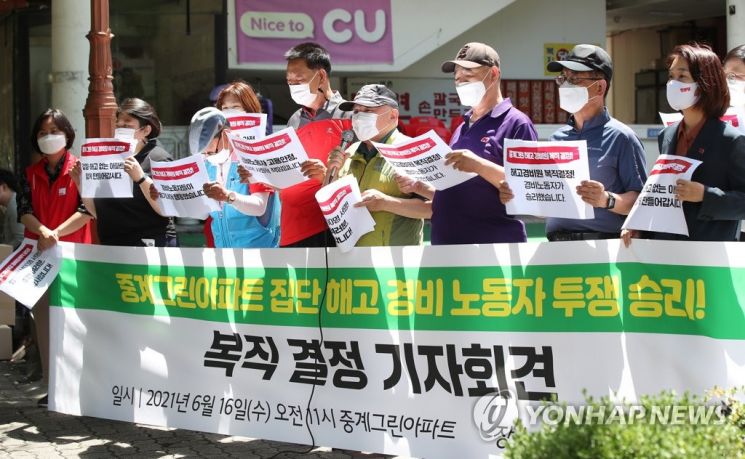 On the morning of the 16th, a security guard is speaking at a press conference for the reinstatement of dismissed security guards held at the Junggye Green Apartment complex in Nowon-gu, Seoul. / Photo by Yonhap News
◆16 Apartment Security Guards Fired with 'Just One Text'
On April 29, 16 security guards at Junggye Green Apartment received a text message from the newly changed apartment management service company stating, "Unfortunately, we cannot continue working together~^^." This was effectively a dismissal decision made with just one text message.
Afterwards, the security guards began protests such as hanging banners on balconies demanding employment succession and organizing signature campaigns. The apartment residents actively supported these protests. It was reported that 1,463 of the 3,481 households in Junggye Green Apartment participated in the signature campaign demanding employment succession for the security workers. The Residents' Representative Council also submitted a petition to Nowon District Office accusing the case as an example of power harassment.
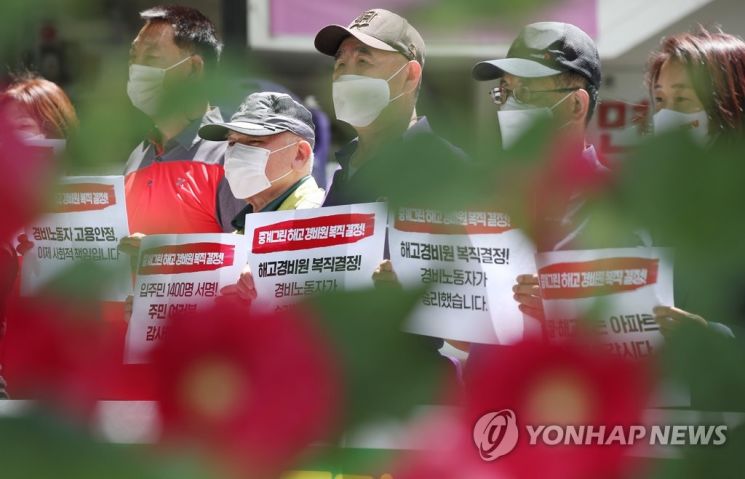 The reinstatement of security guards at Junggye Green Apartment who were notified of their dismissal via text message has been agreed upon. / Photo by Yonhap News
As the controversy grew, Nowon District Office intervened and held a tripartite agreement ceremony with the security guards and the service company. The service company apologized for notifying the security guards of their dismissal via text message and agreed to reinstate six of the 16 dismissed security guards who wished to return. They also agreed to guarantee employment contracts for more than one year.
◆90% of Security Guards Nationwide Are Indirectly Employed... Difficult to Resist Power Harassment
This is not the first case of apartment security guards suffering from unfair power harassment. They face power harassment not only from the contracting companies that employ them but also from residents.
Recently, it was revealed that a resident of an apartment in Mapo-gu, Seoul, had for years forced security guards to perform various chores such as parcel delivery and patrolling smoking areas, and verbally abused them with phrases like "Bark like a dog," sparking public outrage.
In May of last year, a security guard who had been continuously harassed by a resident tragically took their own life, causing shock.
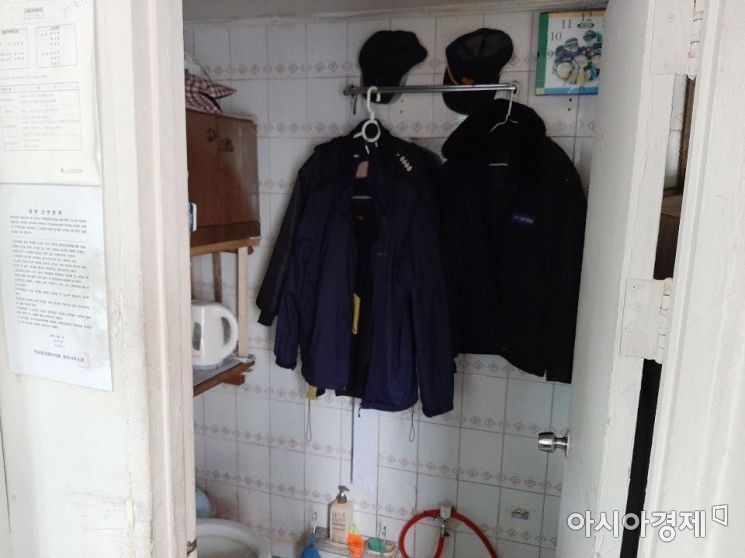 The interior of the security office where the security guard, who took extreme measures due to continuous abuse from residents last year, was working / Photo by Juhyung Lim skepped@
In the case of the Junggye Green Apartment text dismissal incident, it is pointed out that without the support of residents who participated in the signature campaign and persistent problem raising, reaching an amicable agreement would have been difficult.
The reason security guards find it hard to resist power harassment is due to unstable job security.
Security guards work as special employment workers under consignment contracts between individual workers and business owners. According to data from the Seoul Labor Rights Center, it is estimated that over 90% of security guards nationwide are indirectly employed through dispatch, service contracts, or consignment. Most of them sign ultra-short-term contracts of 3 to 6 months.
Because dismissal is relatively easy and jobs are extremely unstable, security guards inevitably remain in a thoroughly vulnerable 'Eul' position in their relationships with employers or residents.
◆Need for Changes in Employment Structure Such as Indirect Employment and Ultra-Short-Term Contracts
Given this situation, the government previously added a 'prohibition of harassment against security guards' clause to apartment management regulations.
The revised 'Enforcement Decree of the Apartment Housing Management Act' amended in January mandates that apartment management regulations must include provisions such as △ prohibition of harassment against workers including apartment security guards △ protective measures for victims △ prohibition of dismissal or disadvantages for reporting harassment. However, it has been pointed out that the criteria for judging 'harassment' are vague, limiting protection for security guards working on site.
Experts suggest that fundamental changes are needed in the labor structure of the security industry, where indirect employment and ultra-short-term contracts of 3 to 6 months predominate.
Kwon Dooseop, CEO of 'Workplace Power Harassment 119,' said in an interview with YTN's 'Open Radio,' "More than 90% of all security workers are in so-called indirect employment, and security guards must renew their contracts at least once a year to maintain employment," adding, "This means they are always at risk of being fired."
He continued, "If the relationship with the company is cut off, they can be dismissed or face disadvantages, making it difficult for security guards to raise issues even if they experience power harassment," and advised, "Local governments should prohibit ultra-short-term contracts of 3 months or less for security guards, or strengthen management by local governments that have supervisory authority over residents' representatives to improve the employment structure."
© The Asia Business Daily(www.asiae.co.kr). All rights reserved.
![Clutching a Stolen Dior Bag, Saying "I Hate Being Poor but Real"... The Grotesque Con of a "Human Knockoff" [Slate]](https://cwcontent.asiae.co.kr/asiaresize/183/2026021902243444107_1771435474.jpg)

















