Public Purchase Model... Tax Benefits for Landowners and Developers
Supplementary Measures Considering Concerns Over Existing Tax Disadvantages
Repeated Patch-ups Amid Moves to Ease Private Regulations
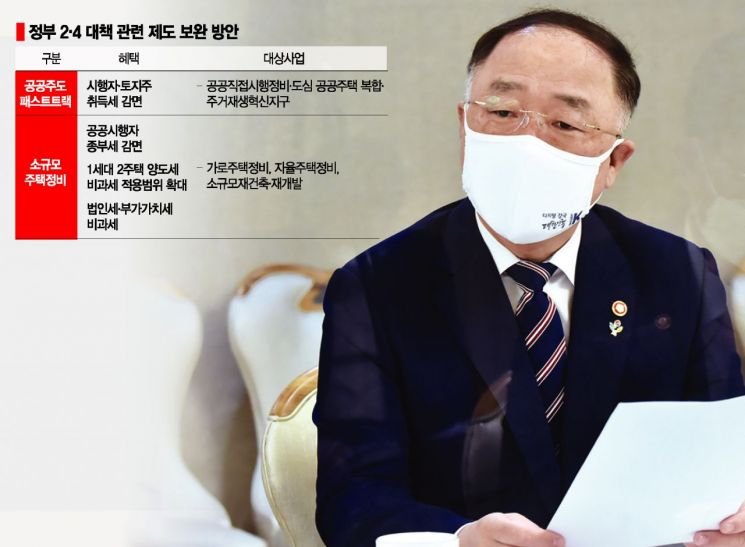
[Asia Economy Reporter Moon Jiwon] The government's announcement on the 17th of additional tax benefits for key projects under the February 4 real estate measures is interpreted as evidence that the public-centered supply plan is falling short of initial expectations. The core of the supplementary measures released that day is the expansion of various tax benefits such as acquisition tax and comprehensive real estate tax for landowners and project implementers. Unexpected institutional loopholes have been exposed in various places during the project promotion process, and due to low participation from landowners who hold the key to supply expansion, the government appears to be resorting to patchwork solutions one after another.
However, there are also criticisms that the acquisition tax and comprehensive real estate tax reductions merely eliminate the 'tax bomb' side effects arising from the public purchase method introduced by the government, making it difficult to serve as a strong incentive. Additionally, considering that the amendment bill for promoting public direct implementation redevelopment projects has yet to pass the National Assembly, the decline in trust due to speculation scandals involving Korea Land and Housing Corporation (LH) executives, and the continued preference for private development, many opinions remain uncertain about the success of public-led supply expansion.
Eliminating 'Tax Bomb' Side Effects in Public Direct Implementation
Hong Nam-ki, Deputy Prime Minister and Minister of Strategy and Finance, said at the real estate market inspection meeting held at the Government Seoul Office that day, "We will resolve tax disadvantages that may arise for landowners and project implementers during the project process conducted in the form of public purchase where the public acquires housing."
Previously, through the February 4 measures, the government introduced the 'public-led fast-track' method, where if more than two-thirds of landowners agree, project implementers such as LH directly secure the site and quickly promote the project. Public direct implementation redevelopment projects and urban public housing complex projects proceed in this manner. However, concerns arose that acquisition tax would be imposed each time ownership transfers from landowners to public institutions and then back to owners, and project implementers might face increased comprehensive real estate tax burdens due to land acquisition. In response, the Ministry of Land, Infrastructure and Transport stated in April that "there will be no disadvantages from a tax perspective."
According to the supplementary measures announced by the government that day, first, when project implementers purchase real estate within the zone to secure the site, acquisition tax is exempted just like in private redevelopment. Acquisition tax is reduced by 50% only when purchasing land or houses from landowners who do not agree to the project. When landowners acquire newly built houses after project completion, only 1-3% of the additional contribution is taxed. This is a lighter burden compared to paying acquisition tax of 1-12% of the acquisition price when acquiring houses through general sales. Project implementers also reduce their burden by excluding comprehensive real estate tax aggregation.
The government also decided to provide tax benefits at levels similar to existing redevelopment and reconstruction for small-scale housing maintenance projects such as street housing maintenance projects. When a public corporation implements the project, comprehensive real estate tax aggregation exclusion applies to houses purchased to secure the site, and if a household holding one union member's occupancy right acquires another house and sells the union member's occupancy right within three years, a special exemption for one household two houses applies as in general maintenance projects.

Level of Eliminating Reverse Discrimination... Concerns Remain
However, despite these easing measures, concerns about public development remain significant. First, the amendment bill to the 'Act on Maintenance and Improvement of Urban Areas and Dwelling Conditions' (Urban and Residential Environment Maintenance Act) for promoting public direct implementation redevelopment projects has not passed the National Assembly Land, Infrastructure and Transport Committee's bill subcommittee. It is widely known that opposition parties, in particular, hold the view that expanding redevelopment projects led by LH, which has yet to regain public trust, is inappropriate. Even four months after the announcement of the measures, public direct implementation redevelopment projects have not yet selected candidate sites.
The urban public housing complex project has also recently been embroiled in patchwork controversies. The National Assembly revised the timing for restricting pre-sale rights related to this project from the original 'February 5' to the expected 'date of the National Assembly plenary session resolution' at the end of this month. Initially, the government had designated those who acquired real estate in project areas after February 5, the day following the announcement of the February 4 measures, as subject to cash settlement to prevent speculative demand inflow into candidate sites. Critics argue that the government initially made the regulations insufficient and only later amended them, which has only increased policy distrust.
© The Asia Business Daily(www.asiae.co.kr). All rights reserved.


















