Domestic Cement Prices Rise for the First Time in 7 Years... Industry Concerns
Inflation Signals Detected Everywhere... Bank of Korea Also Watching Closely
[Asia Economy reporters Eunbyeol Kim, Haeyoung Kwon, and Jonghwa Kim in Sejong] The reason Federal Reserve (Fed) officials in the United States moved up the timing of interest rate hikes was due to concerns over inflation caused by an overheated economy. As COVID-19 vaccination rates rapidly increase, the economy is recovering faster than expected, leading to a surge in demand while supply remains insufficient, causing inflation signals to appear in various sectors.
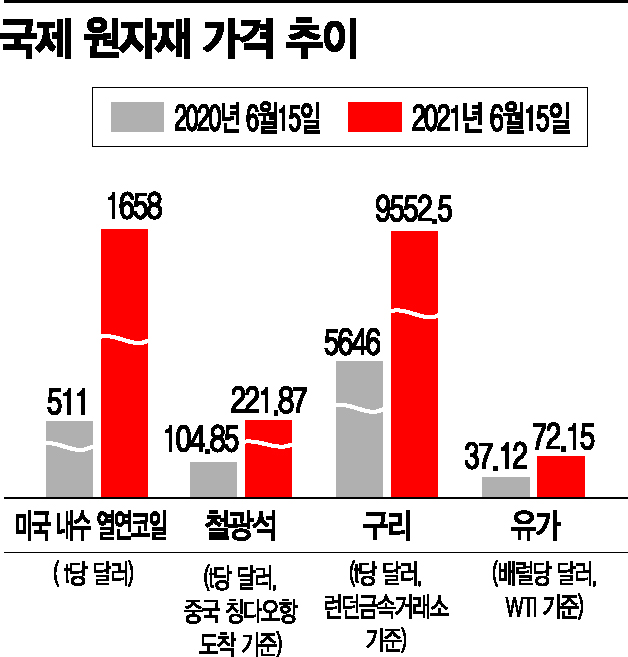
According to the steel industry on the 17th, the domestic price of hot-rolled coil in the U.S. reached $1,658 per ton as of the 15th (local time). This is more than three times higher compared to June 15 last year ($511 per ton). The surge in demand, combined with China’s earlier restrictions on iron ore exports and some speculative demand, has pushed prices to record highs. The price of iron ore arriving at Qingdao Port in China also jumped to $221.87 per ton on the 16th, more than double the $104.85 per ton a year ago. Copper prices rose from $5,646 to $9,552.5 per ton during the same period, and West Texas Intermediate (WTI) crude oil increased from $37.12 to $72.15 per barrel.
As a result, the shipbuilding industry, which was recovering from a long slump through large-scale orders, faced increased cost burdens due to the sharp rise in steel plate prices. Even obtaining these materials is difficult due to shortages. The automobile industry recently agreed to raise the steel sheet supply price by 50,000 KRW per ton following the surge in iron ore prices. The construction sector is also expressing concerns that rising prices of rebar and cement may cause delays in project schedules.
With raw material prices soaring, cement prices will increase by 5.1% starting next month, marking the first hike in seven years since 2014. The Ready-Mix Concrete Association, a major cement consumer, announced that it agreed to purchase cement at 78,800 KRW per ton, reflecting a 3,800 KRW per ton increase to cover the manufacturing cost rise due to higher bituminous coal prices. The price of bituminous coal used in cement production surpassed $125 per ton at the end of last month, up 56% compared to the end of last year, signaling an impending rise in cement prices.
Among central bank officials, including those at the Bank of Korea, there are voices cautioning against dismissing inflation as merely ‘temporary,’ noting that such reasoning has often led to inflation. Yale University professor Steven Roach, in a column titled “The Ghost of Arthur Burns” for Project Syndicate, pointed out that "Former Fed Chairman Arthur Burns argued that sharp rises in food and beverage prices due to oil prices and climate change should be excluded from consumer price indices, and for years, prices of used cars, toys, jewelry, and housing were also excluded, which eventually led to stagflation." He emphasized that "ignoring temporary price factors is extremely dangerous, as painfully learned from that era."
© The Asia Business Daily(www.asiae.co.kr). All rights reserved.

















