Korea Research Institute of Bioscience and Biotechnology Dr. Jeong Ju-yeon, Kang Tae-jun, and Lim Eun-kyung Team
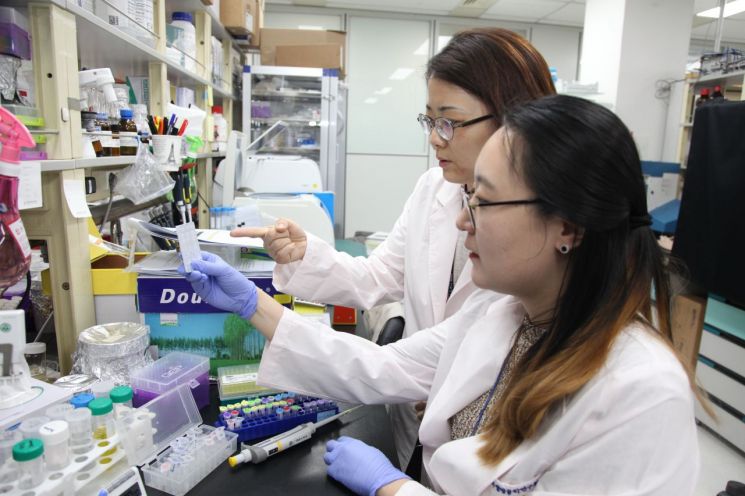
[Asia Economy Reporter Kim Bong-su] Domestic researchers have developed an analytical method that can directly detect Tamiflu-resistant viruses.
On the 16th, the Korea Research Institute of Bioscience and Biotechnology announced that the research team led by Drs. Jung Ju-yeon, Kang Tae-jun, and Lim Eun-kyung at the BioNano Research Center developed a method to directly detect Tamiflu-resistant viruses without preprocessing by selecting antibodies that bind with high selectivity to the virus surface.
This analytical method can directly detect Tamiflu-resistant viruses at concentrations more than 10,000 times lower than other immunoassays. This immunoassay is expected to enable simple diagnosis of Tamiflu-resistant virus infections in the future and be utilized in various point-of-care diagnostic systems. The research was published online on the 11th of last month in the international biotechnology journal Biosensors and Bioelectronics (IF 10.257).
In 2008, the World Health Organization (WHO) reported the emergence of a novel flu virus resistant to Tamiflu treatment in 41 countries worldwide. Since then, mutations of novel flu viruses associated with Tamiflu resistance have rapidly increased. Most Tamiflu-resistant viruses are H275Y-neuraminidase mutant viruses. This mutation involves a single amino acid change in the neuraminidase protein on the virus surface. These mutant viruses are closely related to other novel flu virus variants resistant to drugs other than Tamiflu.
Tamiflu, an influenza virus infection treatment, acts as a neuraminidase enzyme inhibitor. It suppresses viral infection by interfering with the process of releasing proliferated viruses from cells. However, when mutations occur in neuraminidase, Tamiflu’s ability to inhibit neuraminidase decreases. Therefore, to prevent the spread of neuraminidase mutant viruses caused by the surge in Tamiflu demand, the development of technology for rapid and effective diagnosis of drug-resistant viruses is required.
The problem is that the neuraminidase surface structures of Tamiflu-sensitive viruses (A/H1N1 influenza virus) and Tamiflu-resistant viruses are similar, making it difficult to develop detection antibodies. Existing diagnostic methods focus on detecting the gene of a single mutated amino acid, but they take a long time. This results in a lengthy process from specimen collection to diagnosis.
The research team selected antibodies that specifically bind to the H275Y-neuraminidase mutant virus, which is mainly found in Tamiflu-resistant viruses, verified their specific binding, and applied them to a SERS-based immunodetection method. As a result, they were able to directly detect low concentrations of the H275Y-neuraminidase mutant virus and successfully detect the mutant virus even in human nasopharyngeal aspirates. Additionally, using the discovered antibodies, they confirmed relatively high binding affinity to the H275Y-neuraminidase mutant antigen through binding force measurement, structural modeling studies, gold nanoparticle-based colorimetric detection, and immunodiagnostic rapid kits.
By attaching the selected antibodies to gold nanoplate and applying the SERS-based immunodetection method, they detected the H275Y-neuraminidase mutant virus at low concentrations of 100 PFU/ml. They also succeeded in detecting the mutant virus in nasopharyngeal aspirates, which are commonly used specimens for virus diagnosis.
Dr. Jung Ju-yeon, the principal investigator, explained, "The research results using this SERS immunoassay provide a technology that can rapidly and simply diagnose infections of drug-resistant novel flu viruses compared to existing antiviral resistance virus diagnostic methods relying on genetic testing, and it can be applied in various field settings."
© The Asia Business Daily(www.asiae.co.kr). All rights reserved.
![Clutching a Stolen Dior Bag, Saying "I Hate Being Poor but Real"... The Grotesque Con of a "Human Knockoff" [Slate]](https://cwcontent.asiae.co.kr/asiaresize/183/2026021902243444107_1771435474.jpg)















