Over 20,000 Classes Nationwide with More Than 30 Students
Low Effectiveness of Temporary Staff for Class Division
Need to Extend Meal Times and Support Quarantine Personnel
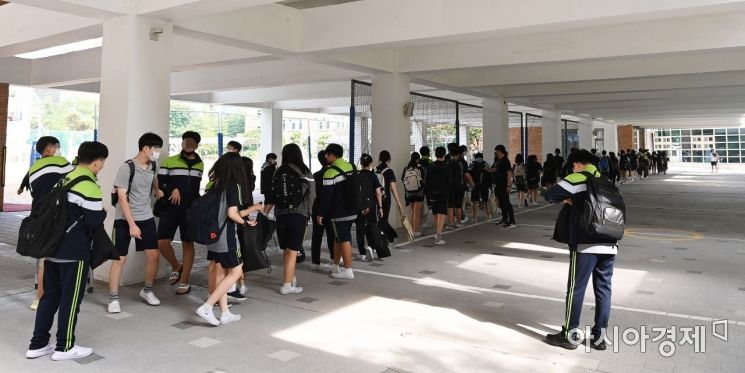 On the morning of the 14th, students are attending school at Wolchon Middle School in Yangcheon-gu, Seoul, where in-person classes have been expanded for metropolitan area middle schools. To address the academic achievement gap caused by accumulated class shortages, the Ministry of Education eased the school density standard for metropolitan area middle schools from one-third to two-thirds starting that day. 2021.6.14 Photo by Joint Press Corps
[Asia Economy Reporter Han Jinju] An elementary school in Incheon with a total of 1,300 students divided one grade into two teams and provided meals in eight sessions of 110 students each. While considering a plan to divide meals into up to 12 sessions to maintain social distancing during full in-person attendance, it was impossible to start lunch at 10 a.m., so they are reluctantly considering increasing density.
Full in-person attendance is scheduled to begin in the second semester, a year and a half after the COVID-19 outbreak, but anxiety about infections within schools remains. Nationwide, 20,000 classes operate with more than 30 students, and conditions for dividing classes are not being established.
According to the Ministry of Education and the Education Statistics Yearbook, as of last year, 19,286 classes (8.4%) had 30 or more students per class. Middle schools (10,391 classes) accounted for the highest proportion at 19.9%, followed by high schools (5,169 classes) at 9.0%, and elementary schools (4,068 classes) at 3.3%. Especially in Gyeonggi-do, where new towns are concentrated, 15.4% of classes are overcrowded. The proportion of classes with more than 21 students per class reaches 84% in elementary schools, 84% in middle schools, and 72% in high schools.
The Ministry of Education deployed 1,717 temporary teachers at the beginning of the semester to promote divided classes to resolve overcrowded classes, but the actual rate of division was only 14%. The Ministry is pushing for a reduction in teachers, citing a decrease in the school-age population and a reduction in students per teacher, making it difficult to prepare fundamental measures to resolve overcrowded classes. A National Assembly public petition demanding an amendment to the Elementary and Secondary Education Act to set the maximum number of students per class at 20 has gained 80,000 signatures as of the 17th.
Teacher organizations argue that not only the issue of overcrowded classes but also quarantine, meal service, and flexible academic management should be allowed. Especially during meal times, which have a high risk of infection, they hope for school autonomy measures such as ▲extending meal times ▲reducing regular class hours in addition to the current staggered meal system, and ▲support for quarantine personnel in cafeterias. The Korean Teachers and Education Workers Union (Jeon-gyo-jo) insists that vaccination should be prioritized for staff and students of vocational high schools that have implemented full in-person attendance.
© The Asia Business Daily(www.asiae.co.kr). All rights reserved.

















