Legislative Notice of the Amendment to the Enforcement Decree of the Act on Reporting and Using Specified Financial Transaction Information
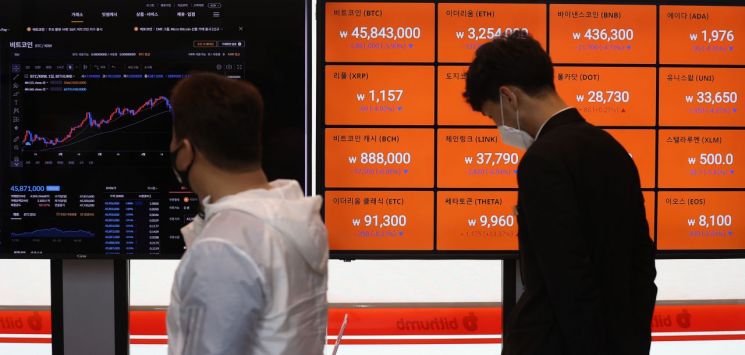
[Asia Economy Reporter Park Sun-mi] From now on, virtual currency exchanges will no longer be allowed to list virtual currencies directly issued by themselves or their special related parties. Exchanges and their executives and employees will also be prohibited from trading virtual currencies on their own exchanges. Virtual currency exchanges handling self-issued coins will face delisting and other measures within a few months.
Following the recent mass delisting of coins by major exchanges and the financial authorities stepping up regulations related to virtual currencies, the coin cleanup process is expected to accelerate before the full enforcement of the Specific Financial Information Act on September 25.
The Financial Services Commission announced on the 17th that it will publicly notify the amendment to the Enforcement Decree of the Specific Financial Information Act containing these details until next month 26. This is a follow-up measure to the "Virtual Currency Transaction Management Plan" decided at the inter-ministerial vice-ministerial meeting on the 28th of last month.
The amendment to the Enforcement Decree includes measures to prevent virtual currency exchanges from so-called self-listing by issuing their own coins or mediating trading and exchange. Exchanges will be prohibited from handling virtual currencies issued by themselves or their special related parties, and the exchanges and their executives and employees will be prohibited from trading through those exchanges.
The term "special related parties" here refers to, if the individual is a person, ▲ a spouse in a de facto marital relationship ▲ blood relatives within the sixth degree ▲ relatives within the fourth degree ▲ corporations or organizations in which the individual alone or together with special related parties holds 30% or more of shares or exercises de facto influence over major management matters, including their directors, executive officers, and auditors. If the individual is a corporation or organization, it includes ▲ directors, executive officers, auditors ▲ affiliated companies and their directors, executive officers, and auditors. In case of violation of obligations, exchanges may be subject to fines up to 100 million KRW, corrective orders, suspension of business, and cancellation of registration.
Acceleration of Coin Cleanup Process
These measures come in response to problems arising from virtual currency exchanges' self-listing of coins, where illegal activities such as price manipulation occur through false entries using their own computer networks. Previously, the government had announced a ban on self-listing to prevent wash trading and price manipulation of coins. This measure is evaluated as a stronger regulation by expanding the scope of special related parties.
Additionally, through the revision of provisions, matters related to the fulfillment of anti-money laundering obligations have been clarified. Financial companies, etc., must conduct risk assessments for all customers. Previously, there was a misconception that risk assessments only needed to be conducted for the purpose of identifying "high-risk customers" as an anti-money laundering measure. Furthermore, it has been clarified that when the customer is a corporation or organization, the representative's date of birth must be verified to identify homonyms. A Financial Services Commission official stated regarding this amendment to the Enforcement Decree, "We plan to complete the amendment promptly after public notification until next month 26, consultations with related ministries, and reviews by the Regulatory Reform Committee and the Ministry of Government Legislation."
Meanwhile, the coin cleanup process of exchanges is likely to accelerate before September 24, when virtual currency exchanges must complete business registration with the Financial Intelligence Unit (FIU). Earlier, Upbit, the largest domestic virtual currency exchange, announced the suspension of KRW trading for five coins including Maro, linked to special related parties. Huobi Korea and Gdac also decided to delist coins named after their exchanges, such as "Huobi Token" and "Gdac Token."
© The Asia Business Daily(www.asiae.co.kr). All rights reserved.
![Clutching a Stolen Dior Bag, Saying "I Hate Being Poor but Real"... The Grotesque Con of a "Human Knockoff" [Slate]](https://cwcontent.asiae.co.kr/asiaresize/183/2026021902243444107_1771435474.jpg)
















