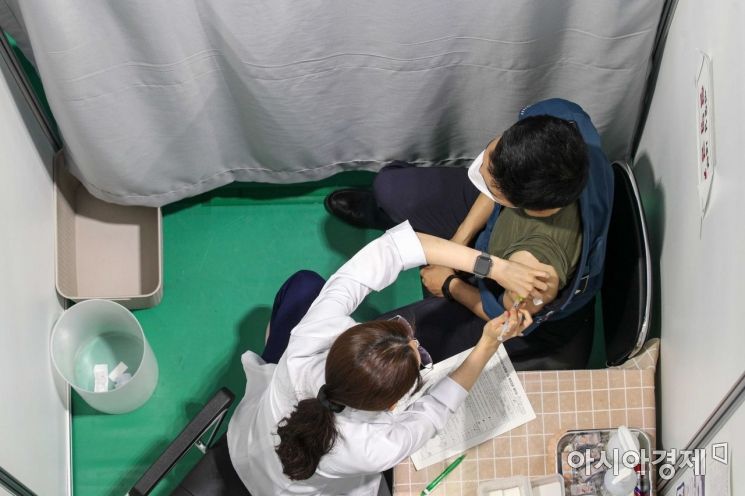
 On the 16th, police forces are engaged in vaccine administration at the COVID-19 vaccination center in Seodaemun-gu, Seoul. Photo by Jin-Hyung Kang aymsdream@
[Asia Economy Reporters Hyewon Kim, Jihui Kim, Chunhee Lee] As health authorities shift the focus of the third-quarter vaccination plan from 'priority vaccination' to 'rapid vaccination,' the possibility of in-house vaccinations using affiliated medical institutions within company workplaces has increased. However, whether such in-house vaccinations will actually take place remains uncertain, as controversies over preferential treatment for large corporations may arise.
On the afternoon of the 16th, Hong Jeong-ik, head of the COVID-19 Vaccination Management Team at the COVID-19 Vaccination Response Promotion Group, said in a press briefing, "The main principle of the third-quarter vaccination plan is that while the first half of the year involved prioritizing certain groups, the second half will see the start of nationwide vaccination. Therefore, instead of specifying detailed priority groups, the plan is to proceed with rapid vaccination to vaccinate all citizens as quickly as possible."
In the first half of the year, 'priority' vaccinations were given to the elderly, residents and inpatients of nursing hospitals and facilities who are at high risk of severe illness or death from COVID-19 infection, those closely connected to them, and frontline medical staff. In the second half, rather than considering separate priorities, the focus appears to be on mobilizing maximum vaccination capacity to increase the speed of vaccinations.
The Ministry of Employment and Labor and the Korea Disease Control and Prevention Agency reportedly began reviewing plans for workplace in-house vaccinations earlier this month, delivering official letters to companies through local employment and labor offices about promoting in-house vaccinations via affiliated clinics within workplaces.
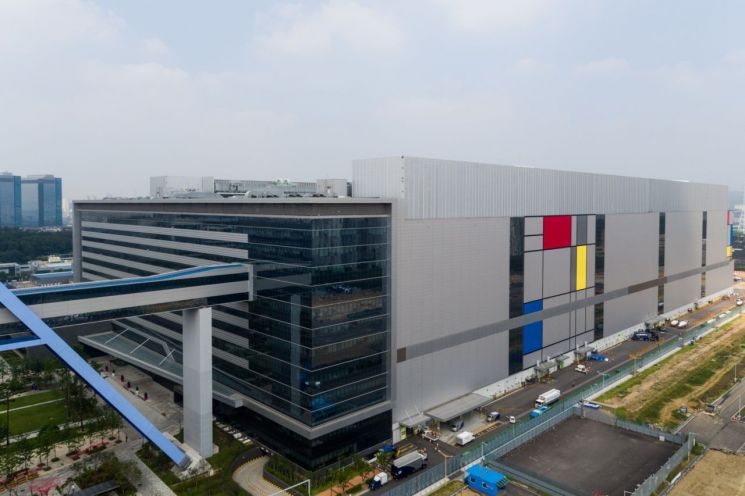
Currently, Gangbuk Samsung Hospital has been hiring double-digit part-time nurses since the 11th to handle vaccination duties at affiliated clinics within Samsung Electronics workplaces in Suwon, Giheung, Hwaseong, Pyeongtaek, Cheonan, and Onyang. Other affiliates such as Samsung SDI and Samsung Electro-Mechanics have also posted job openings for contract or part-time nurses. LG Display has been recruiting contract nursing staff to work at its Seoul, Paju, and Gumi workplaces since the 14th.
The Hyundai Motor Group has also prepared a vaccination plan through labor-management consultations. It is reported that the first dose will be administered as early as late July to early August at three domestic Hyundai Motor factories and research centers, three domestic Kia factories, and Hyundai Steel’s Incheon and Pohang plants.
These employer-led vaccinations are planned to target workers aged 18 to 59, with the Moderna COVID-19 vaccine expected to be used.
The issue lies in negative public opinion. As vaccinations for the general adult population begin in earnest in the third quarter, those in their 30s and 40s who are not affiliated with these companies are expected to receive their first dose no earlier than around August. Moreover, the vaccines used for these in-house vaccinations are messenger RNA (mRNA) vaccines, which are relatively preferred domestically, whereas the vaccine types for general recipients have yet to be finalized.
Especially since most workplaces with affiliated clinics are large corporations, there is concern that this could be perceived as 'priority vaccination for large corporations.' A company official explained, "Because negative public opinion may arise, even companies that have conducted demand surveys are not confident that in-house vaccinations will actually be implemented."
© The Asia Business Daily(www.asiae.co.kr). All rights reserved.
![Clutching a Stolen Dior Bag, Saying "I Hate Being Poor but Real"... The Grotesque Con of a "Human Knockoff" [Slate]](https://cwcontent.asiae.co.kr/asiaresize/183/2026021902243444107_1771435474.jpg)
















