Samsung, Hyundai Motor, Hanwha, Kyobo, Mirae Asset, DB
Internal Transactions Near 100 Trillion Won
Most Capital Adequacy Ratios Decline
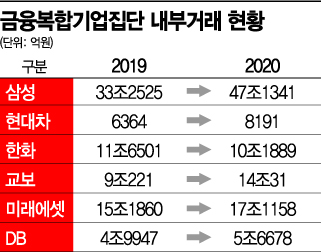
[Asia Economy Reporter Oh Hyung-gil] The scale of internal transactions among financial conglomerates such as Samsung, Hyundai Motor, Hanwha, Kyobo, Mirae Asset, and DB reached 95 trillion won last year. On the other hand, the capital adequacy ratios aimed at preventing the transmission of insolvency among affiliates mostly declined, reducing the groups' capacity to respond to risks at the group level.
According to disclosures from each group on the 16th, as of the end of last year, the scale of internal transactions among six financial conglomerates was 94.9288 trillion won, a 27.0% (20.187 trillion won) increase compared to 74.7418 trillion won the previous year.
The group with the largest internal transactions was Samsung (with Samsung Life Insurance as the representative financial company), which surged 41.7% from 33.2525 trillion won in 2019 to 47.1341 trillion won last year.
During the same period, Mirae Asset (Mirae Asset Securities) followed with 17.1158 trillion won, up 12.7%. Kyobo (Kyobo Life Insurance), which recorded internal transactions of 14.0031 trillion won last year, showed the highest growth rate with a 55.2% increase compared to the previous year.
DB (DB Insurance) recorded 5.6678 trillion won, up 13.4%, and Hyundai Motor (Hyundai Capital) increased by 28.0% to 819.1 billion won. Hanwha (Hanwha Life Insurance) was the only group among the six whose internal transactions decreased by 12.5% to 10.1889 trillion won compared to the previous year.
Among the types of internal transactions, most were sales of securities.
In Samsung's case, the scale of securities sales was 44.3185 trillion won, accounting for 94% of internal transactions. Samsung Asset Management sold securities worth 29.2591 trillion won to financial affiliates, and Samsung Securities also had securities sales amounting to 1.2802 trillion won. Mirae Asset's securities transactions accounted for 98% (16.7354 trillion won) of its total internal transactions.
Most Capital Adequacy Ratios Declined...Stricter Supervision from Next Month
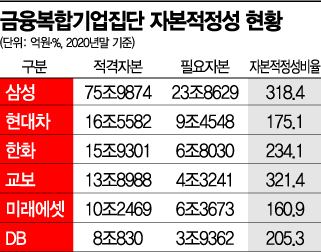
The capital adequacy ratios, which assess the groups' ability to absorb losses from risks, mostly declined compared to the previous quarter.
Kyobo had the highest capital adequacy ratio among financial groups at 321.4%, but it decreased by 21.5 percentage points from the previous quarter. Samsung was the only group among the six to record an increase in capital adequacy ratio, rising 6.2 percentage points to 318.4%.
Following were ▲Hanwha 234.1% (-27.2 percentage points) ▲DB 205.3% (-10.0 percentage points) ▲Hyundai Motor 175.1% (-2.6 percentage points). The lowest capital adequacy ratio was Mirae Asset at 160.9% (-1.3 percentage points).
Meanwhile, under the Financial Conglomerates Act, which will be enforced on the 30th, regulatory oversight of these conglomerates will be strengthened. If the capital adequacy ratio falls below 100% or the risk management evaluation results in grade 4 or lower, the group must prepare a management improvement plan and submit it to the financial authorities.
If the management improvement plan is inadequate or not implemented, the Financial Services Commission may request corrections, supplements, or enforcement. If financial soundness deteriorates significantly, such as when the capital adequacy ratio is below 100% without adding risk-weighted capital, prompt corrective actions under individual sector laws may be taken.
Also, if a financial affiliate conducts internal transactions exceeding 5 billion won, board approval is mandatory.
© The Asia Business Daily(www.asiae.co.kr). All rights reserved.
![Clutching a Stolen Dior Bag, Saying "I Hate Being Poor but Real"... The Grotesque Con of a "Human Knockoff" [Slate]](https://cwcontent.asiae.co.kr/asiaresize/183/2026021902243444107_1771435474.jpg)
















