[Asia Economy Reporter Su-yeon Woo] There is a claim that South Korea should actively utilize the United States' supply chain strengthening and support policies as an opportunity for the Korean economy and use it as a chance to upgrade its industries. This view is based on the idea that South Korea should actively participate in the new US-centered supply chain order and replace China's role amid the US's efforts to check China.
On the 16th, the Korea Economic Research Institute (KERI) released a report titled "Biden Administration's Trade Policy and South Korea's Response Strategy," asserting this position. The report argued that the essence of the US-China trade conflict is not simply about resolving trade imbalances but a hegemonic competition that accepts short-term efficiency losses, making the formation of a US-led economic bloc inevitable. It analyzed that, for the time being, alliances in the form of official and unofficial economic consultative bodies led by the US are more likely to take the shape of a US-led economic bloc rather than multilateral FTAs.
Furthermore, the report emphasized that the combined GDP of the US and its approximately 50 allied countries (including friendly nations) accounts for 65.8% of the world's GDP (as of 2019), highlighting that deviating from the US-led economic order would result in significant losses for national economies. Therefore, it argued that South Korea must actively participate in the US-centered economic bloc.
Lee Tae-gyu, Senior Research Fellow at KERI, forecasted, "The US is likely to adopt a method of swiftly consulting among allied countries with aligned interests to check China rather than spending time on FTA negotiations." He added, "Given China's significant share in the US's major industrial supply chains, decoupling from China will be difficult to achieve in the short term, so South Korea should gradually reduce its trade dependence on China."
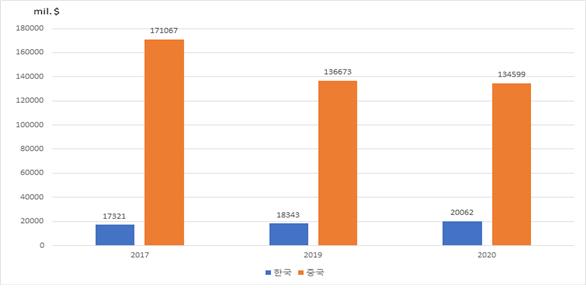 Annual Scale of ATP Imports to the U.S. from Korea and China
 (Data Source: U.S. Census Bureau, Korea Economic Research Institute)
Additionally, the report stated that the US is expected to increasingly exclude China from imports of ATP (Advanced Technology Products?goods embedded with leading technologies among about ten high-tech industries) in the future. It argued that South Korea should seize this opportunity to replace China.
China ranks mostly at the top in the US's ATP imports, while South Korea's scale is considerably lower compared to China. The report emphasized that to replace ATP produced in China with domestic companies, bold R&D investments for industrial upgrading are essential, and active policy support (especially a significant expansion of R&D tax incentives) is necessary.
The report also pointed out that a substantial portion of China-produced ATP is accounted for by advanced foreign companies operating in China. Therefore, it is necessary to dramatically improve domestic investment conditions by implementing delayed reform tasks such as resolving labor rigidity and regulatory reforms so that these companies can choose South Korea as a new production base instead of China.
Finally, the report projected that it will take considerable time for the US to return to multilateralism centered on the WTO. Lee stated, "Currently, a system of reciprocity or bilateralism is structurally more favorable for the US to enforce its interests than multilateralism, at least in the short term." He emphasized, "The return to multilateralism is likely a mid-to-long-term task, so it is necessary to continuously engage in dialogue and cooperation with the US during this period to ensure that South Korea's interests are reflected."
© The Asia Business Daily(www.asiae.co.kr). All rights reserved.

















