Government to Invest Over 100 Billion Won Annually to Develop 'Second Oil' Resource
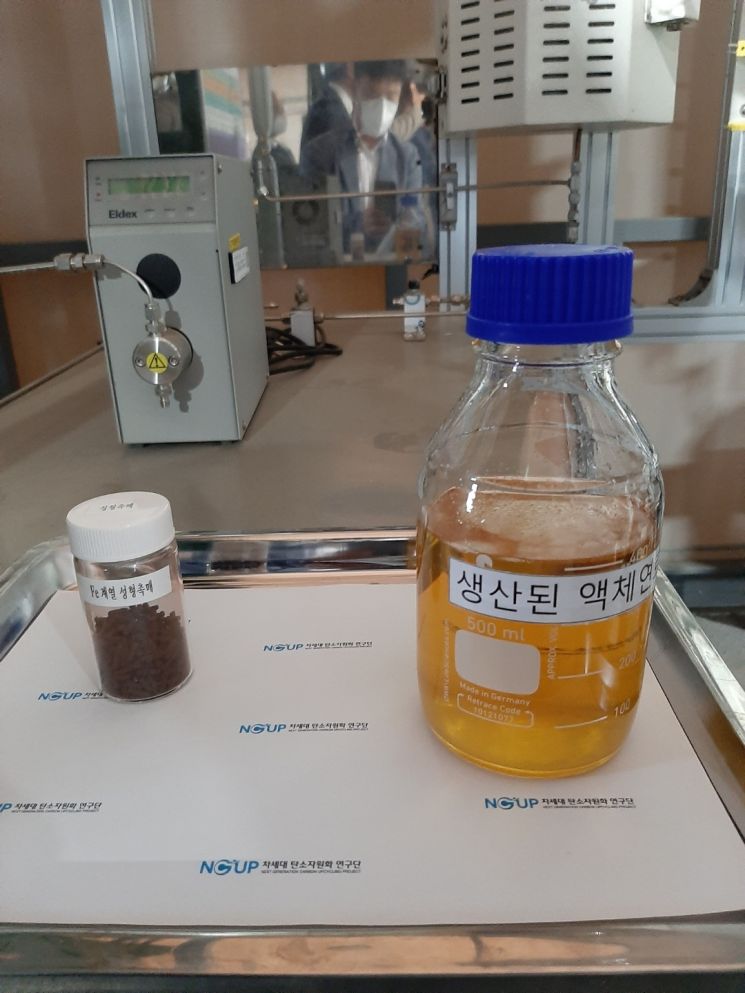
[Asia Economy Reporter Kim Bong-su] As the government is promoting a 'hydrogen economy' for achieving carbon neutrality by 2050, it has now introduced a carbon dioxide (CO2) resource utilization strategy. With an annual investment of over 100 billion KRW, it will actively develop CO2 resource utilization technologies. The plan is to capture carbon dioxide, the main culprit of global warming, and convert it into various chemical substances that can replace petroleum. This approach not only helps prevent climate change but also secures resources, prompting countries worldwide to actively research and develop it as a key carbon neutrality strategy. Let’s explore the relatively lesser-known CO2 resource utilization technology and the Korean government's strategy.
◇ What is Carbon Dioxide Resource Utilization?
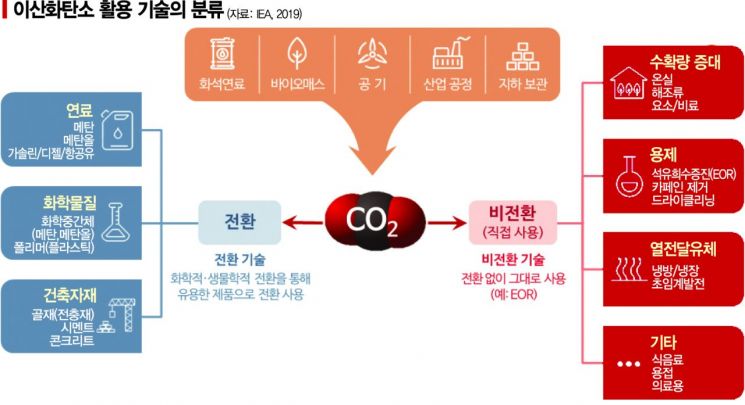
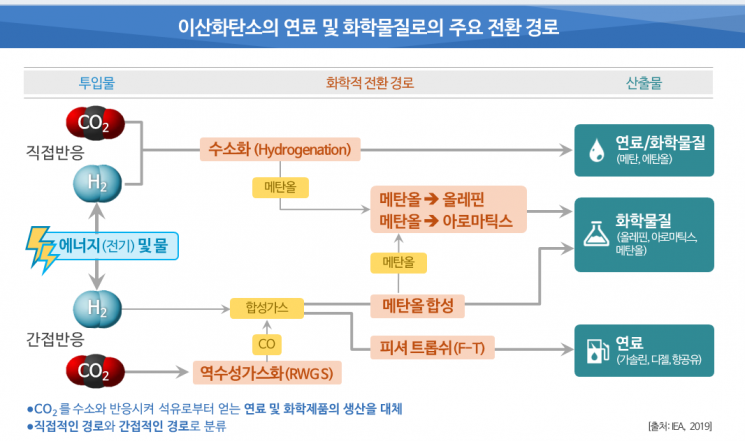
Carbon dioxide is a stable substance with a molecular structure consisting of one carbon atom bonded to two oxygen atoms. CO2 generated mainly from industrial processes such as power generation and steelmaking can be captured and combined with hydrogen through catalysts to be converted into useful substances. It can produce chemical raw materials and intermediates such as naphtha, butanol, ethylene, methane, formic acid, ammonia, as well as construction materials (carbonates) and food and beverage products. Notably, primary chemical raw materials like naphtha, currently refined from petroleum, can also be produced by converting CO2. This means gasoline or plastic raw materials can be obtained from CO2 instead of petroleum. However, the cost-efficiency is currently very low, making it economically unfeasible. The technology for capture and utilization is called CCU (Carbon Capture, Utilization), and when storage (Storage) technology is included, it is referred to as CCUS.
◇ Essential for Carbon Neutrality
The critical limit to prevent global warming is to keep the average temperature rise within 1.5 degrees Celsius. To achieve this, greenhouse gas emissions must be reduced by at least 45% compared to 2010 levels by 2030, and carbon neutrality?where greenhouse gas emissions and absorption are balanced?must be achieved by 2050. Korea announced its carbon neutrality strategy last December to meet these goals. The importance of CCU technology, which can resourcefully utilize large amounts of carbon dioxide and carbon monoxide among greenhouse gases, is therefore emphasized. CO2 resource utilization not only reduces carbon emissions but also replaces petroleum, providing a twofold benefit.
◇ Overseas: 'Core Strategy', Korea: Still Developing
Major countries are actively promoting CO2 resource utilization technology as a key carbon neutrality strategy. The United States, the United Kingdom, Germany, and Japan have included CCUS technology as a core strategic tool in their recently announced long-term low-carbon strategies and are strengthening support. The European Union (EU) has set a goal to reduce about 2.2 billion tons of CO2 by 2050 under its carbon neutrality scenario, aiming to cut 300 million tons (14%) through CCU technology. It supports technology development intensively through major R&D programs like Horizon 2020 and includes CCU fuels in the mandatory use of renewable fuels. The U.S. expanded tax credit benefits for CO2 resource utilization facilities under the '45Q Tax Credit' policy in 2018. The International Energy Agency (IEA) projected that CCUS technology would contribute to 15% of total reductions in its 2070 global carbon neutrality scenario. Korea has promoted related technology R&D through the 'korea CCS-2020' project from 2011 to last year and formulated a carbon resource utilization development strategy in 2016. However, institutional support to accelerate commercialization is considered insufficient.
◇ What about the Overseas Market Trends?
Currently, 21 large-scale commercial CCUS facilities operate worldwide, capturing and utilizing up to 40 million tons of CO2 annually. However, most are used for permanent storage and enhanced oil recovery (EOR). The CCU-related market has yet to form. Nevertheless, with carbon neutrality declarations and strengthened global carbon regulations, the CCU market is expected to grow rapidly. ICEF forecasted in 2016 that the market size for CCU products would reach $840 billion by around 2030, requiring 7 billion tons of CO2 annually. The 2019 International Energy Agency (IEA) report also predicted that CCUS CO2 demand would reach 5 billion tons annually by around 2070.
◇ How Advanced is the Technology Development?
In the U.S. and Europe, various product and process fundamental research is actively underway, with some technologies reaching commercialization. Japan’s Asahi Kasei produces ethylene carbonate as a commercial product, and the EU’s Covestro manufactures polyurethane commercially. The EU is particularly focusing on Power-to-X technology, which utilizes CO2 as fuel such as methanol. In Korea, most technologies remain at the basic and fundamental research stage centered on academia and research institutes. However, electrochemical and photochemical conversion technologies actively researched by the Korea Institute of Science and Technology (KIST) and the Korea Research Institute of Chemical Technology (KRICT) are known to be world-class. Additionally, KRICT is demonstrating technology to produce 10 tons of methanol per day in collaboration with Hyundai Oilbank, and polymer products such as SK Innovation’s polypropylene carbonate and Green Chemical’s alkylene carbonate are at the commercialization stage.
◇ Korean Government Unveils Comprehensive Strategy
For the first time ever, the government has released a comprehensive CCU technology development strategy involving over 50 experts. The goal is to secure price competitiveness at existing market price levels by 2040, realizing carbon neutrality and creating new CCU markets. Through this, the current capture cost of $60-70 per ton will be reduced to around $20, and 14 commercial product groups will be secured by 2030 through chemical and mineral conversion.
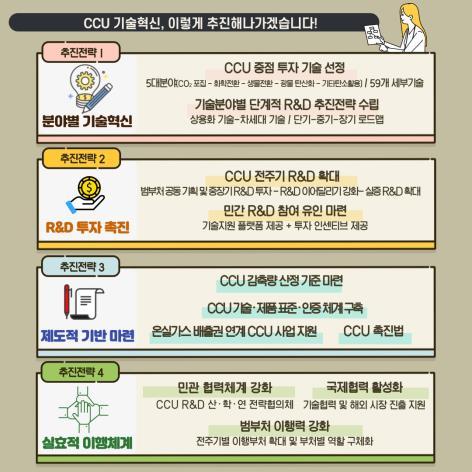
The plan also includes expanding R&D investments by both the government and private sector to secure core CCU technologies. From 2010 to 2019, the government invested a total of 460 billion KRW but only reached half of the initially planned scale. There were difficulties in large-scale demonstrations for systematic development and commercialization. Accordingly, the government plans to prepare a plan by next year and start large-scale investments exceeding 100 billion KRW annually from 2023.
Small-scale demonstrations of capture and conversion processes will be upgraded to medium-large scale, and incentive measures such as expanding R&D tax credits and easing government R&D matching ratios will be prepared. Additionally, a system will be established to objectively reflect the greenhouse gas reduction effects of CCU technology in the national inventory and reduction projects. The government and private sectors will also organize a promotion system to ensure CCU technology is applied in industries and other fields, leading to actual reductions.
An official from the Ministry of Science and ICT said, "This roadmap will be practically used as the basis for planning and promoting government R&D projects in the CCU field. It will serve as an important milestone in achieving the national greenhouse gas reduction target by 2030 and realizing carbon neutrality by 2050 through the field application of CCU technology."
© The Asia Business Daily(www.asiae.co.kr). All rights reserved.
![Clutching a Stolen Dior Bag, Saying "I Hate Being Poor but Real"... The Grotesque Con of a "Human Knockoff" [Slate]](https://cwcontent.asiae.co.kr/asiaresize/183/2026021902243444107_1771435474.jpg)

















