"Financial Imbalances Deepen with Debt and Risk Appetite... Concerns Over Future Financial Stability and Growth"
Some Say "Maintain Easing Policy for Now Due to Economic and COVID-19 Uncertainties"
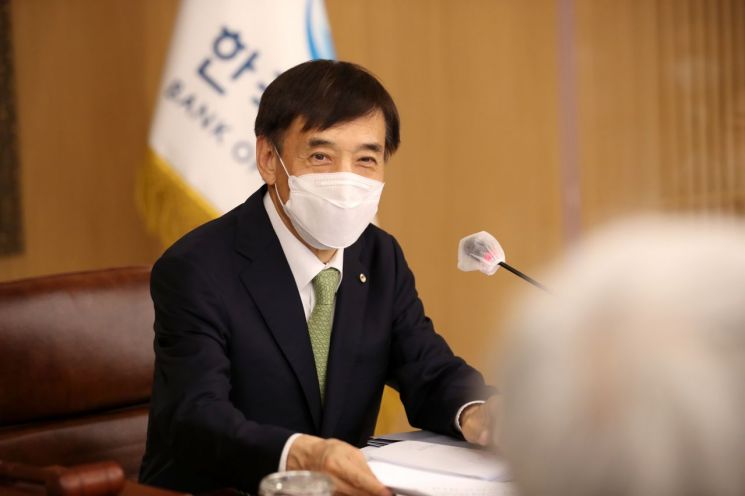
[Asia Economy Reporter Yoo Byung-don] Although the Monetary Policy Committee of the Bank of Korea unanimously decided to keep the base interest rate unchanged last month, many committee members expressed the opinion during the meeting that it is necessary to gradually normalize the currently unusually accommodative monetary policy and low base interest rate.
Based on this, it is interpreted that Lee Ju-yeol, Governor of the Bank of Korea, has recently hinted at the possibility of raising the base interest rate within this year.
According to the minutes of the Monetary Policy Committee meeting (held on May 27) published on the Bank of Korea's website on the 15th, during the discussion on the direction of monetary policy, one member pointed out the risk-taking tendencies of economic agents and the increase in leverage (borrowed investment), stating, "As the economic recovery spreads, the gradual normalization of interest rate levels is necessary to prevent the deepening of such financial imbalances and to reduce the possibility of future financial instability."
He added, "The prolonged continuation of the current unusually accommodative monetary policy stance is judged to increase the cost of the future interest rate normalization process," and predicted, "Although adjusting the degree of monetary policy accommodation may have some negative impact on the economic recovery, considering the strong economic recovery in major countries and the stability of international financial markets, the negative impact can be largely buffered."
Another member also said, "If the interaction between credit (debt) growth and asset price increases becomes excessive, it can lead to the accumulation of financial imbalance risks, which may undermine future financial stability and the sustainability of economic growth," adding, "With expectations for the continuation of accommodative policy stance prevailing, the household's profit-seeking tendency using leverage is strengthening, and recent domestic and external economic recovery and inflation expectations may act as incentives for further leverage expansion, increasing the need for monetary policy considerations regarding related risks."
He suggested, "In this meeting, it is desirable to keep the base interest rate at the current level of 0.50%, while closely monitoring whether the real economy expands further, the inflation path trend, and the possibility of worsening financial imbalance risks including household debt, and gradually adjusting the degree of monetary policy accommodation at an appropriate time."
Another member also stated, "Considering the recent real and financial conditions and the future economic and inflation trends, it is time to consider somewhat adjusting the accommodative stance of monetary policy that was implemented in response to the COVID-19 shock."
However, some members expressed a cautious stance on changing the accommodative monetary policy stance due to uncertainties in the economic recovery.
One member argued, "Although recent real economic conditions are improving, uncertainties surrounding COVID-19 and vaccine distribution still remain, so it is necessary to maintain the accommodative monetary policy stance."
Another member said, "Our economy continues to expand mainly through exports and investment, and inflation has escaped downward pressure, but it will take considerable time to return to the pre-pandemic potential growth trend, and it will also take a significant amount of time for GDP growth to lead to expansion in household income, wages, employment, and consumption."
He added, "Even though inflation has escaped downward pressure, it is still below the target level that the Bank of Korea aims to achieve in the medium term, and since there is no clear reason to proactively control the momentum of economic expansion, it is desirable to keep the base interest rate at the current level of 0.50%."
There was also a member who emphasized both the need for a base interest rate hike and the uncertainties related to COVID-19.
One member said, "Considering the expected strengthening of the domestic economic recovery and the increasing risks in terms of financial stability, it is necessary to consider partial adjustments to the unusually accommodative monetary policy stance implemented in response to the COVID-19 crisis," but advised, "Since uncertainties related to the COVID-19 situation still remain, it is necessary to maintain the accommodative stance for the time being while closely communicating with economic agents about changes in financial and economic conditions and the policy direction reflecting these changes."
© The Asia Business Daily(www.asiae.co.kr). All rights reserved.
![Clutching a Stolen Dior Bag, Saying "I Hate Being Poor but Real"... The Grotesque Con of a "Human Knockoff" [Slate]](https://cwcontent.asiae.co.kr/asiaresize/183/2026021902243444107_1771435474.jpg)















