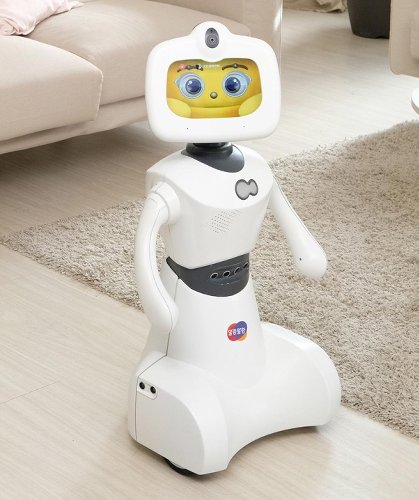
 Image of a home service robot. Provided by the Korean Intellectual Property Office (Source=Hancom Group)
[Asia Economy (Daejeon) Reporter Jeong Il-woong] Robots are taking over tasks such as cooking and cleaning, and children are studying and playing with robots, turning scenarios once seen only in movies into reality. As robots become more integrated into daily life, related technology development and patent applications are also increasing.
According to the Korean Intellectual Property Office on the 15th, patent applications related to home service robots increased from an average of 109 cases per year between 2011 and 2015 to an average of 216 cases per year between 2016 and 2020, growing by about 16% annually.
In particular, recently, patent applications for robots integrated with artificial intelligence technology that interact with humans, move according to instructions, and provide necessary services have sharply increased. The share of patent applications in this field accounts for 36% of all robot-related patent applications.
By service type of patented robot technologies, cleaning robots lead with 674 cases, followed by household robots with 379 cases, robots assisting socially vulnerable groups such as children, the elderly, and the disabled with 312 cases, educational and gaming robots with 162 cases, and companion robots with 65 cases.
However, while cleaning robots still account for a large number of patent applications as the initial form of home service robots, their proportion relative to total patent applications is gradually decreasing. On the other hand, patent applications in robot fields with complex service functions such as cooking, education, and elderly assistance are increasing, compensating for the reduced share of cleaning robots.
Above all, due to the impact of COVID-19, with the activation of remote work and online education, the increase in patent applications related to household robots and educational/gaming robots is also remarkable. For example, last year, 97 patents related to household robots were filed, showing a 17% increase compared to the previous year, and 42 patents were filed in the educational/gaming robot field, a 62% increase year-on-year.
By applicant type, large corporations accounted for 40% (647 cases), small and medium enterprises 26% (418 cases), universities and research institutes 13% (216 cases), and individuals 11% (186 cases).
As home service robots become closer to daily life, the market size is also expanding. In fact, the global market research firm Research and Markets forecasts that the personal robot market size will grow to 5.6 billion KRW by 2030. This supports the argument that domestic companies must secure the robot market through patents.
Won Yoo-cheol, an examiner at the Intelligent Robot Examination Division of the Korean Intellectual Property Office, said, “With the combination of artificial intelligence and robot technology, various home service robots are becoming indispensable daily necessities,” adding, “Reflecting this trend, related patent applications in the robot market are expected to steadily increase.”
He also stated, “The Korean Intellectual Property Office will actively support domestic companies’ technology development and patent preemption through prompt and accurate examination.”
© The Asia Business Daily(www.asiae.co.kr). All rights reserved.
![Clutching a Stolen Dior Bag, Saying "I Hate Being Poor but Real"... The Grotesque Con of a "Human Knockoff" [Slate]](https://cwcontent.asiae.co.kr/asiaresize/183/2026021902243444107_1771435474.jpg)















