Non-Financial Corporate Bonds Totaling $11.2 Trillion
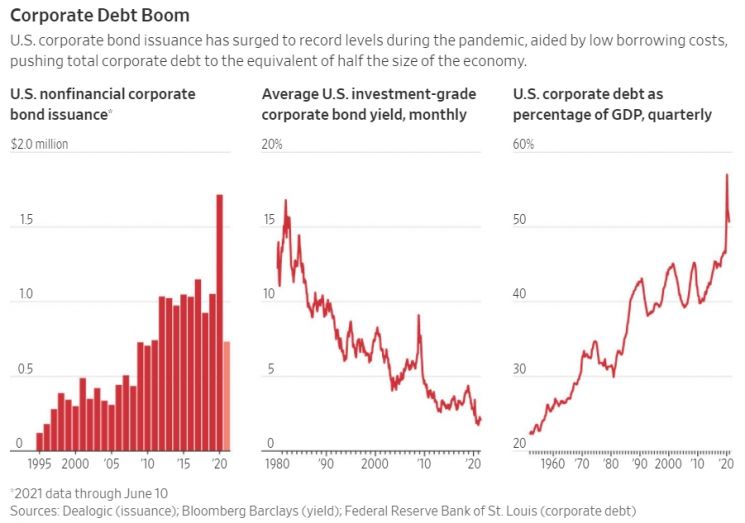
[Asia Economy Reporter Park Byung-hee] According to the Wall Street Journal (WSJ) on the 14th (local time), following the COVID-19 pandemic, the issuance of bonds by U.S. companies has surged significantly, with the current size of non-financial corporate bonds reaching $11.2 trillion, about half of the U.S. Gross Domestic Product (GDP).
The U.S. central bank, the Federal Reserve (Fed), introduced zero interest rates last year to mitigate the economic shock caused by the spread of COVID-19, lowering corporate financing costs. Thanks to this, companies were able to issue bonds on a large scale, securing cash that had decreased due to reduced profits and coping with the crisis situation.
According to financial information firm Dealogic, the volume of bonds issued by non-financial companies last year reached a record high of $1.7 trillion, about $600 billion more than the previous maximum. The bond size of Carnival Group, the world's largest cruise operator, stood at $33 billion as of the end of February this year, tripling compared to the end of 2019. Boeing's debt also more than doubled to $64 billion, and Delta Air Lines carries debt of about $35 billion, roughly double the previous level.
The WSJ analyzed that since the 1980s, with slowing growth rates and low benchmark interest rates, corporate bond issuance based on low interest rates has continued to increase, and COVID-19 accelerated this trend. The Fed reignited the surge in bonds by reintroducing the zero interest rate policy last year, which was first implemented during the 2008-2009 global financial crisis.
At the beginning of last year, the bond yield for investment-grade companies was 2.84%, and as COVID-19 concerns grew, it temporarily rose to about 4.6%. However, due to the Fed's proactive response policies, bond yields fell to a record low of 1.74% by the end of last year.
Companies issued new bonds to reduce interest expenses and extend maturities. Telecommunications company AT&T announced in April that its interest expenses in the first quarter of this year decreased by about $150 million compared to the same period last year.
If the economy normalizes and interest rates rise again in the future, the increased debt will inevitably become a burden for companies. The Fed also noted in a report last month that companies with high debt ratios face increased risks of damage. Particularly, the significant increase in debt among companies with low credit ratings is pointed out as a problem. According to S&P Global Market Intelligence, the volume of bond issuance by CCC-rated companies, which are below investment grade, is at an all-time high this year. If the current trend continues, it is expected to increase by about 35% compared to the previous maximum issuance.
Thorsten Slok, Chief Economist at asset management firm Apollo Global Management, pointed out, "Allowing unproductive companies to continue operating ultimately lowers long-term economic growth rates."
Scott Kimball, Portfolio Manager at BMO Global Asset Management, said, "I don't think corporate bonds will be a problem in the short term," but added, "In the long term, when refinancing periods come, it could become a headache for companies and investors."
Recently, as the debate over the Fed's monetary policy tightening has heated up due to the U.S. economic recovery, some companies have already started repaying bonds. Delta Air Lines repaid $1.5 billion worth of bonds in March and plans to repay an additional $850 million by the end of this month. Delta Air Lines stated that it aims to regain investment-grade status within two years.
© The Asia Business Daily(www.asiae.co.kr). All rights reserved.
![Clutching a Stolen Dior Bag, Saying "I Hate Being Poor but Real"... The Grotesque Con of a "Human Knockoff" [Slate]](https://cwcontent.asiae.co.kr/asiaresize/183/2026021902243444107_1771435474.jpg)















