Differences in Views on Infrastructure Investment Competing with China's Belt and Road Initiative
Failure to Develop Concrete Implementation Plans for Specific Statements
Criticism Arises That Vaccine Donations Are "Just a Combination of Previously Promised Amounts"
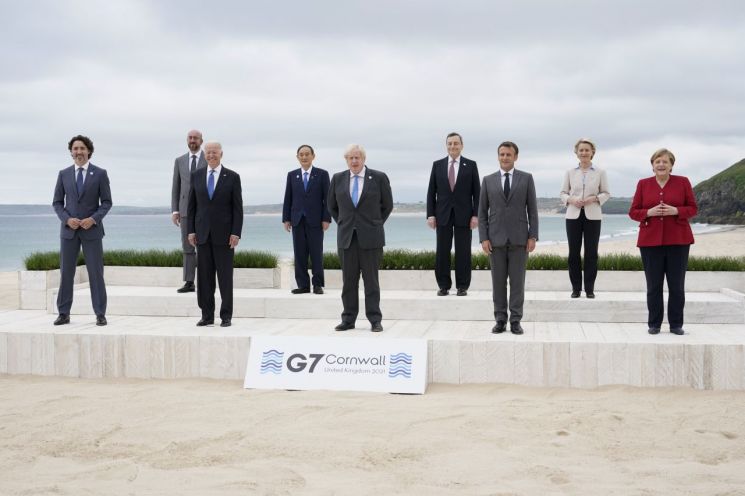
[Asia Economy Reporters Hyunwoo Lee and Hyunui Cho] The leaders of the United States and major European countries achieved principled agreements on various international cooperation issues, including a joint response to counter China, at this year's Group of Seven (G7) summit.
However, despite the U.S. explanation of building a "joint anti-China front," each country showed subtle differences in stance. The infrastructure investment plan for the "Build Back Better World (B3W)" initiative, aimed at countering China's "Belt and Road Initiative (land and maritime Silk Road)," is also expected to face difficulties in formulating detailed plans.
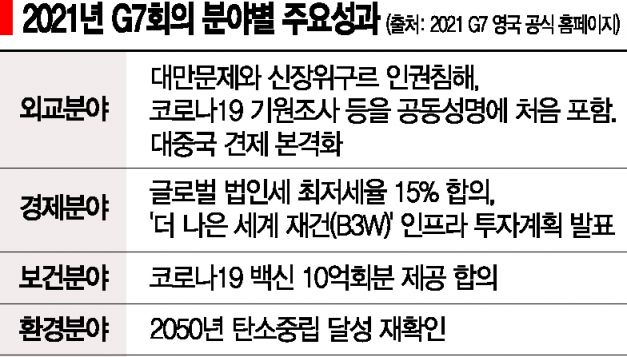
◇ Unified Voice on China's Human Rights and COVID-19 Origin Theories
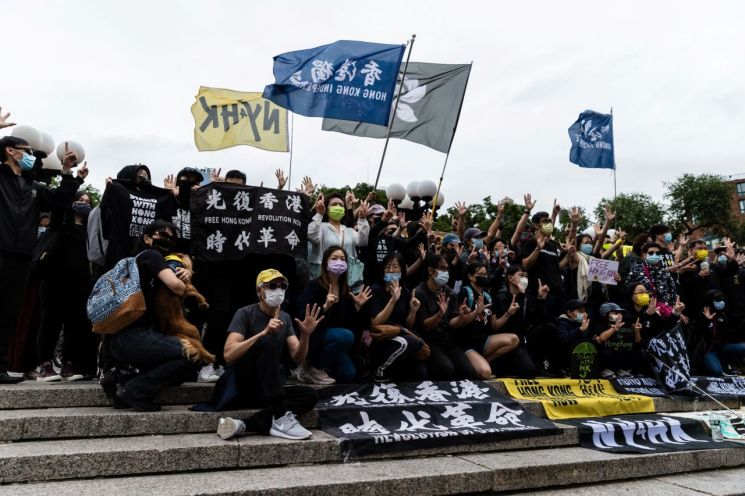
On the 13th (local time), the G7 leaders concluded the summit held in Cornwall, UK, since the 11th and issued a joint statement. This joint statement included content directly targeting China for the first time since the G7 meetings began in 1975.
In the joint statement, the G7 leaders emphasized, "We will promote our values by urging the protection of human rights and freedoms in the Xinjiang Uyghur region and the freedom and autonomy of Hong Kong," and stressed that "China must act to maintain peace in the Taiwan Strait." The statement also included a call, in line with the U.S. Biden administration's demand, "to urge China to reinvestigate the origin of COVID-19."
With major points of contention between the U.S. and China, such as human rights issues in China, the Taiwan issue, and the theory of COVID-19 originating in China, being included in large numbers, it is evaluated that the U.S. and European countries succeeded in reaching a principled agreement to build a joint front to counter China.
Additionally, cooperation on various international collaborations was reaffirmed, including the provision of 1 billion COVID-19 vaccine doses, agreement on a global minimum corporate tax rate of 15%, and the B3W infrastructure investment plan led by G7 countries to counter China's Belt and Road Initiative.
◇ Different Dreams Surrounding ‘B3W’...Europe Says It’s Not Targeting Belt and Road
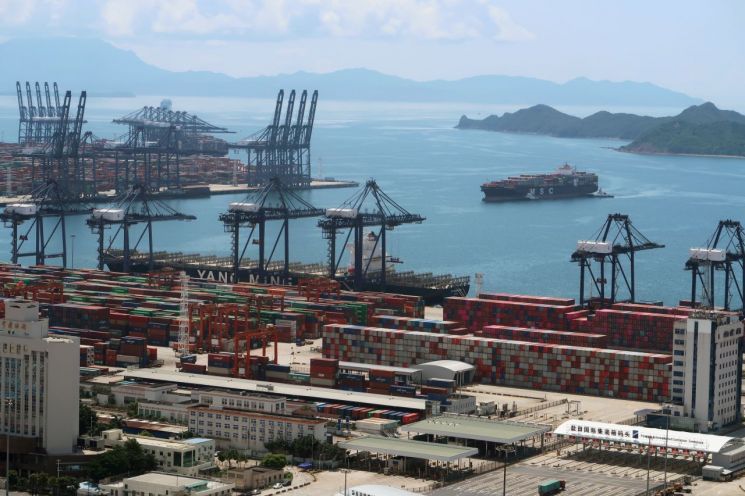
However, there are also criticisms that the perspectives on China between the U.S. and Europe were significantly different. After the G7 summit, leaders of major European countries expressed positions on the B3W investment plan that were completely different from those of the U.S.
German Chancellor Angela Merkel said at a press conference immediately after the G7 meeting, "B3W is not aimed at any specific country but is intended to support the development of poor countries," and added, "I hope that concrete plans for this project will be announced at the G7 meeting to be held in Germany next year."
Ursula von der Leyen, President of the European Union (EU) Commission, also stated in an interview with Euronews, "The Belt and Road project between Europe and China, which began in 2019, aims for mutual prosperity between the two continents," and added, "However, we will create a better model with the U.S., and unlike China, investments will be made without conditions."
In contrast, the U.S. has firmly stated that B3W is a project to block China's Belt and Road Initiative. The day before, President Biden announced the B3W plan, saying, "We can no longer leave infrastructure development in developing countries to China."
The New York Times (NYT) pointed out, "At this meeting, European countries had a strong view of China as a competitive partner, unlike the U.S., which is hostile to China, and they are concerned that the U.S. views China through a Cold War mindset."
◇ Is the Donation of 1 Billion Vaccine Doses Just for Show?
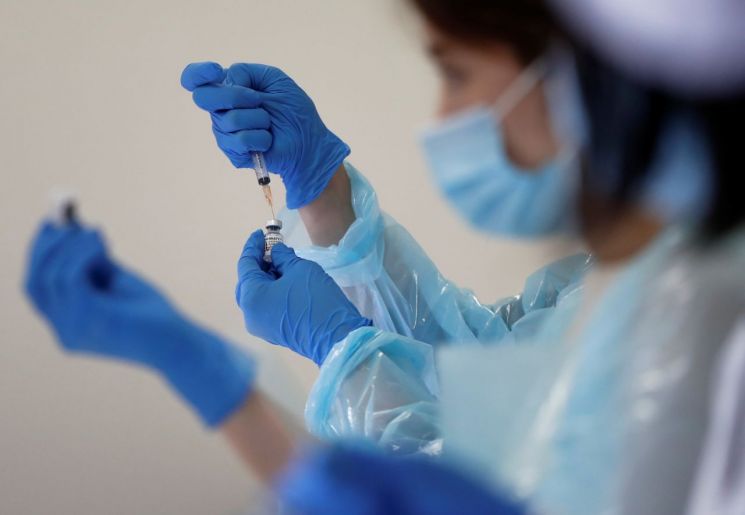
The donation of 1 billion vaccine doses worldwide, considered the biggest achievement of this G7 meeting, is actually evaluated as merely combining previously individually promised support plans. Analysts say this reveals that both the U.S. and Europe still lack the capacity to provide large-scale vaccine donations while the COVID-19 threat remains.
Bloomberg News pointed out, "Some of the vaccine donations will be purchased with funds from COVAX and other programs that the G7 countries had previously promised to support," and added, "In reality, the additional vaccine doses that the G7 will provide amount to only 613 million doses."
The 500 million Pfizer doses that the U.S. announced it would donate this time are planned to be purchased with funds from the $2 billion (about 2.2 trillion KRW) donation President Biden pledged to the international vaccine distribution program COVAX in February, with an additional $2 billion to be contributed if other countries join.
The EU's 100 million doses are the amount announced by Commission President von der Leyen on the 21st of last month, pledging to donate at least 100 million doses to middle- and low-income countries by the end of this year. This total includes individual donations from G7 member states within the EU, such as Germany (30 million doses), France (30 million doses), and Italy (15 million doses), rather than a donation led by the EU Commission, which secured 1.8 billion Pfizer doses. Major foreign media have also pointed out that "the only completely new support plan in the G7 statement is the UK's 100 million doses."
© The Asia Business Daily(www.asiae.co.kr). All rights reserved.
![Clutching a Stolen Dior Bag, Saying "I Hate Being Poor but Real"... The Grotesque Con of a "Human Knockoff" [Slate]](https://cwcontent.asiae.co.kr/asiaresize/183/2026021902243444107_1771435474.jpg)

















