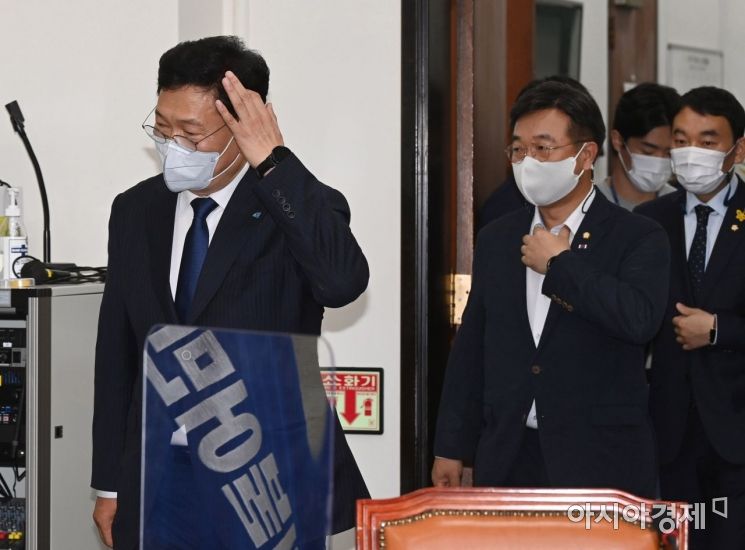
 Song Young-gil, leader of the Democratic Party of Korea, and Yoon Ho-jung, floor leader, are attending the Supreme Council meeting held at the National Assembly on the 14th. Photo by Yoon Dong-ju doso7@
[Sejong=Asia Economy Reporter Kim Hyunjung] The ruling party is experiencing internal strife as discussions on real estate tax reform hit a discordant note. Amid internal backlash against the Democratic Party of Korea leadership's tax reform plan, which focuses on easing comprehensive real estate tax and capital gains tax, the plan to finalize the proposal through a policy meeting scheduled for this week is facing difficulties.
According to political circles on the 14th, the Democratic Party's policy meeting, originally scheduled for the 11th but postponed due to COVID-19 cases within the National Assembly, is planned to be held this week. The specific schedule is still under discussion. The party's real estate special committee had prepared a proposal to change the comprehensive real estate tax application criteria from the existing official price 'over 900 million KRW' to the 'top 2%' and to raise the capital gains tax exemption threshold for single-homeowners from 900 million KRW to 1.2 billion KRW, but internal consensus has not yet been fully reached.
Some lawmakers from internal research groups such as The Better Future, Democracy 4.0, and the Democratic Peace People's Coalition have expressed opposition to the special committee's proposal. Additionally, Prime Minister Kim Boo-kyum indirectly criticized the ruling party's tax easing policy by emphasizing the government's 'consistent stance.' In a recent interview with Yonhap News, Prime Minister Kim said regarding the ruling party's policy discussions leaning toward easing real estate taxes, "It is an excessive aspect to discuss the comprehensive real estate tax as if it is shaking the lives of ordinary people," and stressed, "It is more important for the government to send a signal that it will steadfastly maintain a consistent stance on real estate policy." He added, "We need to quickly move away from the situation where it looks like a power struggle between those who distrust government policies and the government itself," and warned, "Giving the wrong signal that the government will back down if property owners hold out will cause other problems."
The tax reform plan that the ruling party is pushing forward currently also diverges from the government's original proposal. The Ministry of Economy and Finance has maintained a negative stance from the early discussions on setting the comprehensive real estate tax threshold at the 'top 2%.' This is due to difficulties in revenue forecasting and taxpayers finding it hard to predict whether they will be liable for payment. A government official said, "If the concept of the top 2% is introduced, the criteria for imposition will change every year," adding, "It is concerning that taxpayers cannot be certain whether they will be subject to comprehensive real estate tax this year, next year, or the year after." The government has also conveyed to the ruling party's special committee proposals such as introducing a tax deferral system, freezing the fair market value ratio at 90%, and expanding special deductions for long-term residence.
Within the party, opinions are also divided over easing the fair market value ratio, which effectively reduces the comprehensive real estate tax burden. Some lawmakers are reportedly considering proposing related legislation to lower the fair market value ratio.
Meanwhile, opposition parties have also introduced related bills focusing on tax relief. People Power Party lawmaker Jung Kyung-hee recently proposed an amendment to the Local Tax Act to change the tax base calculation for housing property tax from the officially announced standard market price on the 'official announcement date' to the standard market price at the 'acquisition date.' Another lawmaker from the same party, Yoon Hee-sook, recently proposed an amendment to the Real Estate Price Publicity Act to prohibit increasing the official price by more than 5% compared to the previous year.
© The Asia Business Daily(www.asiae.co.kr). All rights reserved.
![Clutching a Stolen Dior Bag, Saying "I Hate Being Poor but Real"... The Grotesque Con of a "Human Knockoff" [Slate]](https://cwcontent.asiae.co.kr/asiaresize/183/2026021902243444107_1771435474.jpg)















