Expansion of Level 2 School Density Standard from 1/3 to 2/3
Increase in Attendance Rate of Metropolitan Middle School Students Previously Below Half
Ministry of Education Discussing Attendance Guidelines in Line with July Social Distancing Revisions
Seoul Metropolitan Office of Education Introduces Rapid PCR and Multi-testing System
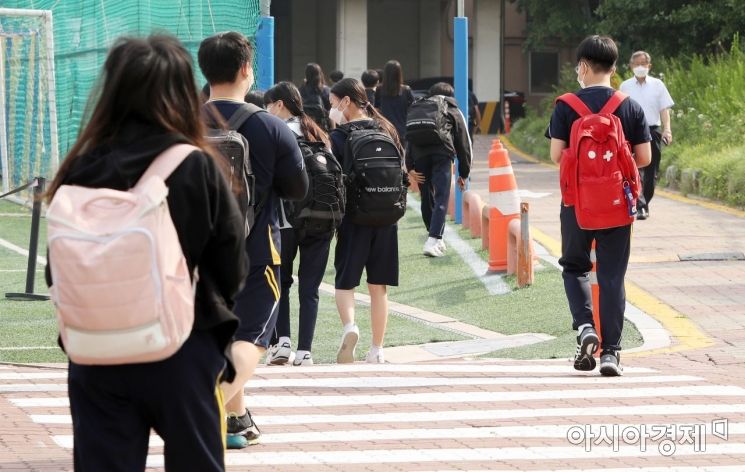 As the school density standard was raised from one-third to two-thirds, middle school students in the metropolitan area have increased attendance, and vocational high school students can now attend school every day. On the 14th, students were attending school at Jangpyeong Middle School in Dongdaemun-gu, Seoul. 2021.06.14 Photo by Joint Press Corps
[Asia Economy Reporter Han Jinju] Lee Seo-woo, a second-year middle school student living in Incheon, received a new timetable starting on the 14th. Since March, he had been attending school for one week and taking remote classes for two weeks, but from this week, the schedule changed to two weeks of in-person classes and one week of remote learning. With two-thirds attendance allowed even at level 2, he alternates attending school with first and third-year students.
From this day, the school density standard changed from one-third to two-thirds, significantly increasing the number of school days for middle school students in the metropolitan area. Vocational high school students will attend school every day starting from this day.
Since the start of the school year in March, first and second graders in elementary school and third-year high school students were exempt from the school density calculation standard, allowing other grades to increase their attendance days, but middle school students in the metropolitan area still had a significant shortage of school days. As of the end of last month, the attendance rate for metropolitan area middle school students was only 48.3%. With this expanded attendance policy, the attendance rate is expected to rise to the level of metropolitan elementary schools (67.7%) and high schools (67.2%). Outside the metropolitan area, full attendance is being expanded. Jeonnam started full attendance last week, Chungbuk from the 21st, and Gangwon region will begin full attendance next month.
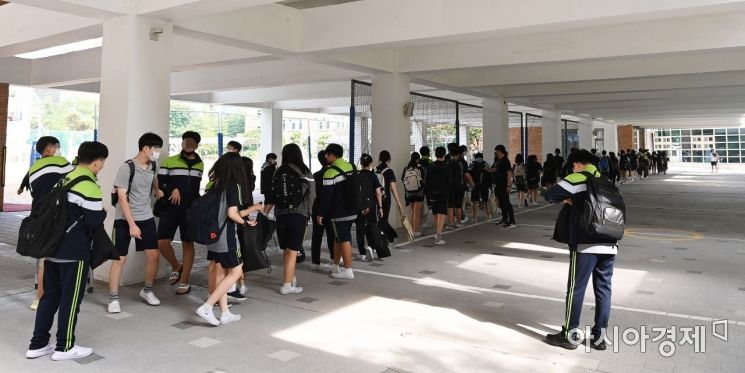 On the morning of the 14th, students are attending school at Wolchon Middle School in Yangcheon-gu, Seoul, as in-person classes expand in metropolitan area middle schools. To address the academic achievement gap caused by accumulated class shortages, the Ministry of Education relaxed the school density standard for metropolitan area middle schools from one-third to two-thirds starting that day. 2021.6.14 Photo by Joint Press Corps
The Ministry of Education plans to complete vaccination for all teachers and staff, as well as examinees such as third-year high school students and repeaters, by August in preparation for full attendance in the second semester. They are also consulting with health authorities on phased guidelines for full attendance in the second semester linked to the July social distancing reform plan. Deputy Prime Minister and Minister of Education Yoo Eun-hye recently said at a meeting with school principals, "We will continuously expand attendance aiming for all students to attend school in the second semester," adding, "We are supplementing and reviewing comprehensive school quarantine rules including phased meal plans and management, and life guidance to prevent blind spots for infection during meal times."
The Ministry of Education is preparing measures that comprehensively address learning loss and emotional and social recovery caused by over a year of remote classes. Minister Yoo said, "We are considering customized support for students who need supplementary academic learning or individual guidance, and also preparing support measures for emotional and social issues."
The Seoul Metropolitan Office of Education plans to introduce a multi-testing system including rapid COVID-19 PCR tests and expand quarantine personnel in line with the expanded attendance. This is because there is no vaccination plan for students under 16, and concerns about quarantine remain due to a cluster infection of 37 students at a high school in Gangbuk-gu.
From July, the Office of Education will pilot rapid PCR testing, which was introduced at Seoul National University, at five schools including dormitory schools and special schools for one month. Saliva tests are easy to administer and results can be obtained within 1 to 2 hours. Additionally, a pilot project for self-test kits has been underway since early this month at 19 schools with dormitories accommodating more than 100 students. The Office of Education will support two quarantine personnel at 190 schools with more than 500 students and will additionally provide health support instructors to schools with more than 850 students.
© The Asia Business Daily(www.asiae.co.kr). All rights reserved.
![Clutching a Stolen Dior Bag, Saying "I Hate Being Poor but Real"... The Grotesque Con of a "Human Knockoff" [Slate]](https://cwcontent.asiae.co.kr/asiaresize/183/2026021902243444107_1771435474.jpg)
















