[Asia Economy Reporter Jeong Hyunjin] Recently, with the increase in labor and corporate-related regulations such as minimum wage hikes, amendments to the Commercial Act, and the Fair Trade Act, 500 domestic companies generally expressed dissatisfaction with the outcomes of regulatory reforms. The perceived effectiveness of regulatory reforms has been declining since the current government took office.
On the 14th, the Federation of Korean Industries (FKI) commissioned the polling agency Research & Research to survey 500 companies from the 20th of last month to the 3rd of this month on the '2021 Regulatory Reform Perception Index.' The results showed that this year's regulatory reform perception index was 92.1, down 1.7 points from last year. An index below 100 indicates that companies are 'dissatisfied' with the outcomes of regulatory reforms.
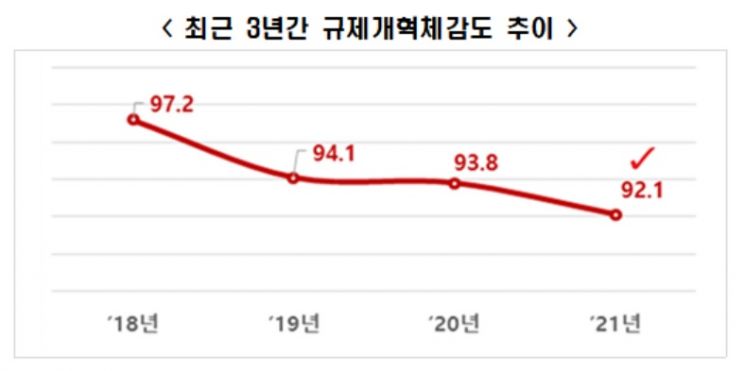
The perception index was highest at 97.2 in 2018, when the Moon Jae-in administration began and expectations for the new government were high, but it has steadily declined to 94.1 in 2019 and 93.8 in 2020.
In this survey, 19.0% of respondents expressed dissatisfaction with regulatory reform outcomes, about 2.4 times higher than the 7.8% who expressed satisfaction. Notably, the proportion of companies responding as 'very dissatisfied' with regulatory reform outcomes over the past year was 6.8%, an increase of 0.9 percentage points compared to the previous year.
Among the 95 companies (50 large enterprises and 45 small and medium enterprises) that answered they were dissatisfied with regulatory reform outcomes, the reasons were investigated. The most common response, at 29.5%, was 'insufficient resolution of invisible regulations,' followed by 'new or strengthened regulations in the relevant field' (28.4%), 'insufficient improvement of core regulations in the relevant field' (21.1%), and 'lack of regulatory reform will among public officials' (16.8%).
The FKI noted that the item 'new or strengthened regulations in the relevant field' showed an increased response rate and ranking compared to previous years. In the 2019 survey, this response had a 14.6% rate, ranking 4th; last year, it rose to 19.0%, ranking 3rd; and this year it moved up to 2nd place. The FKI analyzed that this was due to the passage of major regulatory legislation through the National Assembly last year, including the three corporate regulation laws (Commercial Act, Fair Trade Act, Financial Conglomerate Supervision Act), the Serious Accident Punishment Act, and the Tada Ban Act.
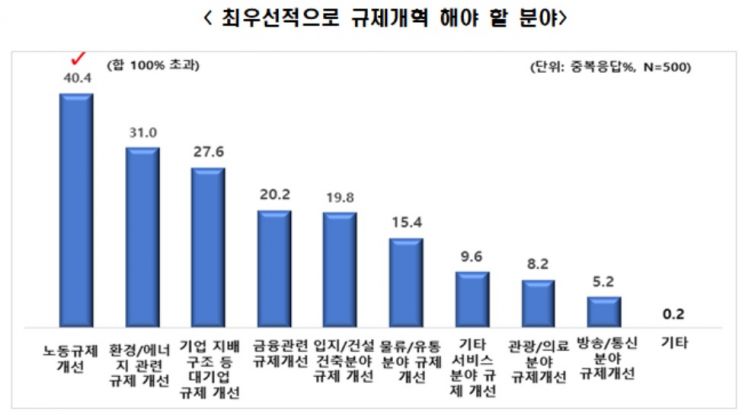
Respondent companies identified 'labor regulations' (40.4%) as the top priority area for government regulatory reform (multiple responses allowed), followed by 'environment and energy-related regulations' (31.0%) and 'large enterprise regulations' (27.6%). In particular, the need for reform in labor regulations was more than 9 percentage points higher than in other areas.
Regarding the outlook on the current government's regulatory reform policy performance, negative responses accounted for 25.0%, about 2.4 times higher than positive responses at 10.4%. The reasons for the negative outlook on regulatory reform performance were identified as 'lack of government will to improve regulations' (24.8%) and 'concerns about economic democratization and anti-business sentiment' (21.6%).
© The Asia Business Daily(www.asiae.co.kr). All rights reserved.
![Clutching a Stolen Dior Bag, Saying "I Hate Being Poor but Real"... The Grotesque Con of a "Human Knockoff" [Slate]](https://cwcontent.asiae.co.kr/asiaresize/183/2026021902243444107_1771435474.jpg)

















