Criticism of China at Press Conference After G7 Summit
G7 Statement Also Points Out China Issues
Contrast with 2018 When Only North Korea and Russia Were Mentioned
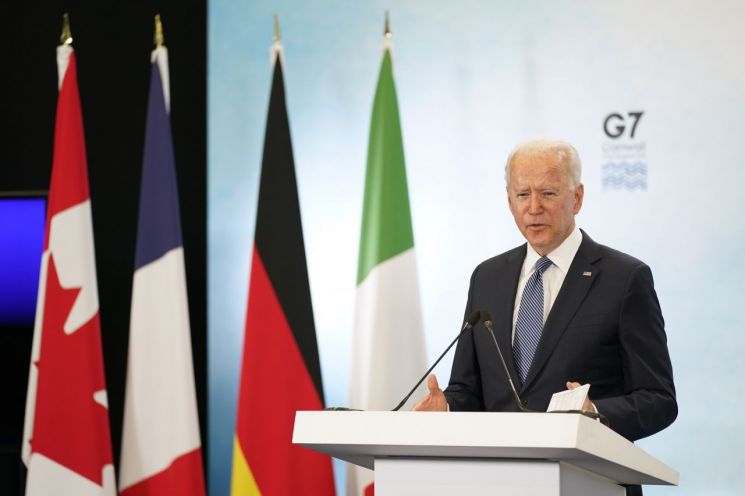
[Asia Economy New York=Correspondent Baek Jong-min] U.S. President Joe Biden has led the solidarity of democratic countries against China on the occasion of the Group of Seven (G7) summit. At the joint press conference held after the G7 summit, President Biden firmly established his position as the leader of the free world confronting China by strongly pressuring China.
On the 13th (local time), at the joint press conference of the G7 summit, President Biden stated, "The United States has returned to the negotiating table and is fully engaged." He also emphasized that democratic countries are competing with authoritarian states. The U.S. has continued to criticize China by referring to it as an authoritarian country.
He expressed concern over China’s treatment of the Xinjiang Uyghur minority and urged China to "act more responsibly."
President Biden also demanded cooperation in investigating the origins of COVID-19 in China. He said, "We have not been able to access the laboratory to determine whether COVID-19 originated from bats in animal markets or from a lab accident," adding, "Intelligence agencies are not yet certain, so I have not reached a conclusion." He indicated that the lack of cooperation from China has prevented a conclusion.
The G7 also criticized China directly in their closing statement, aligning with the U.S. position.
The leaders mentioned China’s crackdown on pro-democracy forces in Hong Kong, forced labor in Xinjiang, conflicts with Taiwan, and trade issues, intensifying their offensive against China.
The statement declared, "We will promote our values by urging China to respect human rights and fundamental freedoms in Xinjiang, and to uphold the rights, freedoms, and high degree of autonomy of Hong Kong as guaranteed by the Hong Kong Joint Declaration and the Basic Law."
The G7 leaders also referred to peace and stability in the Taiwan Strait. Concerns about conflicts in the South China Sea were also included.
The G7’s concerns extended to economic conflicts with China. The leaders stated they will continue to discuss collective approaches to address China’s non-market policies and practices that undermine the fair and transparent operation of the global economy.
It is considered unusual that China, rather than North Korea or Russia, was the main focus of the G7 summit outcomes.
A senior U.S. government official said, "In the 2018 G7 summit joint statement, North Korea and Russia were allocated an entire paragraph, but China was not explicitly mentioned at all," adding, "At that time, no agreement could be reached on anything related to China."
U.S. Secretary of State Antony Blinken also gave consecutive interviews to ABC and CBS on the same day, praising President Biden for uniting G7 member countries against the challenges posed by China. He asserted, "We must be able to address China from a position of strength in all areas."
He described this meeting as the most important summit he has attended, stating, "It has actually proven that democracy coming together as one can be delivered in concrete ways to the people of each country and to the world."
© The Asia Business Daily(www.asiae.co.kr). All rights reserved.
![Clutching a Stolen Dior Bag, Saying "I Hate Being Poor but Real"... The Grotesque Con of a "Human Knockoff" [Slate]](https://cwcontent.asiae.co.kr/asiaresize/183/2026021902243444107_1771435474.jpg)















