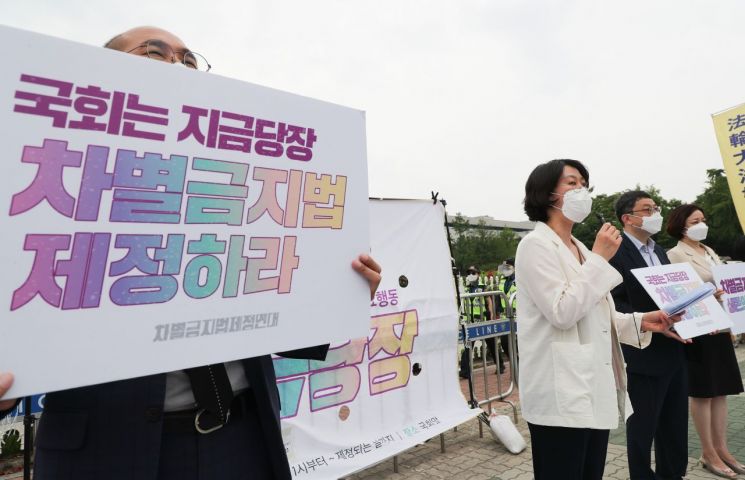
[Asia Economy Reporter Hyunju Lee] The National Assembly is still turning a blind eye. This is about the Anti-Discrimination Act. On the 29th, it will mark one year since the Anti-Discrimination Act was proposed in the 21st National Assembly. Although the Anti-Discrimination Act has always been a "hot potato" and requires more discussion, the National Assembly has not conducted a single review since it was once submitted at the full meeting of the Legislation and Judiciary Committee in September last year.
The public demand is growing stronger. The petition for public consent regarding the enactment of the Anti-Discrimination Act has approached 90,000 signatures as of the 13th, about three weeks after it started. Petitioner Kim said, "Every time discussions about the Anti-Discrimination Act begin, the National Assembly always repeats that 'social consensus is necessary.' That is wrong. It is not that the public cannot keep up with the National Assembly's awareness, but rather that the National Assembly does not follow the public's awareness." Once the number of signatures exceeds 100,000, the petition is referred to the relevant standing committee.
The Anti-Discrimination Act is based on the grounds for prohibition of discrimination under the National Human Rights Commission Act and specifies the criteria for judging discrimination by gender, disability, age, language, country of origin, ethnicity, race, nationality, skin color, regional origin, physical appearance, marital status, pregnancy or childbirth, family and household form and situation, religion, ideology or political opinion, criminal record with expired sentence effect, sexual orientation, gender identity, educational background, employment type, medical history or health status, social status, etc. The 23 grounds for direct discrimination commonly apply to areas such as ▲employment ▲goods and services ▲educational institutions ▲administrative services.
Some raise concerns about the Anti-Discrimination Act. They question whether a comprehensive law is really necessary when there are individual laws related to discrimination such as the Equal Employment Opportunity Act and the Act on the Prohibition of Discrimination against Persons with Disabilities, or argue that it significantly restricts 'freedom of expression.'
Attorney Hyein Cho explained, “Individual laws do not cover all areas of discrimination grounds, and creating individual laws for every issue could cause more confusion among laws and make things more complicated.” She added, “Since people inherently have complex identities, a comprehensive law is necessary to properly address such complex discrimination.” Attorney Cho also said, “Sexually harassing remarks are not freedom of expression, and any remarks that constitute harassment cannot be justified as freedom of expression,” and “There must be an agreed boundary that is not protected by freedom of expression, and that can be the Anti-Discrimination Act.”

The area where the most noticeable change will occur if the Anti-Discrimination Act is enacted is employment. According to Article 3 (Scope of Prohibited Discrimination) of the bill, the employment sector is thoroughly covered from recruitment and hiring to retirement and dismissal, the stages of terminating the employment relationship. Discrimination related to sexual harassment or bullying is also specified.
If the bill passes, individuals who experience discrimination will be able to raise issues through complaints to the National Human Rights Commission. This is a way to resolve personal issues through social public mechanisms and find solutions. Jang Hye-young, a Justice Party lawmaker who proposed the bill, said, “Even if the Anti-Discrimination Act is passed, various discriminations will not disappear all at once,” but added, “It will create a space where our society can have a more mature and advanced dialogue about discrimination.”
© The Asia Business Daily(www.asiae.co.kr). All rights reserved.
![Clutching a Stolen Dior Bag, Saying "I Hate Being Poor but Real"... The Grotesque Con of a "Human Knockoff" [Slate]](https://cwcontent.asiae.co.kr/asiaresize/183/2026021902243444107_1771435474.jpg)

















