Immune Response for Antibody Formation Develops Over Time After Vaccination
Individual Variations Observed
"Severe Pain After Some Time"
"No Symptoms Except Fatigue"
Most Immune Responses Are 'Temporary'
Disappear After 2-3 Days
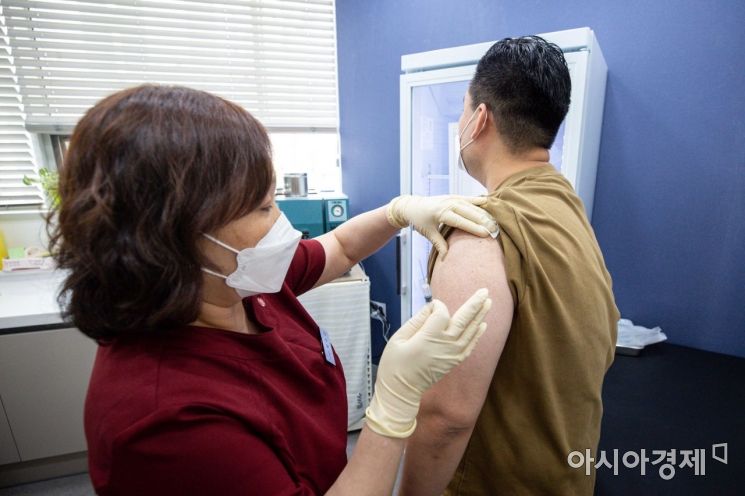 On the 10th, when Janssen vaccine administration began for reservists and civil defense personnel aged 30 to under 60, as well as those related to defense and diplomacy, a person in their 30s eligible for vaccination received the Janssen vaccine at Kim Internal Medicine Clinic in Yongsan-gu, Seoul. Photo by Kang Jin-hyung aymsdream@
[Asia Economy reporters Chunhee Lee and Jeongyun Lee] "From 12 hours after vaccination, significant immune symptoms appeared. It was difficult to move due to muscle pain."
"I was anxious, but aside from slight body aches and feeling unwell overall, there were no major issues. There was little muscle pain except at the injection site."
On the 10th, vaccination with the Janssen (a subsidiary of Johnson & Johnson) COVID-19 vaccine began. In the pre-registration conducted on the 1st for reservists and civil defense personnel aged 30 and above, as well as military-related workers, about 900,000 reservations were completed within approximately 18 hours of opening, showing high popularity. Since most of the target group is in their 30s, the government's vaccination plan is likely to be organized by age order, leading to a rush to register due to anxiety about "not knowing when they will be vaccinated."
However, among those who succeeded in making reservations despite the competition, anxiety also spread. Currently, viral vector COVID-19 vaccines such as AstraZeneca (AZ) and Janssen are not permitted for those under 30 in South Korea. Health authorities decided to stop viral vector vaccine administration for people in their 20s because the risk of rare thrombosis (thrombocytopenic thrombosis) increases as age decreases, and the benefits of vaccination are less than the risk of thrombosis in this age group. For those aged 80 and above, the benefit-risk ratio was 690 times in favor of vaccination, but for those in their 20s, it was 0.7 times, indicating higher risk.
People in their 30s were excluded by a narrow margin. For this group, it was judged that 6.9 people could be saved by vaccination, while 4.0 could die from rare thrombosis, resulting in a benefit-risk ratio of 1.7, so vaccination was permitted. Because the difference was slight, anxiety naturally increased even after applying for vaccination. Moreover, since younger people tend to be healthier and have stronger immunity, immune responses such as chills and fever can be more intense, leading to widespread concerns among people in their 30s about whether vaccination would be safe.
We explored the adverse reactions after Janssen vaccination through the post-vaccination experiences of two Asia Economy reporters who received the Janssen vaccine.
High fever and muscle pain from 13 hours after vaccination... Endured with painkillers, symptoms subsided after over 30 hours
Reporter Jeongyun Lee (32) received the vaccination at around 8:05 a.m. on the 10th. After filling out information about severe allergic reactions, COVID-19 infection, and underlying diseases, presenting ID, and measuring body temperature, vaccination was administered following a medical examination. Immediately after vaccination, there was only a stiff feeling in the upper arm (deltoid) where the shot was given. She maintained daily activities without other symptoms throughout the day.
However, after 13 hours, past 9 p.m., physical changes began to appear. Besides pain at the injection site, muscle pain developed in the neck and shoulders. Additionally, a slight fever and dizziness appeared, resembling early cold symptoms.
The full immune response began around 10 p.m., 14 hours after vaccination. High fever started along with chills. Muscle pain spread to the lower back as well as the neck and shoulders, and the soles of the feet throbbed with each step.
She turned on the heater at home, took Tylenol, and tried to sleep but could not rest well due to ongoing body aches. Sometimes she felt cold, sometimes hot, waking up every few hours and tossing and turning. She continued taking acetaminophen, following the dosage of 500 mg: two tablets per dose every 4-6 hours, taking two tablets approximately every 5 hours.
The state of enduring pain while taking acetaminophen began to improve around 1 p.m. on the 11th, 28 hours after vaccination. Fortunately, her company granted vaccine leave to all vaccinated employees the day after vaccination, allowing her to rest. Muscle pain and high fever became bearable. Although hungry, she had little appetite, making lunch difficult to eat.
By around 5 p.m., 32 hours after vaccination, the high fever and chills finally subsided, and most muscle pain disappeared except for the neck and shoulder areas.
Only some muscle pain and fatigue hours after vaccination... 'Natural inflammatory response'
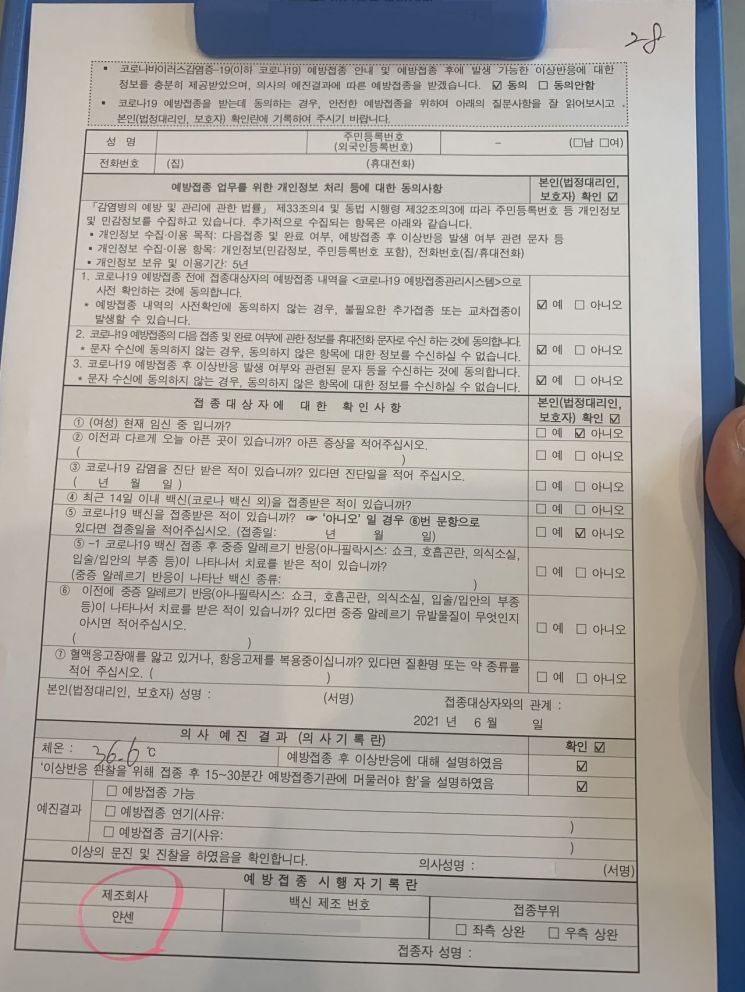
On the other hand, some experienced no significant adverse reactions. Reporter Chunhee Lee (31) received the vaccine around 5 p.m. on the 10th. She visited the reserved medical institution where her temperature and identity were checked. The medical form indicated she was the 28th person vaccinated that day.
The vaccination was quick. After reviewing the medical form, the injection into the left upper arm took less than a minute. At the time of vaccination, it felt like a typical injection, but unlike other shots, she felt muscle tightness at the injection site afterward.
During the 15-minute observation period for adverse reactions, no other physical changes occurred besides the muscle tightness at the injection site, so she left the clinic. However, some vaccinated individuals left the clinic after only about 7 minutes, claiming time had passed. The clinic also released vaccinated people without strict time checks.
About 4 hours after vaccination, she gradually felt heavier and unwell, but aside from muscle stiffness at the injection site, no pain or other adverse reactions occurred. No significant physical changes were noted until bedtime.
The next morning, 12 hours and 30 minutes after vaccination, at 5:30 a.m., no major adverse reactions were present. She felt heavy as if mildly ill or having a slight cold, but these symptoms gradually subsided after taking acetaminophen painkillers. Afterward, only the feeling of muscle tightness at the injection site remained, and other symptoms disappeared by the afternoon of the next day.
On the morning of the fourth day after vaccination, the 13th, she received a notification through the "National Secretary Goopy" app for reporting first-dose adverse reactions. She accessed the health status check service and reported mild post-vaccination health status.
She checked "Pain at the injection site" as "pain present but not requiring medication" along with "fatigue." The system responded that "there are no major adverse reactions requiring health center reporting." It explained that this is a natural inflammatory response after vaccination and rest is sufficient.
Those like reporter Jeongyun Lee, who experienced strong immune responses after Janssen vaccination, are also undergoing normal reactions. Many people experience chills, fever, and muscle pain starting 8 to 13 hours after vaccination. Especially for those vaccinated in the afternoon rather than early morning, many experienced sudden fever or chills during sleep the next early morning, causing disturbed sleep.
High fever and chills are part of the 'antibody formation process'... Most disappear after 2-3 days
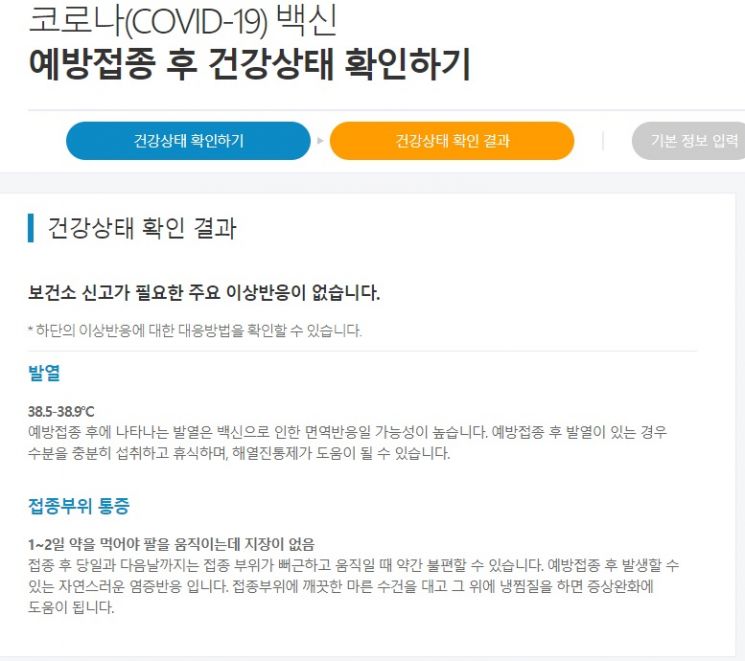 COVID-19 Vaccination Health Status Monitoring Service. High fever and pain at the injection site are explained as natural immune responses.
 [Image source=Korea Disease Control and Prevention Agency website]
Immune responses are normal reactions that can occur after vaccination. When the vaccine antigen enters the body via injection, it stimulates immune cells to form antibodies. During this process, various substances including cytokines are secreted, and inflammatory cytokines cause fever and body aches.
Especially in younger people, immune responses are more active, and cytokine secretion is stronger. This is also why the rare severe condition called "cytokine storm," which can occur during viral infections like COVID-19, mainly appears in younger individuals.
However, most people who experience these immune responses report that most pain and symptoms disappear within 2 to 3 days after vaccination. The COVID-19 Vaccination Response Task Force classifies muscle pain, headache, fever, chills, nausea, and similar symptoms reported as adverse reactions as common side effects after vaccination.
According to the task force, among 453,732 people vaccinated with the Janssen vaccine over two days on the 10th and 11th, 288 reported adverse reactions. Of these, the majority, 262 cases (91.0%), were common side effects. The remaining 18 cases were suspected anaphylaxis, and 8 cases involved special interest adverse reactions, intensive care unit admissions, or other serious adverse events.
© The Asia Business Daily(www.asiae.co.kr). All rights reserved.



















