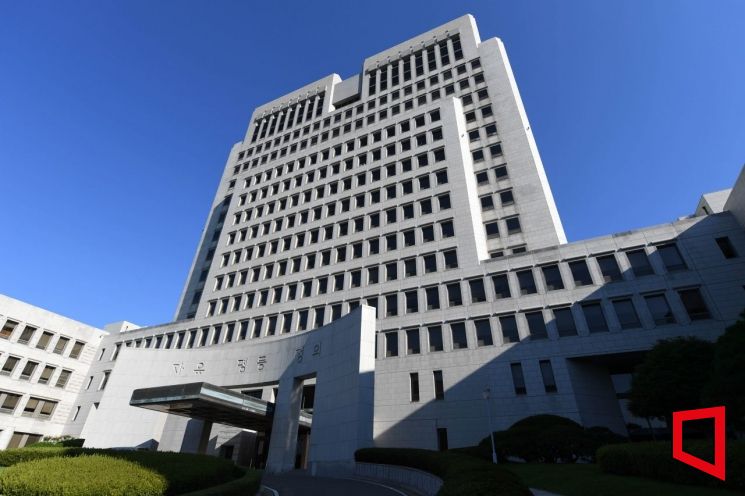
 Supreme Court in Seocho-dong, Seoul. Photo by Mun Ho-nam munonam@
[Asia Economy Reporter Kim Daehyun] Even if the right to use land for burial sites (bunmyo giji-gwon) is recognized, the Supreme Court has ruled that the landowner must be paid land usage fees. The right to use land for burial sites refers to the right to occupy adjacent land if a burial site has been installed without the landowner's permission and has been peacefully and publicly managed without dispute for over 20 years.
On the 13th, the Supreme Court's 3rd Division (Presiding Justice No Jeonghee) announced that it overturned the lower court's ruling, which had ruled against the plaintiff, in the appeal trial of a burial site usage fee claim lawsuit filed by Corporation A against the B clan, and remanded the case to the Suwon District Court.
Previously, the B clan had installed and managed burial sites on land in the Dongducheon area of Gyeonggi Province, which Corporation A had purchased since 2013. This was because the B clan had sold ownership of the land to the state and others twice, in 1975 and 1988, but the burial sites remained intact.
In response, Corporation A filed a lawsuit demanding the removal of the burial sites and land usage fees, claiming that the burial sites interfered with the exercise of ownership rights. On the other hand, the B clan rejected A's demands, citing the acquisition of the right to use land for burial sites, stating that the burial sites had been installed since the 1800s.
The first trial dismissed all of Corporation A's claims. At that time, the court pointed out, "There is no evidence proving that there was an agreement between the previous landowners and the B clan to relocate the burial sites," and stated, "It should be considered that the B clan acquired the right to use land for burial sites."
Furthermore, the court added, "There is no evidence to recognize any agreement regarding land usage fees between the plaintiff and the defendant," and "It is reasonable to conclude that the plaintiff cannot claim damages equivalent to land usage fees for the defendant's possession." The second trial also upheld this judgment and dismissed the plaintiff's appeal.
However, the Supreme Court ordered the case to be re-examined and judged. The court held that even if the B clan acquired the right to use land for burial sites, they are obligated to pay land usage fees unless there are special circumstances.
The court stated, "If a person who installed a burial site on their own land transfers the land without a special agreement to relocate the burial site and thereby acquires the right to use land for burial sites, they are obligated to pay land usage fees to the landowner from the time the right is established," and added, "The lower court erred in misunderstanding the legal principles regarding transfer-type burial site usage rights."
© The Asia Business Daily(www.asiae.co.kr). All rights reserved.
![Clutching a Stolen Dior Bag, Saying "I Hate Being Poor but Real"... The Grotesque Con of a "Human Knockoff" [Slate]](https://cwcontent.asiae.co.kr/asiaresize/183/2026021902243444107_1771435474.jpg)














