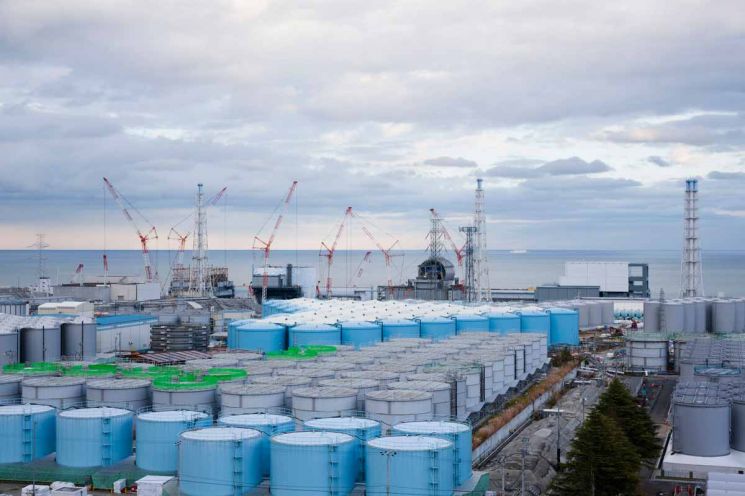
 On the 12th (local time), according to local media, Japan announced its plan to discharge radioactive contaminated water from the Fukushima Daiichi Nuclear Power Plant accident into the sea after diluting it with seawater, without confirming the tritium concentration measurement results.
 [Image source=Yonhap News]
[Asia Economy Reporter Sumi Hwang] Japan has announced plans to discharge radioactive contaminated water from the Fukushima Daiichi Nuclear Power Plant into the ocean after diluting it with seawater, without confirming the tritium concentration measurement results. The reason given is that there is no place to store the diluted contaminated water during the period when the measurement results are pending.
According to local media on the 12th (local time), Tokyo Electric Power Company (TEPCO), the operator of the Fukushima Daiichi Nuclear Power Plant, plans to measure tritium in the contaminated water stored in tanks on the plant site before diluting it with seawater, and calculate the amount of seawater needed for dilution based on the results.
Afterward, the diluted contaminated water will be discharged into the ocean, and tritium concentration will be regularly measured by sampling a certain amount from the discharge outlet. The issue is that it takes about half a day to a day to obtain the tritium concentration measurement results after dilution with seawater, meaning contaminated water will continue to be discharged into the ocean during that time.
Reports indicate that the contaminated water in the storage tanks contains 64 types of radioactive substances, and 70% of the stored contaminated water has concentrations of radioactive materials other than tritium exceeding the Japanese government’s standards.
Accordingly, Japan has announced a policy to dilute the contaminated water with seawater more than 100 times to reduce the tritium concentration to less than 1,500 becquerels (Bq) per liter, which corresponds to 1/40th of the Japanese government’s standard, before discharging it into the ocean. However, there are concerns that even if the tritium concentration after dilution exceeds 1,500 Bq, contaminated water will continue to be discharged into the ocean while waiting for the measurement results.
In response, Reiko Hachisuka, a member of the Fukushima Daiichi Decommissioning Review Committee of the Nuclear Regulation Authority of Japan, expressed the opinion that "if possible, the (tritium) concentration should be confirmed before releasing it into the sea," according to local media.
© The Asia Business Daily(www.asiae.co.kr). All rights reserved.
![Clutching a Stolen Dior Bag, Saying "I Hate Being Poor but Real"... The Grotesque Con of a "Human Knockoff" [Slate]](https://cwcontent.asiae.co.kr/asiaresize/183/2026021902243444107_1771435474.jpg)















