'Agisaedungji' Low Birthrate and Aging Policy Committee Gwangju Metropolitan City Association Launch Ceremony Participation and Special Lecture
'Korea in Crisis, Talking About the Future' Theme... "We Must Solve Low Birthrate, Aging, and Social Pol
 Chungnam Governor Yang Seung-jo is giving a special lecture on the theme "Korea's Future Amid Crisis" at the launch ceremony of the 'Baby Bird Nest' Low Birthrate and Aging Policy Committee Gwangju Metropolitan City Association.
[Asia Economy Honam Reporting Headquarters Reporter Yoon Jamin] Yang Seung-jo, Governor of Chungnam Province, raised his voice saying, "South Korea is in crisis."
Governor Yang of Chungnam Province made this statement during a special lecture titled "South Korea in Crisis, Talking About the Future" at the launch ceremony of the 'Low Birthrate and Aging Policy Committee Gwangju Metropolitan City Association' on the afternoon of the 11th.
Governor Yang emphasized, "South Korea is facing three major crises: low birthrate, aging population, and social polarization," adding, "We must put our heads together to overcome and resolve these issues, and it is imperative that we do so."
He first opened the discussion on social polarization.
He stated, "60% of South Korean citizens believe that no matter how hard they work, their current economic status will not improve," and "75% of young people say they would like to emigrate if conditions allow, and the suicide rate holds the dishonorable top spot among OECD countries."
He also pointed out, "The monthly income of the lowest 10% of households with two or more members is only 1.06 million won, but their monthly consumption is 1.4 million won," and "The average wage for non-regular workers is 1.771 million won, the national pension subscription rate is 38%, and the employment insurance subscription rate is 48%. What hope is there?"
As a solution to this social polarization, he stressed the need to expand the tax ratio relative to GDP and strengthen property tax, income tax, social welfare tax, and wealth tax.
Governor Yang also identified "aging" as another crisis facing South Korea.
He explained, "The proportion of the elderly population in our country is expected to soar from 14.9% in 2019 to 37% by 2045," and "According to statistics published by the OECD in 2019, South Korea's elderly poverty rate for those aged 65 and over is 45.7%, ranking first overwhelmingly among 36 countries. The elderly suicide rate is also the highest among OECD countries."
He emphasized, "To solve these problems, social insurance support like that in Germany or France is absolutely necessary," and "We must consider elderly social participation and participation in the general labor market, as well as promote physical health through medical care and social health through community engagement."
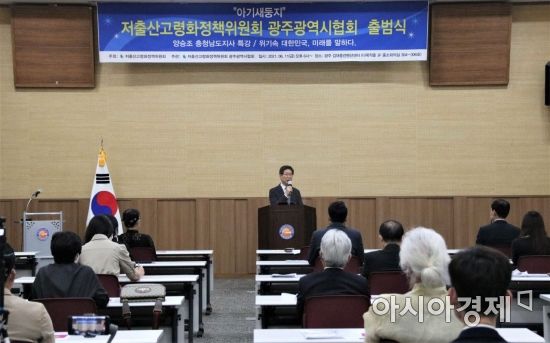 Chungnam Governor Yang Seung-jo is participating in the launch ceremony of the 'Baby Bird Nest' Low Birthrate and Aging Policy Committee Gwangju Metropolitan City Association and giving a special lecture on the theme "Korea in Crisis, Talking About the Future."
The last crisis Governor Yang Seung-jo mentioned for South Korea is "low birthrate."
Governor Yang said, "Among 198 countries, South Korea has the lowest birthrate. This is a serious problem," and criticized, "We need to identify the root causes and make decisive actions, but the nation is in chaos while leaving this unattended."
He added, "This is not a criticism of the administration but a comment on the social atmosphere," and asserted, "If left as is, South Korea will not just possibly disappear, but will disappear. Not 99.99%, but 100% disappearance."
He also pointed out, "The generational imbalance and population cliff caused by low birthrate exert pressure on childcare, national defense, labor market, social insurance, and finances," and "The decline in the working-age population and economic growth slowdown will accelerate, leading to the collapse of obstetrics and gynecology, kindergartens, elementary, middle, and high schools, and universities, as well as shortages in military service resources, collapse of self-employed businesses, and depletion of the national pension, making the situation uncontrollable."
He stressed, "It is not about blindly encouraging childbirth, but a social structure that reduces the costs associated with childbirth through child-rearing and employment support is necessary," and "Comprehensive measures covering the social structure from education to the labor market according to life stages are required."
Meanwhile, Governor Yang Seung-jo of Chungnam Province, after serving four terms as a member of the National Assembly and chairing the Health and Welfare Committee in the 20th National Assembly, has diagnosed low birthrate and aging issues and proposed structural solutions based on local field experience.
Currently, the provincial administration is focused on overcoming the three major crises of low birthrate, aging, and social polarization, and Chungnam's policies are becoming examples that lead to national policies.
In particular, the Chungnam-type baby allowance "Happiness Nurturing Allowance," 100% free education, eco-friendly free meals, and free school uniforms are being implemented stably and receiving favorable reviews.
Along with this, to go beyond "Chungnam, a good place to raise children" to "South Korea where children are happy," he is working together with the Baby Nest Low Birthrate and Aging Policy Committee.
© The Asia Business Daily(www.asiae.co.kr). All rights reserved.


















