Easier for New Candidates to Challenge Party Leadership
Considering Reducing Delegate Voting Weight
Despite 45% Turnout in Party Leader and Supreme Council Member Elections
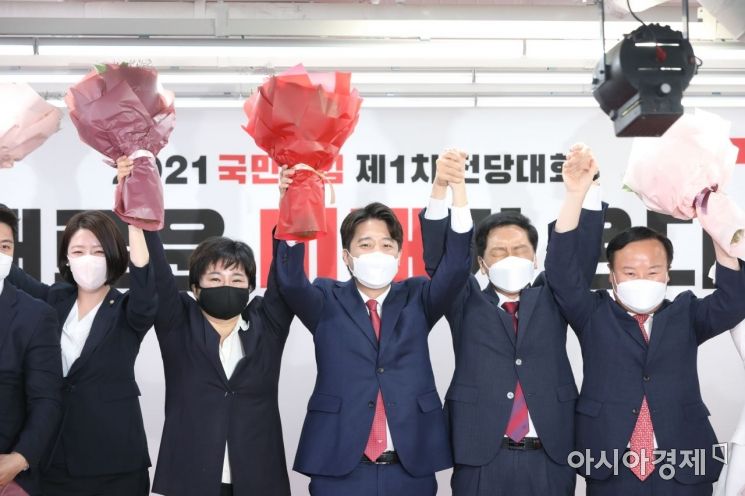 On the 11th, at the People Power Party Central Party Office in Yeouido, Seoul, newly elected party leader candidate Lee Jun-seok and the Supreme Council members are posing at the party convention held to elect the new party leader. Photo by Yoon Dong-joo doso7@
[Asia Economy Reporter Koo Chae-eun] Encouraged by the election of Lee Jun-seok as the new leader of the People Power Party, voices are emerging within the Democratic Party of Korea calling for the creation of a "Democratic Party version of Lee Jun-seok." To this end, a specific plan to reduce the weight of the existing delegate voting rate in the party leader and Supreme Council member elections is being considered.
According to political circles on the 11th, Kim Yong-min, Senior Supreme Council Member of the Democratic Party, is considering proposing a bill to lower the delegate proportion in the current party convention rules, which allocate 45% to delegates, 40% to party members with voting rights, 10% to the general public, and 5% to general party members. Kim has argued that "the will of delegates should not be overly represented in the party leader election" for party reform and democratization.
Within the Democratic Party, the overwhelming 45% weight of delegates has been pointed out as the reason why "new figures" like Lee Jun-seok cannot challenge in the party convention. Since delegates tend to move in close connection with incumbent lawmakers or district party chairpersons, the structure favors senior lawmakers or those belonging to factions with strong influence.
Senior Democratic Party lawmaker Jung Chung-rae has also made similar claims. At a press conference on the 7th, Jung said, "It is difficult to realize the party's dynamism under the current party convention rules, and there are shortcomings in intra-party democracy." Specifically, Jung mentioned that the number of candidates advancing to the party leader final round should be set at six, allowing first-term lawmakers, second-term lawmakers, and outsiders to participate in the party convention to invigorate the party.
Meanwhile, the Democratic Party is also stirred by the historic election of a party leader in their 30s for the first time in constitutional history. A first-term Democratic Party lawmaker said, "It is an encouraging result," adding, "There is a need to show changed appearances, such as having first-term lawmakers lead the presidential election planning team or putting forward new figures in their 30s at the forefront." Lawmaker Park Joo-min said about Lee’s election, "There is great public expectation for a new wind and new politics," and added, "I hope it creates politics where the competition is about who is more capable."
© The Asia Business Daily(www.asiae.co.kr). All rights reserved.
![Clutching a Stolen Dior Bag, Saying "I Hate Being Poor but Real"... The Grotesque Con of a "Human Knockoff" [Slate]](https://cwcontent.asiae.co.kr/asiaresize/183/2026021902243444107_1771435474.jpg)















