Industry Minister Meeting at Naju KEPCO Headquarters... Specific Response Directions Announced
KEPCO to Promote 2.7GW Offshore Wind Power... KHNP to Develop 300MW Floating Solar Power
Minister Moon Seung-wook Urges "Swift Progress"
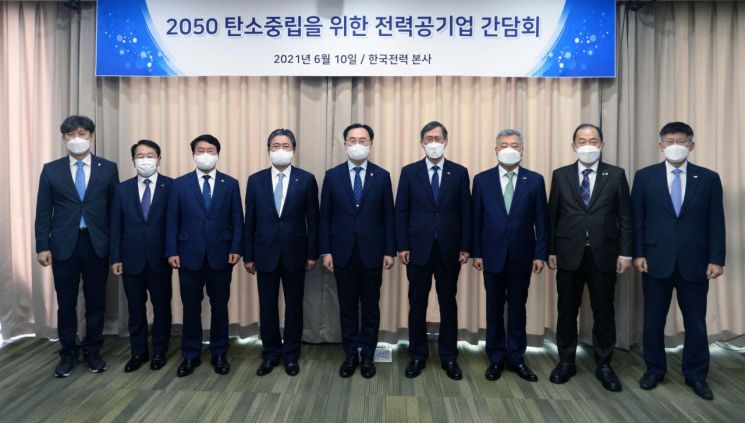 Moon Seung-wook, Minister of Trade, Industry and Energy (fifth from the left), is taking a commemorative photo before a meeting with the presidents of six power generation public enterprises and the chairman of the Korea Power Exchange at the main conference room of Korea Electric Power Corporation headquarters in Naju, Jeollanam-do on the 10th. They reviewed the current status of carbon neutrality response, a major issue in the energy sector, and discussed future response directions at the "Power Public Enterprises Meeting for 2050 Carbon Neutrality."
[Sejong=Asia Economy Reporter Kwon Haeyoung] Seven electric power public enterprises, including Korea Electric Power Corporation (KEPCO), are promoting large-scale projects such as offshore wind power and hydrogen turbine power generation to actively lead the carbon-neutral era. The plan is for electric power public enterprises, which account for more than two-thirds of domestic power supply, to take a leading role in achieving carbon neutrality.
On the 10th, the presidents of electric power public enterprises, including KEPCO, revealed specific response directions for carbon neutrality at the 'Electric Power Public Enterprises Meeting for Carbon Neutrality' held at KEPCO headquarters in Naju, Jeollanam-do, with Minister Moon Seung-wook of the Ministry of Trade, Industry and Energy.
The presidents of electric power public enterprises emphasized, "In the face of the challenging task of carbon neutrality, electric power public enterprises must cooperate more closely," and added, "We will promote representative carbon-neutral projects such as large-scale offshore wind power, hydrogen turbine power generation, and hydrogen production plant construction."
KEPCO and power generation companies will cooperate in the development of large-scale offshore wind power and the establishment of supply chains. KEPCO is promoting an offshore wind power generation project with a total capacity of 2.7 gigawatts (GW). Specifically, the projects are being carried out with 1.5 GW in Sinan, Jeollanam-do, and 1.2 GW in the southwestern region of Jeollabuk-do.
To revitalize offshore wind power, KEPCO has also partnered with private companies. In April, KEPCO signed a Memorandum of Understanding (MOU) for cooperation to revitalize the offshore wind power industry with 44 domestic offshore wind power companies, including Doosan Heavy Industries & Construction, Korea Electric Wire Corporation, and Samkang M&T. The plan is to continuously develop core offshore wind power technologies and, based on the accumulated power generation experience domestically and internationally, to expand the domestic industry and jointly pioneer overseas offshore wind power markets.
Korea Hydro & Nuclear Power is carrying out the world's largest 300-megawatt (MW) Saemangeum floating solar power project. The Saemangeum Development Authority, Jeollabuk-do, and other local governments are also participating jointly. Once Korea Hydro & Nuclear Power starts power generation, it will produce 394 gigawatt-hours (GWh) of electricity annually, enough to supply approximately 93,000 households for one year. The project is being promoted as a resident-participation type business, where local residents around Saemangeum participate and share the operating profits of the power plant.
Korea Western Power is promoting a 'hydrogen co-firing power generation technology' project that drastically reduces greenhouse gases. This power generation method mixes hydrogen fuel with existing liquefied natural gas (LNG) power generation and uses the combusted gas to drive turbines. Western Power plans to gradually replace gas turbine fuel from natural gas to hydrogen, reducing carbon dioxide emissions by at least 30% and up to 100%.
Korea East-West Power is advancing a floating offshore wind power project. This project, promoted by Ulsan City as a new marine business, involves Korea East-West Power, Korea National Oil Corporation, and Equinor, the Norwegian state-owned oil company. By 2030, a floating offshore wind power complex with a capacity of 6 GW, equivalent to six nuclear power plants, will be established. The goals include creating 210,000 new jobs, reducing carbon dioxide emissions by 9.3 million tons, and producing 84,000 tons of green hydrogen.
In addition, Korea South-East Power is developing carbon capture utilization technology to support early commercialization, Korea Southern Power is developing hydrogen fuel cell power generation and ammonia co-firing, and Korea Midland Power is promoting the construction of hydrogen production plants utilizing existing coal power sites.
Minister Moon Seung-wook of the Ministry of Trade, Industry and Energy emphasized, "Electric power public enterprises must more boldly transition to renewable energy and swiftly promote high-risk projects such as large-scale offshore wind power," adding, "Over the next 30 years, electric power public enterprises must fulfill their basic role of stable power supply as well as the historical mission of achieving carbon neutrality." He further stated, "Electric power public enterprises should actively participate in the government's 'Energy Carbon Neutrality Innovation Strategy' formulation process and devise concrete implementation plans."
© The Asia Business Daily(www.asiae.co.kr). All rights reserved.
![Clutching a Stolen Dior Bag, Saying "I Hate Being Poor but Real"... The Grotesque Con of a "Human Knockoff" [Slate]](https://cwcontent.asiae.co.kr/asiaresize/183/2026021902243444107_1771435474.jpg)















