On the 11th, Announcement of the 'System Risk Survey Results'
[Asia Economy Reporter Jang Sehee] Domestic and international economic and financial experts identified the high household debt level as the biggest threat (risk) factor to South Korea's financial system. Additionally, global inflation, intensified US-China conflicts, and uncertainties in the real estate market were also analyzed as threat factors.
According to the results of the 'System Risk Survey' announced by the Bank of Korea on the 11th, 82 domestic and international financial institution executives and key financial experts selected the domestic financial system risk factors as such. Financial system risk refers to a situation where financial functions are paralyzed, causing serious damage to the real economy.
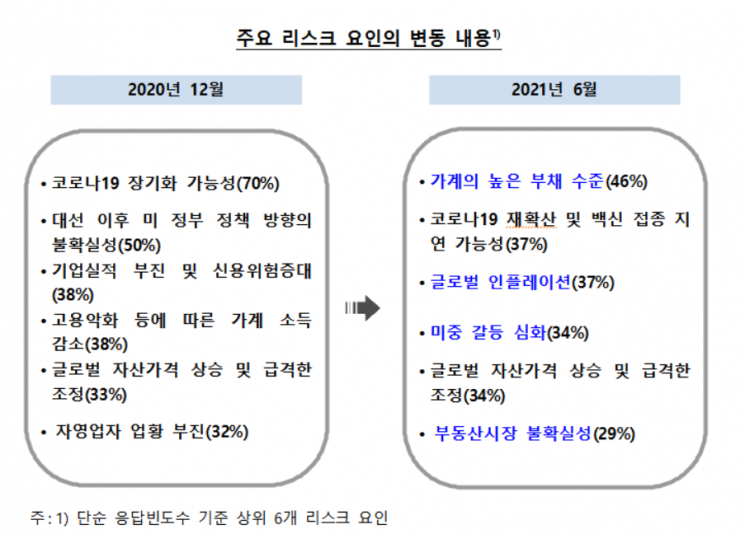
46% of respondents cited the high household debt level as the biggest risk factor. This was followed by the possibility of COVID-19 resurgence and vaccination delays (37%), global inflation (37%), intensified US-China conflicts (34%), global asset price increases and sharp adjustments (34%), and uncertainties in the real estate market (29%).
In particular, with the recent expansion of rising oil and agricultural, livestock, and fishery product prices, global inflation and others were mentioned as new risk factors in this survey.
The likelihood of shocks occurring in the financial system was forecasted to be lower than in December last year. The proportion of respondents who answered that the likelihood of shocks occurring within one year is 'high' decreased from 20% to 9%, while those who answered 'low' increased from 45% to 47%.
However, regarding the likelihood of shocks occurring within 1 to 3 years, both negative and positive response proportions increased. The proportion of respondents who answered that the medium- to long-term likelihood of shocks is 'high' rose from 18% to 29%, and those who answered 'low' also increased from 23% to 28%.
As the most urgent issue to resolve to enhance financial system stability, the majority opinion was to prepare for the normalization or reduction of accommodative policy stances regarding COVID-19 response support measures by countries worldwide.
Respondents stated, "COVID-19 support measures and liquidity supply contributed to financial stability in the short term," but also noted, "It is necessary to pay attention to the fact that potential risks within the financial system have increased significantly as debts of corporations, households, and governments have greatly risen."
© The Asia Business Daily(www.asiae.co.kr). All rights reserved.
![Clutching a Stolen Dior Bag, Saying "I Hate Being Poor but Real"... The Grotesque Con of a "Human Knockoff" [Slate]](https://cwcontent.asiae.co.kr/asiaresize/183/2026021902243444107_1771435474.jpg)















